
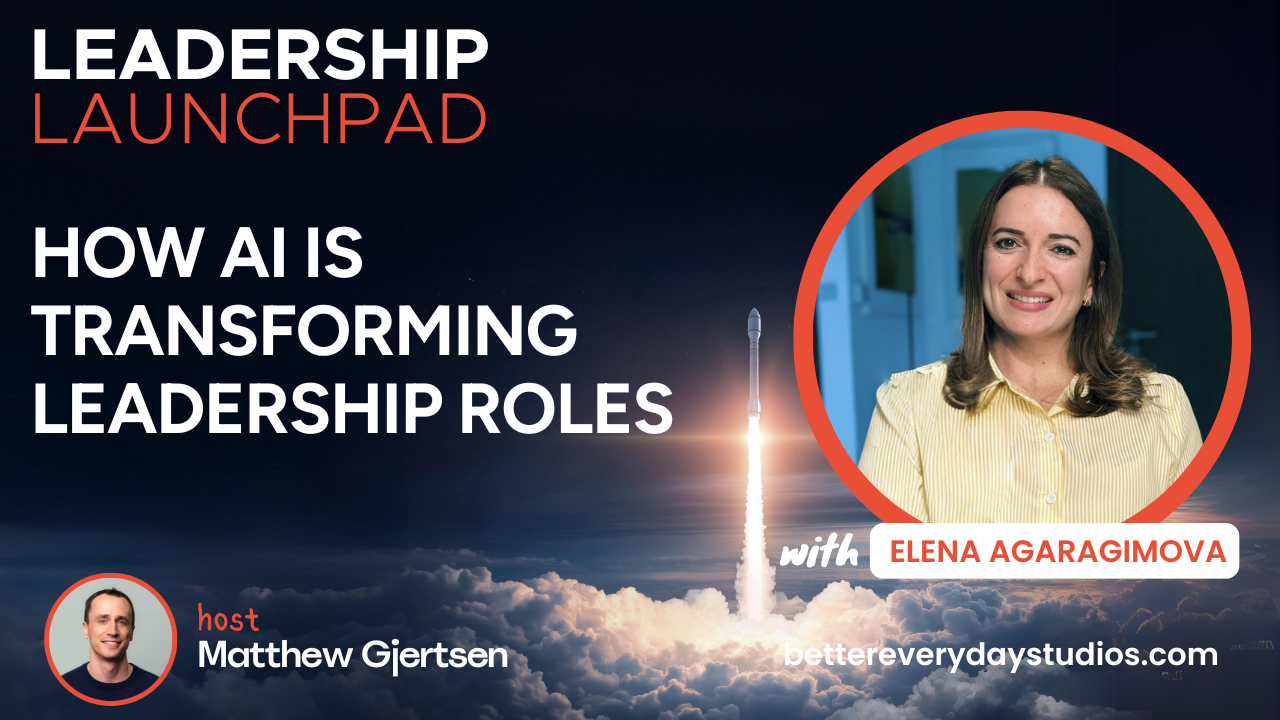
In this episode, Elena Agaragimova, co-founder and CEO of Shiftwell, joins to discuss the role of AI in modern management and leadership. Drawing on her experience in talent development and performance, Elena explains how AI tools can help both individual employees and managers. She highlights how AI can support employees in taking ownership of their performance and well-being, while also freeing managers from some administrative tasks so they can focus on more strategic responsibilities. The conversation covers the challenges faced by middle managers, the importance of data-driven insights, and the evolving future of AI-powered coaching. Elena also shares her perspective on how AI tools differ from traditional engagement surveys and coaching, and offers thoughts on where this technology may be heading.
 Automated Transcription
Elena Agaragimova [00:00:00]:
How can we actually utilize AI to help people on the individual side drive their own performance and on the manager side take some of that stuff off of their plate. Right. And at the same time be there as a support.
Matt Gjertsen [00:00:29]:
I feel like I can't turn around today without hearing about AI, but I realized that I haven't really talked about AI on this show very much. You know, what does AI mean for the idea of being a manager? How is it helping managers do their job better? I haven't talked about it because I personally don't feel like I'm that qualified to talk directly about it. And so that's why I'm so excited for today's guest, Elena Agamova. Elena is the co founder and CEO of shiftwell, a human centered tech platform focused on performance well being and building sustainable workplaces. So we focus in today's discussion about AI, what AI is doing for managers and the way AI is evolving to provide tools to help make managers more effective. Sometimes that means helping them improve their performance, and sometimes it means completely taking away some of the things that managers used to do that there may be not that well suited to accomplishing. And so I can do it for them. Before we get into the discussion, I do want to remind you that if this is your first time listening to the show, please make sure to hit subscribe so you never miss a future episode.
Matt Gjertsen [00:01:42]:
And if you are already subscribed, I would humbly ask that you share this show with at least one other person because that, after all, is how we grow. I can't tell you how much it means to me. So with that, let's get into the discussion with Alaina Agrigamova. Elena, welcome to the leadership launchpad. How are you doing today?
Elena Agaragimova [00:02:01]:
Thank you. Great to be here, doing well.
Matt Gjertsen [00:02:05]:
I'm excited for this discussion today. I don't know if we've had a discussion like this on the show yet kind of around AI and leadership. We were talking a lot in the world today about how AI is changing everything. And I think it'll be great to kind of have a focused discussion around AI and what that's doing for leadership and leaders and managers. But to start off, give us a sense of kind of your journey, of how you arrived at the problem that you're working on right now.
Elena Agaragimova [00:02:31]:
Yeah. So over the last 14 plus years, I've been in learning space, learning talent, performance, held different roles, so worked with young people, kind of graduates, all the way up to senior leaders and so on. So it's just, you know, been in the Space and different in nonprofits, in education space, in corporate America, typing tech. Had my own business in this space as well, the first business, now in the second venture. So kind of just been living this talent space and really trying to figure out along all of my different roles and positions that I've held, like, what is it that makes people. Like, what is it that drives individuals? What is it that makes one person a high perform versus not right. How can we help people and organizations grow, you know, find fulfilling work, you know, or, you know, find that purpose in their work. And at the same time for the business to, you know, for the managers, the business to just kind of drive things forward versus this firefighting that feels like happens continuously in many companies, at least that I've seen.
Elena Agaragimova [00:03:28]:
So that's kind of the background of where the point that I'm coming from.
Matt Gjertsen [00:03:34]:
Excellent. Yeah, I think. Yeah, there's so much in that of. I think a lot of times, in fact, I'm a big follower of somebody of Gary V. Gary Vaynerchuk, who's kind of a media personality and he always says his job title is firefighter. As a CEO or as a leader. So often that's what you're doing. But yeah, I think it is good to figure out ways to get out of that mode.
Matt Gjertsen [00:04:00]:
So where are you at now? What are you doing right now?
Elena Agaragimova [00:04:03]:
Yeah, so it's interesting that you point out the firefighters. I guess I focus a lot on the middle manager. So like on the man, on the. On the middle manager. Because I feel like, yes, as a CEO, you absolutely. As an owner of a business, nobody's going to care about your business like you. That's primarily your job is to fight fires. Should a middle manager be in continuous firefighting mode when they actually need to be supporting their teams, driving the business and the project forward? I don't think so.
Elena Agaragimova [00:04:25]:
Right. Like, so that's the population I'm talking about. So. So some of the things that, you know, that we see in talent development is a couple of problems. Like, right. Number one, everybody always wants employees to be productive and be high performers and be engaged. Yet survey after survey, whether it's the Gallups ones or similar ones that say over 70% of the workforce essentially in corporate spaces are disengaged. That's a very huge population of people disengaged.
Elena Agaragimova [00:04:54]:
And that means different things. But ultimately that number doesn't change. And ultimately people are just kind of. A lot of them are just kind of clocking and clocking out. You're not getting the best out of your people. At the same time, the growing problem of the middle manager, the manager who gets promoted into role A, they don't really know how to manage a team. They haven't had the training. At the same time, they're now responsible for not only their own individual contribution, but also the contribution of their team.
Elena Agaragimova [00:05:18]:
And so a lot of talk about burnout and all that good stuff, right? Like just all these topics that come up around the challenges that managers have. They have to manage up, manage down and work across different stakeholders. So these are the challenges that we've talked about for years in this space. And there's a lot of like one off trainings that happen and so on. None of them focus on behavior change, none of them focus on continuous learning. Right. And now with AI, there's actually a lot of opportunities for us to say how can we actually utilize AI to help people on the individual side drive their own performance and on the manager side take some of that stuff off of their plate. Right.
Elena Agaragimova [00:05:58]:
And at the same time be there as a support, as a resource. So I'll pause here before I dive into, further into what I mean by that.
Matt Gjertsen [00:06:07]:
Well, there's, there's a couple of things. First, I want to make sure. I always like to define terms when you say middle manager. What is what, what does that mean to you? I think a lot of times in companies, you know, depending on the size of the company, I'll just be honest, when I hear middle manager, I usually think of like director because they're like in the middle, like versus like frontline versus exec team. But as you were describing it, I think it was a little, sounded a little bit different. So what do you mean when you say middle manager? Manager.
Elena Agaragimova [00:06:32]:
So I'm primarily in tech, so I do a lot of work in tech. So a lot of people that are in those project management roles, right. That also have the leadership kind of, you know, program managers, project managers that have the leadership hats, depending. And I work with a lot of small and medium sized companies, so they usually wear the hat of a project manager and a leader, essentially.
Matt Gjertsen [00:06:52]:
Yeah, yeah. And so it's just a heavily, it's middle because they're a heavily translational role where they're kind of in between the work that's being done and the ultimate deciders that are like leading the company and they're in between those two layers. And so a lot of their role is bouncing between those. That makes a lot of sense. And then. Yeah, I completely agree with you of it's interesting what is going to be enabled by AI specifically for helping these two. There's two distinct ideas that I think I heard you mention. One is creating AI tools that can help take jobs that maybe traditionally were the manager and do them for the manager.
Matt Gjertsen [00:07:37]:
And then there's maybe things that will just help the manager get better. Is that right? That there's kind of a distinction there and are those the two distinctions or are there others?
Elena Agaragimova [00:07:47]:
Yeah, so you got pretty much right. So one thing we have to look at is on individual performance. This is one thing that I don't really agree with. That's traditionally like managers responsible for. There's a lot of push for managers to care for their employees from a more of like even like a personal level health perspective. I don't necessarily agree with that point. I think that as an employee, as an individual, you need to take ownership of your own career development. You need to take ownership of your own health and well being and time management and all that good stuff.
Elena Agaragimova [00:08:17]:
Right. And I think a lot of that, like a lot of that gets put on a manager today. And I don't exactly agree with that. Which is why part of the solution with the AI, for example, is actually help that individual. I think not everybody knows how to get there. Some, some people are, you know, those that are high performers, they know what to do, they kind of know how to drive their own career and so on. Low performers need a lot more handholding. But that middle, that middle group of people who are kind of like have the potential, want to do better, but don't really know how to get started.
Elena Agaragimova [00:08:44]:
This is where tools like I can really help them and act as a coach essentially. Right. But I'll talk about an important piece here as well. When we talk about performance, it's not just about am I good in my career, it's also thinking about what makes me good, great perform, what makes me great at my job, great in my career, driving the business forward, et cetera. And it's a lot of other things. It's not just your career, your technical skill, your functional skills. It's also that wellbeing piece, the environment, the purpose and so on. So when it comes to the research that's out there, what drives people, what makes them a high performer and ultimately at the same time being in good health are all these different things.
Elena Agaragimova [00:09:24]:
Right. So it's not just your career, like I think we've all realized, especially after it's all connected. So there's, you know, what we do at least is there's an assessment that A person would take and that would evaluate them on six elements that really drive human performance. And based on that, it will tell you, you know what, Matt, you have gaps in X, Y and Z. And those gaps are very specific to you. They're not some data that's taken from somewhere else. These are your actual results. And then it will help you from an individual perspective to actually look at what, based on these gaps, what are some priorities that I need to work on? And then furthermore, how can I start changing behaviors on a consistent and regular basis in order for me to actually drive this change within myself instead of waiting for my manager to come get me in handhold, which is never going to happen, and it's just not feasible and scalable.
Elena Agaragimova [00:10:13]:
So that's on the individual part. I want to just like, make that very clear. Like, I think individual need to take ownership of their own performance. And then I can talk about managers. But I'll just pause here in case you have more comment or anything.
Matt Gjertsen [00:10:24]:
Yeah, I think that's interesting because there's definitely pieces of what you're saying that I 100% agree with and some things that I might. Might not agree with. But, but you know, they're just, they're just different opinions. I don't think there's a. There's a right or wrong answer. Because I think ultimately, very often when I think about it, when I'm training managers, I am trying to convince them that they need to care about the people side, care about their people. It is ultimately the individual's responsibility to figure themselves out and to get it done. But that managers play a big.
Matt Gjertsen [00:10:56]:
Can play a big part in that. But it almost sounds like you're saying, like, that's great, we can have all the sentiment we want in the world, but the reality of the situation is that they're just not going to have the time, especially for the audience that you really talked about. Very often, you know, managers spend a lot of time on the low performers because they got to get them up. They spend a lot of time on the high performers because they're the ones bringing in the business or they're the ones getting things done. But then there's that broad swath in the middle that can easily get forgotten about. And so by creating a tool to provide that support, it's just always going to be. It's going to be more consistent because, like, that's its job. It's there, it's helping you, it's understanding you.
Matt Gjertsen [00:11:42]:
And so the. Even if we do believe in a perfect world, the manager should be doing this. In reality, maybe that manager doesn't have time, maybe they don't have the tools. And so by providing something like an AI coach or an AI assistant, it allows from a company perspective you to not rely on the, you know, you're not leaving your employees fate up to kind of a roll of the dice of which manager they get and how skilled they are at this. Is that, is that kind of right?
Elena Agaragimova [00:12:13]:
Yeah, correct. Yeah. And then, you know, listen, yes, an ideal manager should care and so on and ideally that's what we want them to do. Right. And I think that if, you know, from an individual perspective, if they also identify their own gaps as a manager, because that tool obviously that I also is very useful to the manager, then they'll be at their best and then they can lead by example, they can be at their best performance and thus inspire and motivate their team and so on. But the important piece about the manager here is that again with AI tools and the data that's available, what, what can be done is let's say you have, you know, 20 of your team members take this assessment and you know, obviously it's up to the individual how much information they want to release to the manager. So obviously you're not going to be releasing information around your physical health or something like that, but things that are around your environment, your career and things that are work related can be released to the manager's knowledge and it will provide kind of like an aggregate data report to the manager and say out of your 20 employee, 20 team members, 18 expressed that they don't have the resources to do their job well. They don't feel like it's a safe environment and that actually gives you some actionable things that you as a manager can address because that is your role.
Elena Agaragimova [00:13:27]:
So that's part of the care, if you want to call it that is like do. Your role as a manager is to remove obstacles, open doors, right? Create opportunities, you know, develop, mentor, coach. So if you have some, you know, at least like some, some data and reporting around what does your team actually need the most versus imagine spending 20, you know, 20 different hours per, you know, with the, with each person. If you give them an hour, if you do that every week, all you're going to do is just mentor and coach these people without actually having specific things that you can focus on that will drive the team forward, let them focus on their individual things. You're there as a resource, as a support mechanism, right? You're not there to handhold but at the same time, the care comes in from things you can actually impact, which is that specific things that you can address that you as a manager lead on, you know, like again, creating a safe environment, whatever. Just pick any example.
Matt Gjertsen [00:14:21]:
Yeah, yeah, well, and I love that that kind of change is that, you know, whether or not, however involved or not involved, the manager is on each individual and how responsible they are for each individual performance. They are 100% responsible for kind of the context in which that performance takes place, the culture in which that performance takes place. And so it allows, it gives them more insights into, into that side of it. So, so we have AI is able to create these tools, are able to provide much more support for the individual, which is kind of removing some of those things that maybe we would, we traditionally said is the manager's responsibility. What are some other things that are specifically being starting to be done to support managers? What kind of tools are starting to be unlocked?
Elena Agaragimova [00:15:09]:
Yeah, so of course, again, they have the access to that individual development, so they themselves can also develop because they also don't get the same support from leadership in the organization. So this is where the middle part comes in. Because the manager, of course, they're kind of stuck in the middle because it's like, okay, they need to, they're trying to, you know, bring information from the leadership. They don't always get that. So there's a lot of organizational, systemic things that they can't control. And so where I, again, and a lot of this data analytics comes in is you have them, you have the data from the employees and the manager, like everybody in your company. Right. So you, let's say you're a company of 300 people and I don't know, 250 people said they don't feel their values aligned with the work that the company does.
Elena Agaragimova [00:15:50]:
Maybe people are burnt out, they're not sleeping, again, pick your problem, etc. They don't feel like they have the resources. Right. So then as an organization, as leadership, you start to look at your whole company and you say, wait a minute, we're spending these millions of dollars on technologies and tools that nobody's actually using. Take any engagement tool, for example. Any engagement survey that is just one size fits all versus one size fits one. Right. So it's very ineffective.
Elena Agaragimova [00:16:17]:
Nothing gets done. People are usually not very honest in those engagement surveys, but companies still continue to spend a lot of money on these things. So as an organization, you then start to say a audit. Where are you spending your money and what's actually Working and driving your company forward. For the manager, it's a plus because now the manager doesn't need to go and say, listen, my people need X, Y and Z. There's data that shows that this is where your company is. This is where 80% of your company. This is how they feel.
Elena Agaragimova [00:16:43]:
This is what they need, actually. So maybe that's what you should focus on. So it kind of alleviates that pressure from the manager. So it targets individuals, managers, and then the organizational piece as well.
Matt Gjertsen [00:16:55]:
Okay, so walk me through how, I guess how is. How do you see these new tools being different than traditional engagement tools?
Elena Agaragimova [00:17:06]:
So going back to one size fits all versus one size fits one. So an engagement tool, for example, an engagement survey done once or twice a year on a, you know, in a good company, I guess, you know, maybe a little bit often that it's based on people's feelings in that moment, in that, in that endpoint in time. Right. It's not a continuous thing versus when you have access to assessment. And an AI coach, that's very much an AI coach. It's not a ChatGPT. It's actually an AI trained to be a coach. And it will only discuss the things that you need to be discussing in that conversation.
Elena Agaragimova [00:17:37]:
Right. So it's very focused on you. And then on top of that, you can always go back. That coach will keep you accountable. You can go back to take the assessment. You can actually track your progress. You can look at your gaps getting smaller or larger or whatever it may be. So that's one way, right? Like that's, there's, there's a lot of coach coaching tools out there.
Elena Agaragimova [00:17:55]:
There's a lot of different assessments. But the assessments don't evaluate the six elements that we're talking about here. Like, so the different elements that drive human performance. And a lot of research on that. And so a lot of assessments now look at just like your leadership skills and what it will tell you, Matt, like, you know, like, I don't want to name any specific one to take. Any personality or leadership assessment will tell you, well, here's where you are. Here's, you know, kind of how you are and, you know, good luck. And then you have to hire a, an external provider or coach to debrief you, to help you make sense of it and so on.
Elena Agaragimova [00:18:29]:
And then at the same time, like, yeah, you could retake it. But it really, like, if you're not really taking and making any changes and behavior changes, right. It's really, like nothing changes. So with the AI tools, with the data that we have available today, it's like looking at, okay, you can actually take the assessment, you can retake it, you can see your progress, you can have an AI coach that works with you through in real time problems, like as an employee, it will actually help you. It's like having a coach essentially. Right. But at the same time for people who are not very comfortable with AI, there's also options. You still have that option to have like an in person coach.
Elena Agaragimova [00:19:06]:
And I think that will always be there. But I think you will see that more and more people start using the tools because you can talk to that tool at midnight, at 2am, when you can't sleep, or just because you're up working on something, you can talk to it on the way to a meeting. That will help you prepare for a conversation that's for the individual, for the manager. It will equip you and say, you know, I have this meeting coming up with this person based on their report. Here's some things I can actually pick out from that and help them drive that behavior further and offer that support and resource.
Matt Gjertsen [00:19:37]:
Yeah, I'd be interested to know as somebody who's kind of in this, where you see some of this going, because you mentioned it's not just, you know, a wrapper of ChatGPT, it's going to be more involved than that. It's going to be more customized to you. And I, I was just listening to a discussion by some chip makers and how many advances there are allowing for much More locally hosted AIs AIs that are hosted on your laptop or on your phone. And I was joking with somebody at the association for Talent Development conference earlier this year that we already have seen in tech, this big shift wherever it used to be that every major company like had their own servers. Right. You had your own data set or in your company. And then we obviously went away from that. Nothing's on prem anymore, everything's hosted.
Matt Gjertsen [00:20:28]:
And I was kind of saying, wouldn't it be interesting if this whole big evolution of AI brought back all the on prem stuff? Because everybody wants like their AI, like they want their thing. I wonder what you're seeing, the advances in this and how long it's going to be before when I. And I guess I'll explain a little bit more like from the point of view of learning management systems. Learning management systems used to primarily be hosted software. Just like you would download Word and it was now yours. And we've shifted to a model where everything's subscription so almost all learning management systems and HRIs are subscriptions. Do you think we're going to go to a world where there is more almost like on prem AI tools, if you will, or something to that effect? Because I think the big concern that so many people have with these tools is not wanting to just keep uploading more and more data into the cloud, into the AI gods that just have everybody's information all floating around and they want it to be, be theirs. And I think if we are ever going to get to the point where we can develop coaching, true coaching relationships with these systems in a scalable way, it's going to need to feel hyper personal.
Matt Gjertsen [00:21:49]:
Like this is mine. I have a relationship with them. So from where do you see, where do you see that going?
Elena Agaragimova [00:21:57]:
Yeah, it's a great question. I don't have any data to back this up. This is a personal opinion. This is a personal opinion and I go down rabbit holes. I. Yes, I think, I think we will get to a point, I mean if you really want to take it extreme, I think we'll get to a point where we'll have an AI coach, but it'll be like a robot, you know, like it will go like, I really think, like it's just going to go to that point. You know, I think, I don't know when it's going to happen. I don't think anybody, I think, I think it's going to happen so fast that it's going to smack us in the face and we're not even going to see it coming.
Elena Agaragimova [00:22:32]:
That's, that's so it's like expect the disruption, expect the unexpected and just don't be surprised when it gets here. Because I think that's what happens with technology and with AI. Like everybody's just like freaking out now because it's gonna, you know, it was like, oh, it's gonna replace jobs. Like, okay guys, like we've known this, this is, this was coming. And now because it's actually starting to make an impact. So. So yes, I think it will be super personalized. I think it will be much more, I mean, much further than the where it is today.
Elena Agaragimova [00:23:00]:
I think that people will. Again, personal opinion. I think we will feel more comfortable and we will build connections with these tools and we will be able to share things with them, I think with new generations, especially with Gen Z's and stuff. Like they're, they're so used to technology. I think like, you know, like I'm an elderly millennial, you know, and I think like millennials and up like we're kind of thinking about like, oh, data and all that stuff, you know, and like, we worry about these things, but the reality is it's already out there. And. Yeah, and it's just what it is. Like, I was LA with my partner because we were going through airport security.
Elena Agaragimova [00:23:36]:
So this fun story. We're going to airport security, you know, now they take your picture.
Matt Gjertsen [00:23:41]:
Yeah.
Elena Agaragimova [00:23:41]:
And, and he was like, well, I don't want my picture. I was like. And he works at a cleared facility. And I'm like, you literally, they know more about you than they could like, more than this silly picture. You know what I mean? And so, so I think it's already out there. So. And with Gen Z's, they're so comfortable and they're, they're making connections, you know, even just online in an online world. And it's scary to imagine, but I think, I think people are going to be using it.
Elena Agaragimova [00:24:09]:
We're going to be very, yeah, we're going to be comfortable sharing things with, with these tools because it's also, they're not judgmental. And so, you know, like, especially in coaching conversations, right. One there it's going to be, you know, it's more accessible and available. Not everybody can afford a live coach. Right. That's usually, you know, only, you know, selected for like executives or people who can afford it. So. So yes, to your question.
Elena Agaragimova [00:24:34]:
I think, I think it will be very, you know, we're going to own it. You know, there's already obviously ways to protect your data and own the data and, you know, own all those things. So, yeah, I think it's just going to keep going in that direction or it might go the complete opposite way and we're just going to have this like, monopoly of, you know, a, you know, choose a, I don't know, a company name that's going to own all that data anyway, you know.
Matt Gjertsen [00:24:58]:
So, yeah, it's, it's interesting. There's two thoughts that come to mind. I read a lot of sci Fi and I read it for this exact, you know, conversations like this of where, you know, because there's so many, so many examples of where they've. You take one thing and run it to the extreme and see what happens. And there was this one, to your point, about data and being comfortable sharing. There was like this one book I remember reading, I cannot remember the title, where they basically invented how to have these micro wormholes that you could see through and so you could open them up anywhere. So basically privacy was completely eliminated and there was these Two, most of society just kept living their lives because there were these two groups that kind of split off in reaction to that, where one group decided, well, if everybody can see everything, then I'm just not going to care anymore. And they, like, became nudists and just, like, walked around, whatever, because anybody could see into their house at any time.
Matt Gjertsen [00:25:49]:
And then there was another group of people that tried to hold on to their privacy. And they lived their entire lives in darkness. They never talked. They would want to talk when they. When they wanted to communicate with other people who were like them. They would, like, have to physically touch and they had, like, a tap code that they would use. And so they had to go to these crazy extremes because they cared about the privacy. And I think you're right.
Matt Gjertsen [00:26:10]:
We're basically already in a world where, yeah, your photos are out there all the time. So much of privacy law is around, like, expectation of privacy, and there's just not a lot of that anymore. So that was one thing that came up. And then kind of going back to this idea of personal connections. I need to rewatch the movie her because I think it's such a fantastic movie. It really captures the moment we're in today. And I remember there was a moment where Joaquin Phoenix's character is talking to her and he kind of asks. I forget the exact scene, and I don't remember his reaction, but he's developing this really loving personal relationship with his AI.
Matt Gjertsen [00:26:56]:
He's falling in love with it. And then at one point, he asked the question, how many people are you talking to right now? And she says, like, 8 million, 673. You know, so like, it's this deeply personal thing with him, to him, but to the AI, it. There's two ways to think about it. On the one hand, it must be completely impersonal and not care because it's having this relationship with 8 million other people. But the other way to look at it is actually its quote, unquote consciousness, or its at least cognitive ability, is so large that the connection, the amount of personal connection that it is giving you is exactly the same as the amount that you are giving it. It just. It has 8 million times more of that cognitive capacity, so it can have that many.
Matt Gjertsen [00:27:47]:
That relationship with that many other people. And so that's the one question that I still have in my mind around a lot of this stuff is whether some people clearly are. There's already people who are, like, proposing to their AIs and things like that. But is that. What's that? What's going to be like that for the majority of people. If I know that the thing I am talking to is having this exact same conversation or similar conversations with thousands or millions of other people, can I be as invested in this relationship? I don't know. Like, I 100% think there's a chance that you are right and that, like, that just becomes the norm and we're all okay with it. And maybe I'm just also the elder millennial.
Matt Gjertsen [00:28:31]:
That's, like, holding on to these personal connections. I think that's the real. That's the really interesting thing.
Elena Agaragimova [00:28:36]:
Yeah, yeah, it's very interesting to think about, for sure. And, you know, just final point on that, I just. I'm less concerned about millennials and up. I'm more concerned about Gen Xs who are already, in many cases, not to fault of their own, but just circumstances, and some of them is to their own detriment. But, you know, not socially strong. You know, we see this. You know, not socially strong. You know, they're meeting significant others later, they're developing relationships later, if at all.
Elena Agaragimova [00:29:08]:
I spend a lot of time just looking into youth and just understanding, like, you know, just the loneliness epidemic. The. The lack of, you know, the loneliness epidemic comes from the lack of relationships, the lack of friendships, lack of those community ties and so on. And I think, you know, not just in America. I mean, Japan, they're having a big pandemic with that. Right? Like, young men just don't leave their homes. Like, they're already. They're already building those relationships.
Elena Agaragimova [00:29:35]:
So to us, yeah, I agree. Like, I want to hold on to that stuff, but also from, like, you know, if just from user, you know, future making sure that, you know, I'm involved in that process and hopefully try to create something useful out of it. That's kind of how I'm like, okay, I would love to be a part of, you know, the group of people that are actually building something with that and actually trying to make tools that are helpful to us that don't drive all these other social problems further, but actually enhance some of those things, you know. And so that's kind of from the business perspective. That's why I see it. But on a personal level, you know, if I could, I'd be living on a farm somewhere and raising my own chickens and cows and et cetera, and probably never touching technology.
Matt Gjertsen [00:30:21]:
Well, you can do it. As somebody who just left LA and moved out to the country, I highly encourage everyone to do it.
Elena Agaragimova [00:30:27]:
Let me know if you got any farmland near you for sale?
Matt Gjertsen [00:30:32]:
Absolutely. Well, this has been fantastic. I think, kind of to summarize, regardless of where this ends up going over the long term, and I think there's lots of unknowns there. The great thing to know is that in the near right now, there are tools out there that can, that can help people. And so whether you're an HR and learning development professional, and it's understanding what tools are out there to give that extra boost to your managers, if your managers are overwhelmed, which so many of them are, there's lots of tools out there that can help them. And then if you're an individual manager and don't have the ability to make these purchases for an entire company, there's also, I'm sure, tools for you of individual personal coaches that can. That can help you with this. So I think it's great to know that we already have these tools as they, as they say, you know, this is the.
Matt Gjertsen [00:31:14]:
This is the worst they're going to ever be. Like, right? Like they're just getting better every single day. So even if, even if you don't get the exact results you want right now, it's helpful to, you know, get into the habit of using these tools because they're just going to keep getting better. Yeah. So there's a lot out there. So thanks for kind of opening the conversation around this idea of what these AI tools are doing. I think it's been really helpful. Thank you so much for listening to today's show.
Matt Gjertsen [00:31:42]:
If you are looking for help turning your organization's great engineers into great managers, me and my team at Better Everyday Studios would love to help we deliver targeted and interactive training workshops that are designed to help build the three fundamental skills of any new manager. Building trust, giving feedback, and setting goals. Reach out to me through Matt better everyday studios.com so we can start making your organization better every day.


