
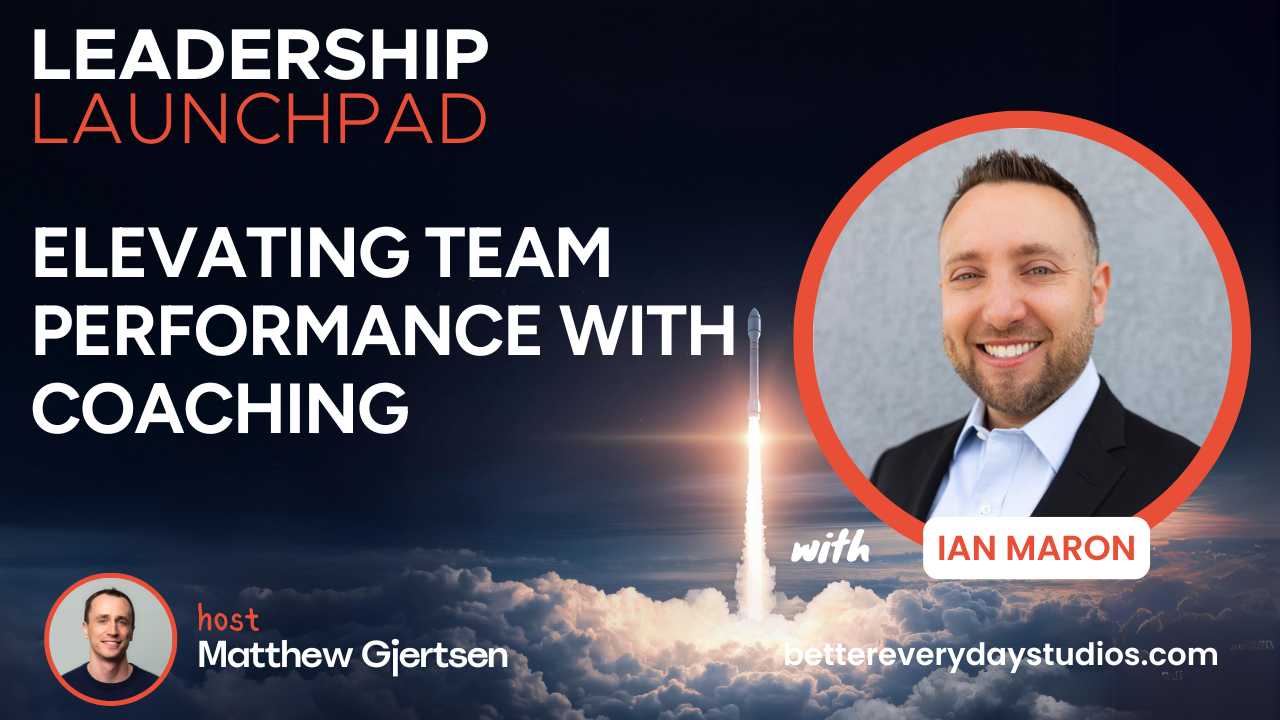
In this episode of Leadership Launchpad, Ian Maron, VP of People and Talent at Apex, joins the show to discuss the value of coaching in leadership, particularly in technical and engineering environments. Ian shares insights from his career journey—from teaching with Teach for America to leading HR and people teams at several companies, including startups in the aerospace industry. The conversation explores the key differences between management, mentorship, and coaching, highlighting the importance of having a range of leadership tools. Ian introduces the GROW model (Goals, Reality, Options, What’s next) as a practical approach managers can use to develop their teams and shares a live coaching session that demonstrates its use. The episode offers actionable techniques for new managers and leaders looking to foster growth, creativity, and autonomy within their teams.
 Automated Transcription
Ian Maron [00:00:00]:
A specific methodology that I learned and that often business coaches and managers who use coaching can use is called the Grow model. And the Grow model stands for your goals, your reality, your options, and what you'll do next.
Matt Gjertsen [00:00:37]:
I often hear and talk about the phrase great players don't make great coaches. And what this phrase means is that when you take a great player or employee and make them a coach or an instructor, they're not always able to translate their skills into, you know, words or actions and behaviors that can be beneficial to the people that they're supposed to be coaching or helping. The challenge is that we do this all the time in the modern workplace. We take great individual contributors, great engineers, and we make them managers where they're expected to coach their people, but they just don't have those skills. So what are we to do? My guest today on the leadership launchpad is Ian Marin, the VP of People and talent at Apex, a spacecraft manufacturing company that is trying to revolutionize and streamline the speed at which satellites are made. Ian and I met several years ago at a previous space company that he was working at, and he's incredibly passionate about this idea of coaching and thinks it's critical for people. So during this discussion, you're going to learn the basic distinctions between things like traditional management mentoring and coaching, why coaching is so important. And we finish by Ian actually coaching me on how to grow my business using the Grow model of coaching.
Matt Gjertsen [00:02:10]:
It's a fantastic discussion. I'm sure you're going to get a lot out of it. Before we get into the discussion, I do want to remind you that if this is your first time listening to the show, please make sure you subscribe so you never miss a future episode. And if you happen to be someone who's responsible for developing leaders and managers in your organization, I would love to talk to you. Please reach out through Matt better everyday studios.com so we can have a conversation about how to make your managers better. With that, let's get into the discussion with Ian Marron. Ian, welcome to the leadership launchpad. I am really excited for this discussion.
Matt Gjertsen [00:02:49]:
How are you doing today?
Ian Maron [00:02:50]:
Thank you, Matt. I'm doing great. It's great to be here with you. Really excited as well.
Matt Gjertsen [00:02:56]:
Yeah, we first met when you were at a previous company. You've had quite a bit of experience these past few years, especially in the space world. Could you give listeners just a quick touch of some of the places you've been and maybe finish of saying a little bit about what the company you're at right now? Is working on.
Ian Maron [00:03:18]:
Yes, absolutely. So I began my career with Teach for America. I was a third grade bilingual teacher in the South Bronx. Those were my three years of service. After that I moved to a digital advertising and digital consultancy called rga. I was there for almost a decade. I started as a HR generalist and left as the VP of hr, moved to BCG Digital Ventures here in Los Angeles and led the people and talent team for North America building startups. We built a couple of unicorns during that time.
Ian Maron [00:03:46]:
And then I was really lucky to join ABL, a rocket launch startup in 2023. I was really lucky to then join ABL. I was at ABL for a little bit more than a year and then an opportunity came up with Apex. And Apex is a satellite bus manufacturer. We're based in Playa Vista in Los Angeles and we build and productize satellite buses. So the idea behind what it is that Apex can do is to build buses at scale and at a better cost for our, for our clients. And we can deliver a bus to you within six months. You can go on our website and actually order and pick out the satellite bus that you'd like.
Ian Maron [00:04:21]:
And it's, it's a really great business model. We've got about 170 employees here in Playa Vista. We've grown more than 300% in the last year and just done a series C raise. And it's a really exciting time to be in, in this space and to be in Los Angeles.
Matt Gjertsen [00:04:36]:
Awesome. I mean, you certainly, you know, kind of get into the space world in a couple years ago, in 2022. That definitely is when things were, I mean, things have been taken off in the space industry recently. And I know the rockets get a lot of the press like because, you know, of all the big, the fire and everything like that, it's really exciting to see them launch. But the revolution in satellites is really incredible because we're really fully shifting from a world where every satellite is this bespoke custom build to something where everybody, you know, I really think we're moving to a world where there are, you know, we're on this exponential curve of the number of satellites that are going to be up there. Because as launch costs decrease and then as production costs decrease, there's just lots of utility to, for all kinds of companies, for all kinds of reasons to, rather than rely on somebody else, like just do it yourself and have it as kind of a strategic asset for your company. So that's, that's awesome. I would just, I hadn't planned on asking this, but I got to ask, since you did start your career, have a big chunk of your career in the consulting world and then you relatively recently moved in house, what was that like? What's it been like to move from building and consulting companies that aren't fully like yours? And now you're internal where it's like, okay, now I'm part of the team.
Ian Maron [00:05:54]:
I mean, I love it. I was really lucky to be working on the professional services side and to get to work with many creative people, many engineers, many visual designers, experienced designers, and I was able to work alongside them as they were building products for all of our clients. What's really fun and exciting about being in the aerospace world is actually being next to the hardware. So compared to selling our services as and and selling ideas that we had and working alongside of our clients, it's been so exciting to actually sit with engineers in at ABL and now at Apex, and then also to sit next to our technicians and our production team who are building the physical product. And we are building so quickly here. So to be able to see from design to execution, where we would be able to put out a bus within the first. Within a year for our first product, Ares, to see what it is that we're doing on our next satellite, which is called Nova, with some really ambitious timelines, but some really, really talented and very smart people who are able to design and then execute and then build. It's really fun to be on the hard.
Ian Maron [00:07:01]:
The hardware side as 2. On the hardware side too.
Matt Gjertsen [00:07:04]:
Yeah, that's one of the things that I always love about working. Yeah, working in these companies is just. It's so tangible.
Ian Maron [00:07:11]:
It's just.
Matt Gjertsen [00:07:11]:
It's just right there in front of you. Yeah, I couldn't agree more with that. Well, when we talked a few weeks ago, one of the things that you had mentioned regarding management and leadership, since this is something that you're working directly with these people on, that you're really passionate about, is this idea is coaching and managers as coaches. And before we get. So that's mainly what we're going to be talking about today. But before we get into that, I think it's also really important to define terms because I think there's a number of terms around here. So if you think about, you know, coaching, mentoring, those two words are often used synonymously, but they are different. And then managing, like how do you think of kind of those three words? Defining those three words?
Ian Maron [00:07:55]:
Yeah, so I think there's been an evolution in the way that people work and in the way that managers and leaders lead. So if we go back in time, when we were in a. When we were building different sorts of products and when the world operated a little bit differently, we had managers who really were required to tell their people what to do and monitor people to make sure that they were meeting compliance targets and actually delivering against what was expected. And the economy and work has shifted to the degree that many people in the world are knowledge workers. I would assume many of our listeners are knowledge workers working in the space industry. And what it is that we need as knowledge workers is different from what it is that people needed because of the way that work has changed over the last 50, 30, 20, even the last 10 years. And when I think about management, I think that some people think of management as telling people exactly what to do or how to do it and directing people and monitoring people. So I think about the way that that's how people kind of grew up with a conception of management.
Ian Maron [00:08:59]:
And because work has changed and because a lot of people want creativity, want autonomy. What we've seen a lot that what we've seen is happening more recently in the last 10, 20, 25 years is people and managers moving more into less dictating what actually needs to happen and more coaching and helping people to solve the problems that are in front of it. Because some of the problems that we're tackling are novel and the problems that we're tackling are. Can be solved in different ways. So I think about this like there are times where you need to use different management techniques. And I'll answer your question specifically about management and mentorship and coaching. But there are times where you actually do need to tell people exactly what to do. So if you are an attending physician and your resident is about to perform a surgery, you need to tell them how to hold the scalpel.
Ian Maron [00:09:47]:
That's really important, right? Because it's really critical that we don't mess things up. Or if you are an instructor pilot and you're teaching somebody how to land a plane, you need to tell them exactly what to do. There's a best way to do it. In those sorts of circumstances, management can mean actually telling people exactly what to do. But in a lot of other circumstances, the sorts of problems that we're trying to solve, about how we can code for this particular program to work in a particular way, or what this hardware should look like, or how we can engage with this client, or how we can grow our skills, those are things that have less defined answers and as a result we need to help people come to the right answers on their own and that's where coaching can play a role. So for, for the way that I think about coaching is helping people to discover and answer their own questions in ways that work for them. Coaching is a process in which you can help people identify the problems that they're trying to solve, come up with different options about how they might want to tackle them, and then help them to discover and decide what it is that they're going to be doing next to actually help break through some of the problems that they might be having. Mentorship is a little bit different in that it's where people are learning from you and there's often an apprenticeship that goes alongside of people learning from you as an expert who's been doing something for a long time and people can ask you specific questions so you can kind of show and guide people along the way the skills or the, or the abilities that you've developed over the course of your career.
Matt Gjertsen [00:11:10]:
That makes a lot of sense. I don't know why, I've never quite thought about it that way, but I don't know if I've ever heard somebody say, I'm going to a mentoring session. Where you always say, I'm going to a coaching session. Right. You know, whereas. Because coaching is kind of a conversation that we're going to have. Whereas mentorship is much more of like a longer term relationship and process where you're kind of doing something a little bit more together and ad hoc.
Ian Maron [00:11:37]:
Yeah, definitely. I think for mentorship there's, there's less of a power dynamic than you might have with a manager that you're talking to. There's always positional authority that a manager has that can make it, that it can be a difficult conversation or that people might have certain feelings about how their manager is going to think about them in different ways. Whereas mentorship, it feels like it can just be a completely open conversation and there's very little of a power dynamic.
Matt Gjertsen [00:12:00]:
That can actually happen in the conversation that makes sense. And what I'm doing as I'm listening to you, I'm also kind of reflecting on the aerospace industry as a whole. One thing that I find really interesting, especially in startups, is how mixed the workforces are. Right. You'll have people, you'll have maybe a brand new manager who's in charge of engineers, they're in charge of technicians, they're in, you know, like test supervisors. They got all these different people. How do you think? Because from what I'm hearing, It sounds like, you know, mentoring especially can be really effective in more of that like hands on kind of environment. But do you think depending on the kind of work environment or the kind of work that's being done, you're, I imagine you're pulling different levers at different times?
Ian Maron [00:12:46]:
Yeah, absolutely. I think if there's a key takeaway from our conversation that leaders and managers need to have different tools in their toolkit for different situations and for different people. And Absolutely. To your point, the workforce has changed and evolved and on a given time you, or in a given day, you might be working with different people who are trying to solve very different problems. You might be on the production floor and teaching a person how to, how to approach something. You might be thinking about how to approach a particular client situation. You might be trying to solve a really difficult engineering challenge and helping people to uncover and think through the way that they might want to solve those challenges. And as a manager and as a leader, you need to have different approaches that you're going to take because one size isn't going to fit all kind of problem that you're encountering and it's also not going to fit all kinds of people that you're, that you're connecting with.
Matt Gjertsen [00:13:35]:
Yeah, yeah. And I think it's that ability to have different styles that is especially difficult early on. You know, I think the phrase that I always love is great players don't make great coaches. I would change that a little bit of like great players don't automatically make great coaches. But I think in the world that we live in, you know, especially high growth startup, you need to get a lot done. You're identifying the people who have great technical ability and you're promoting them and you're making them a manager. And it's, you know, again, thinking about those different pillars, I think it's, it can be relatively easy for them to pick up the traditional manager mantle and direct tasks because they know how to do it. But I'm guessing in your experience, is it a little bit more difficult for them to pick up that, that coaching part of it?
Ian Maron [00:14:31]:
Yeah, it definitely can be because it's just, it's a different way of thinking and it's a different way of learning and a different way of leading. I find. And one of the key philosophies in coaching is that anybody who wants to grow and anybody who wants to learn and to do something different has the ability to do so. So it's like, it's the, it's the growth mindset which is A key principle behind coaching as a, as a manager, as a, as a coach. And I think that to your, to your question, people can learn those different skills and learn those different abilities if they want to, and some of it can be about aptitude. Yes, some people are naturally going to be more teachers, more coaches, more mentors, and some people are going to be naturally more independent and more successful when they work on their own. And all those different sorts of people have a place in our workforce and our companies. But I think that you have the opportunity to learn how to become a coach.
Ian Maron [00:15:24]:
But there are some specific skills in order to actually be a successful one. And hopefully we'll get to talk a little bit about that today. Like, what, what actually it can look like for a coach and how you can approach different situations. But I think to your question about, like, is it, is it true that a great employee will become a great manager? Is it true that a great player will become a great coach? I think that it's not automatically true, exactly to your point, but there are things that businesses can do in order to help develop people to become those great managers and great leaders.
Matt Gjertsen [00:15:56]:
Yeah, well, let's, let's pivot to that right now. I mean, in terms of some of those techniques, because I think that's the core question. It's like you've spent your whole life being an excellent individual contributor. You know how to solve the problems, you know how to do the work. All of a sudden you've been put in charge of all of these people and you're. And you just. I know the struggle because I felt it myself, you know, and I struggled even when I went from being a pilot to working in the corporate world, because at least when I was a pilot, like, I had done exactly the things that I was coaching and mentoring people to do. So I knew it very well.
Matt Gjertsen [00:16:38]:
But then when I moved into the corporate world, maybe I had never done that before, or maybe they were more experienced than. Maybe they were better at the thing they were doing than I was. And I just, it kind of blew my mind of like, I'm. What, what am I supposed to do here? So, yeah, I know you have a couple specific techniques that people can apply. So. So what are. Let's talk through those.
Ian Maron [00:16:59]:
Yeah, I think if we frame it first, I think one of the most important things that you can do as a manager and as a leader is to build a partnership with the people that you have with you. And I think that there have been studies around psychological safety and creating trust alongside of your Employees where you can actually help people to grow and develop. So I think that it all starts with that relationship. One specific thing that you talked a little bit about from moving from a pilot and in the corporate world, people need to learn how to delegate, people need to learn how to give feedback. There are some very specific skills and we can learn all of these different skills on, on YouTube or really in so many different free resources and so many great books that we can leverage to learn those very specific skills. For me, coaching is also another skill set that I don't know that we've all learned necessarily how to do at this point. And it's for people who are trying to create excellent, high performing teams and trying to develop and grow their people. So a specific methodology that I learned and that often business coaches and managers who use coaching can use is called the grow model.
Ian Maron [00:18:04]:
And the grow model stands for your goals, your reality, your options, and what you'll do next. So anytime that you're working with an employee or you're working with a person on your team who is trying to figure out how to solve a particular problem and it's not necessarily appropriate to tell them to pick up that scalpel and make that cut in the particular space, you can use this model where you're, where you're creating a sense of partnership and helping the other person explore how they might want to solve the problem that's in front of them. And again, you just break it up into what is the goal, what is it that you're trying to achieve, what's the current reality, the things that will make this hard, the things that are getting in the way, what are your options? How could you approach this? And then what will you do? And a coaching session could be three minutes or it could be 50 minutes, depending on how, what it is that you're trying to solve and what it is that you're trying to tackle. But oftentimes, oftentimes what I think about is that old parable. If you give a man a fish, he'll eat for a day. If you teach a man to fish, he'll, he'll eat for a lifetime. And I think that oftentimes as managers, what happens for us is that we want to just help people by telling them the right answer, but it doesn't help them to grow and learn. And our job is to help coach people so that they can learn how to answer their own questions and, and continue to be better problem solvers as they continue to grow in their careers.
Matt Gjertsen [00:19:26]:
Yeah, yeah, totally. I love that model. Because I think you're 100% right in a big. One of the frames around leadership that I love is comes from Jeff Bezos, who says, as you progress up in a hierarchy. I may have said this before on the show, so apologies for everybody who's listening. If you've heard this before, as you move up in a company, your timeline for decisions should be getting longer and longer. Like he as the CEO of Amazon, decisions that he makes shouldn't matter for five years, right? Like, those are the kinds of decisions that he would be making. His direct reports, like the C suite, that's beneath him.
Matt Gjertsen [00:20:11]:
None of his direct reports should be making decisions that are going to matter for one to two quarters. Right. Or like one to four quarters, like, you know, three months to a year, like they should be much more longer. And then as you go down, it gets lower and lower. And like frontline employees, it's like, no, right now, like, I'm, I'm making decisions for right now. I have to do this job. And so manager is like that first step where kind of to your point. I think part of the transition we have to make is the thing with coaching is that the payoff isn't immediate.
Matt Gjertsen [00:20:38]:
The payoff is a week later, a month later, six months later. Ideally, it compounds on itself. And I think coaching is one of those first instances where you can really say, okay, I need to put my long term hat on here and make sure I'm not just thinking about how can we do things now, but what's going to impact us and help the team for the, for the longer run. I think we were going to do a little bit of an example here where you were going to have a little bit of a coaching session with me. Is that, is that right?
Ian Maron [00:21:07]:
I'm ready if you're ready. I mean, I don't know, let's do it. If you're ready. I'm ready. Let's do it. Let's go.
Matt Gjertsen [00:21:13]:
I like it. I like it. So where do we start? You want to walk me through the grow model so that like, as we go through this.
Ian Maron [00:21:20]:
Yeah. So if there, if there's a key takeaway for the grow model, it's the G R O W. It's what are your goals, what's your current reality? What are your options and what are you going to do next? So I would ask you, Matt, I know that you're a business owner, you're an entrepreneur. We kind of talked a little bit about this, but we didn't go into detail. So it would be really exciting to hear a little bit about what's going on in your business. And if there's something that you want to be different, what might that one thing be that you want to be different?
Matt Gjertsen [00:21:51]:
It's, it's really funny that you ask me this because you mentioned delegation earlier as one of the key skills that you need to learn as a manager. And without a doubt, delegation is the one that I most commonly hear and that I most struggle with specifically with my business. I'm trying to, you know, I am trying to grow a business where I'm going to, you know, I have a couple part time employees and I want it to keep growing and growing so that I have a true team in kind of the Tim Ferriss sense. I want to create something that I can walk away from for a month and come back and everything's still working just fine. And so that starts by, yeah, delegating more work. I think that's, that's, that's the goal that you know, have. Get client work. Make it so that I am doing less client work.
Matt Gjertsen [00:22:41]:
That's the goal.
Ian Maron [00:22:42]:
I got you. Why is that so important to you?
Matt Gjertsen [00:22:49]:
It's the only way that I can create something that lasts that you know, I'm. That it's a thing that's not me, you know, that I can, whether. And I can do it, you know, do whatever I want with it. I could, I could sell it, sell it to the employees, you know, just let it die or whatever. But the only way to make, to have options other than just keep working is to create something that can stand on its own when I'm not there.
Ian Maron [00:23:15]:
Got it. So if I'm hearing you right and let me know if I'm getting it right or kind of mishearing. What I'm hearing is that you want to create something that lives beyond you and something that can be successful when you're not there. And also what I'm hearing is that you want to have a business that runs to a degree on its own.
Matt Gjertsen [00:23:34]:
Yes, yes. Or is capable. Can it has the potential to.
Ian Maron [00:23:40]:
So when you think about that as your goal. So just pausing for listeners like what it is we've heard is Matt's goal that he's trying to focus on is how he can make his business more sustainable. So let's talk about your current reality. What's happening right now that is making that so hard.
Matt Gjertsen [00:23:58]:
I think there a lot of, a lot of work. I think we've come a long way over the last six months and a lot of client Work is being done by various members of the team. I am still a relative lynch, like, bottleneck in that I'm still the primary interface with all of the clients. And so it's. The information is still passing through me. Tasks are decided by me. And so I think that's probably the biggest thing, is that I'm still the bottleneck on most work being completed. If I don't lay out the things that need to be done, then nothing's moving forward.
Ian Maron [00:24:38]:
How is that working so far?
Matt Gjertsen [00:24:41]:
It works great when it works. It doesn't work great when it doesn't, you know, I mean, generally I'm in the position now where I still want to be in the trenches. So it's not, you know, I'm around all the time. But it does present limitations. I, I actually, a couple of years ago, I was really, really freaked out because I suddenly got a call from an ambulance. An emt got a call from an EMT from my dad's phone. Like, my dad called me in the middle of the day and it was an emt because he had been found, like, collapsed in the front lawn. Yeah, it turned out fine.
Matt Gjertsen [00:25:15]:
He had an aneurysm. It turned. He was like the miracle of all miracles. But I hop on a plane, I fly up there, and I'm thinking, okay, like, life's changing now. You know, Like I'm, you know, there was the chance I'm, you know, very directly involved in my father's life for a long time. And those are the things that, that kind of worry me is that as long as everything's moving, everything's fine. But if there was something to happen, if I suddenly couldn't work for six months, if, you know, like, there's nothing to. There's nothing there.
Matt Gjertsen [00:25:48]:
So it works well now, but there, it's, there's. I feel there's fragility.
Ian Maron [00:25:53]:
I got you. So I'm hearing it's like, it's really important to you. It's not just about the business, but it's also about your life and your family.
Matt Gjertsen [00:25:59]:
Yeah, yeah.
Ian Maron [00:26:01]:
So making a sustainable business, that's like a really big goal. Figuring out how you can be the Tim Ferriss and kind of step away and the thing runs all by itself. Like, that's going to take. That's going to take some time. But you mentioned a little bit of delegation would be something that you'd like to do. So if we think about a concrete thing that you could see changing over the next month, what do you think could, could be a change that you might be able to make in order to move towards that longer term goal.
Matt Gjertsen [00:26:30]:
Like with a lot of things with delegation, I think it's ultimately, you know, this is exactly what it was in the, in the, in the plane as an instructor pilot, you have your bubble of comfort and you're always trying to trust people more and more over time. And so I think for me there's actually a couple projects where I could theoretically put the team member more directly in contact with the stakeholder from and see what happens. There's actually one project in particular that I'm thinking of. They're very qualified, they're doing the work. I could kind of remove myself as the key communicator and become the observer.
Ian Maron [00:27:16]:
Got it.
Matt Gjertsen [00:27:17]:
That's one option.
Ian Maron [00:27:18]:
Okay, so just for listeners, like, we've gone through your goal, we've talked about your current reality. Now we're starting to get into options. And this sounds like a pretty good option for Matt. Like he's thought this through. He's thinking about what it is that he might want to do. So we have not actually talked about this now. So we're just going really now on the, on the option side and just building out some different ideas about how to actually make that successful. That's for listeners, like a, like a little break.
Ian Maron [00:27:43]:
Go ahead, Matt.
Matt Gjertsen [00:27:44]:
And, and I actually do want to go farther on that for listeners is because I think a lot of times maybe you're working with somebody who's new in their career, relatively junior, you ask them something like kind of what options do you have? And they're just like, I don't know, how much should you be provide? Because I think going back to this idea of wanting to provide solutions, I think there's a tendency to just say, well, what if you do this or this or this, when should you do that? Or should you never do that? Like, what are your thoughts on that?
Ian Maron [00:28:15]:
Yeah, if, if there's a takeaway, I don't think that there's only one right way to coach.
Matt Gjertsen [00:28:20]:
Yeah.
Ian Maron [00:28:20]:
And everybody's going to show up organically and naturally in their right in, in their way. That's going to make sense for them. If it's true coaching, like the purest sense of coaching, I might aim to help you unlock that. So let's go back into this example and let's pretend that you said, you know, Ian, I'm really stuck. So here's how I might approach that with you. I might say, I'm hearing you, Matt. Like, you want to figure out how to delegate more. You Want to figure out how to make this a more sustainable business, but you're not entirely sure what it is that you should do next.
Ian Maron [00:28:50]:
If a friend came to you with this sort of problem, what advice might you give them?
Matt Gjertsen [00:28:55]:
Love that, love that, reframe.
Ian Maron [00:28:57]:
So, and in that case, oftentimes when you, when you think about it from. And you externalize it from yourself, it allows you to kind of unlock something. Because we think about things so much and we can sometimes get stuck in our patterns and our ways of working and our ways of thinking that reframing it and putting ourselves outside of the problem can help. Another really great question that you can ask is, well, who's somebody who you've seen do this successfully and what advice do you think they would give you? So it's unlocking. So perhaps they've seen a parent do it in their own business. Perhaps they've seen a friend or colleague do it in a different circumstance. Perhaps they've read a good book about it. What you're trying to do is just unlock so that people start to build these patterns within their own brains to help to solve their own problems.
Ian Maron [00:29:42]:
Because you're not always going to be able to help people coach or help people unlock different, different ideas. So in this case, to answer your question, I think you'll see what makes the most sense as a manager. And there's not one good way to coach if there's a takeaway. It's, it's. Your presence is an intervention. You are able to help people simply by being a thought partner to them. And it comes back to being, to, to really building that partnership and high level of trust to help people unlock the problems that are in front of them.
Matt Gjertsen [00:30:14]:
Yeah, that makes sense. That totally makes sense.
Ian Maron [00:30:17]:
Get back into it.
Matt Gjertsen [00:30:18]:
Yeah. Coachee hat back on.
Ian Maron [00:30:20]:
Okay. Coachee hat back on. Coach hat back on. So we've talked about delegation, we've talked about why this is so important to you. It's really important because you want to be able to spend time with your family. You want to be able to be there in the case of emergency. So I'm hearing like it's super important. You also want to build this business that's sustainable.
Ian Maron [00:30:38]:
And you've identified that there might be one project in which a person might actually be able to have some client interface where you could potentially come out of the direct client interface. What would need to be true in order for that to be successful?
Matt Gjertsen [00:30:56]:
I think the one. They would have to be open to it. So I think that would be like the first Step is talking to them. Are you comfortable with this? And then it's funny, in my book I just wrote a chapter about expectations. Is being really clear about what I mean by that and not just saying, hey, I need you, I want you to be the front person on this. I want you to start talking to them. But setting expectations, whether that's being. Can you make sure to follow up with them every day? Can you be responding to emails within an hour? Just lay out some of those.
Matt Gjertsen [00:31:32]:
What I think the successful relationship would be so that I'm not assuming they know what that is. I think those are probably the two primary things that I would have to.
Ian Maron [00:31:43]:
Do to make it successful.
Matt Gjertsen [00:31:44]:
Definitely.
Ian Maron [00:31:45]:
What do you think will be in it for them?
Matt Gjertsen [00:31:47]:
Growth for them for sure. They have signaled that they. And they've signaled the capability for sure of being that. And so it's at least in the learning development world. One of the things that we often talk about is getting out of order taker mode where somebody of a starter career just being told what to do. And it's a clear bridge out of that for sure.
Ian Maron [00:32:08]:
Yeah. So I think what I'm hearing is for you, you need to talk to this person at first, like see if they're open to it, see if they're interested in it. It sounds like you have a sense that they will be because they've talked to you about being interested in personal growth in the past. And then it sounds like you want to set some of your expectations. I might even push you a little bit and say, try to do some of that coaching with them where you're saying, okay, you're going to take this on. What are your options and what are you going to do in order. In order to actually make this successful? Right. So just put in practice this grow model.
Ian Maron [00:32:38]:
All right, so I'm hearing we've got some good options in front of us. And now just coach hat off for a second more talking to the listeners for a second. Now we got to actually make this real. So Matt has some ideas. It seems like he's bought in. Now it's time for us to get into like the five W's. What is he going to do? When is he going to do it? Where is it going to happen? So you're going to see me move into that mode for a second and will help to actually lock in, lock in this, this, this change that you're going to make. So Matt, we've agreed you are going to talk to this person.
Ian Maron [00:33:14]:
You're going to see what's in it for them and you're going to agree what your expectations are. When are you going to do that?
Matt Gjertsen [00:33:23]:
Uh, I actually need to follow up with them on something today. So I want to. I think this is a conversation that I want to have live, you know, face to face, not in person, but like, at least on, like on a zoom call. And so probably when I follow, definitely this is what I'm going to do. None of this probably maybe the next follow up that I have with them this afternoon, I'm going to see if they have time before the end of the week to meet for 30 minutes. We'll start with just getting a sense of where the project is at and making sure we're both aligned. And then the second half of the conversation, switch to having this conversation, which I love your point about, Rather than just saying these are my expectations, kind of more asking them, what do you think success looks like? How do you want to drive this relationship? Yeah. So that's.
Matt Gjertsen [00:34:09]:
I'm going to try to do it. I am going to say that, like find time and see if we can find time before the end of the week.
Ian Maron [00:34:16]:
Okay, that sounds great. We talked about what you're going to do, where you're going to do it. We talked about how you're going to approach it. So it sounds like you've got a pretty good plan. Is there anybody else that needs to support you in this that you think would be useful to get some buy in from them?
Matt Gjertsen [00:34:32]:
The only person would be the customer potentially, and just letting. Giving them a heads up, which I think there's plenty of things that are in it for them as well, of prompter communication, easier communication, that kind of thing. More direct communication. So ultimately it makes it more likely that their project will go along faster. Great.
Ian Maron [00:34:52]:
So is there anything else that you think might make it so that this would be difficult for your customer to say yes or make it difficult for your. For your teammate to say yes.
Matt Gjertsen [00:35:06]:
The only roadblock would be time and time commitment from the. From the teammate. That would be the only one. And that's the main thing that we'll need to make sure to have a conversation about.
Ian Maron [00:35:16]:
Is it worth unpacking that a little bit more or do you have some ideas already that you want to approach that with?
Matt Gjertsen [00:35:21]:
I think I have some ideas. Yeah.
Ian Maron [00:35:23]:
Amazing. So now we've wrapped up that coaching session, so just to just kind of put a bow on it. We started with goals. We talked about what it is that Matt's trying to do, why it's so important to him. We then went into his current reality. We talked about some specific options that he had. He already had something that he wanted to do. And then we went into the what he's going to do next.
Ian Maron [00:35:45]:
And we said that he's going to have a conversation with his. With his direct report. We framed out how he's going to say it. And for me as the coach, I said very little to Matt about what he should be doing in that case. I was really pulling out the insights from him so that he would then be able to be successful. How was it for you?
Matt Gjertsen [00:36:02]:
I thought it was great. I mean, you've clearly had many of these conversations before. And I think the important point about coaching so often, especially when you have more experienced team members, is they know what they need. It's just providing them the time. It's asking the right questions providing them the time. Nothing that I said here felt groundbreaking to me, but at the same time it was like, oh, yeah. I just hadn't taken a moment to think about it. Which is sometimes the most effective coaching that you can do.
Matt Gjertsen [00:36:36]:
Totally.
Ian Maron [00:36:36]:
Just creating the space person to have a moment to think and then a thought partner. That's super important. And I think that that's a differentiator for really great leaders and great managers until AI replaces us all, where we can really be a differentiator and help people to think things through. There's one other thing that I would do in a normal coaching session, whether with a direct reporter or coaching, which is to ask, how can I support you in this and when can I follow up? So, Matt, how can I support you in this and when can I follow up?
Matt Gjertsen [00:37:09]:
I want you to pester me every day for. No, serious, seriously, do, please feel free. If you remember it two weeks from now, follow up and see how it's going and make sure I've done it.
Ian Maron [00:37:24]:
You got it.
Matt Gjertsen [00:37:25]:
Two weeks from now? Yeah.
Ian Maron [00:37:26]:
Yeah, two weeks from now. And then we'll see if we want to. If you want to pivot or do something different. But two weeks from now, it's going on my calendar.
Matt Gjertsen [00:37:33]:
Excellent. Awesome. Well, this. I think that's. That's perfect. Perfect way to end this. I think this has been a fantastic discussion because coaching, delegation, mentoring, like, I think these are. They're critical skills, but they're a challenging skill because this might be the first time you've ever had to do them, especially when you're a new manager.
Matt Gjertsen [00:37:52]:
And I think we've given a great, you know, great techniques, great example for people to kind of unpack and follow. So this was awesome. Ian, I can't thank you enough. Thank you so much for being here.
Ian Maron [00:38:01]:
Yeah, my pleasure. And I think just try it out, right? Like, the first time you try something, it might not work perfectly, but. But come back to that, to that grow model. And there's a key takeaway. It's that your. Your presence will be an intervention and you will be supportive to your person and give them the space to unlock all the answers that they might already have.
Matt Gjertsen [00:38:23]:
I love it. Thank you so much.
Ian Maron [00:38:25]:
Thank you.
Matt Gjertsen [00:38:27]:
Thank you so much for listening to today's show. If you are looking for help turning your organization's great engineers into great managers, me and my team at Better Everyday Studios would love to help. We deliver targeted and interactive training workshops that are designed to help build the three fundamental skills of any new manager. Building trust, giving feedback, and setting goals. Reach out to me through matttereverydaystudios.com so we can start making your organization better every day.


