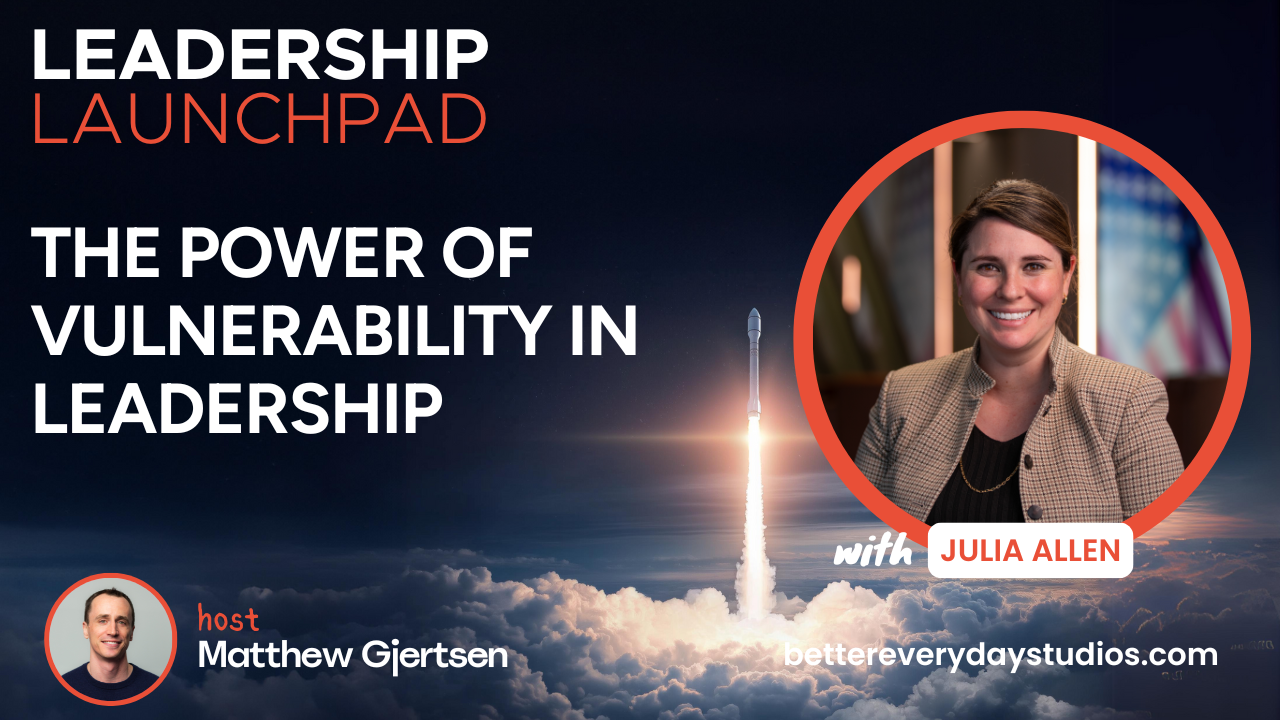
In this episode, Julia Allen, former Chief Technology Officer at Saab, shares her leadership experiences across the military, government, and tech industries. She discusses her time as a company commander in the Maryland National Guard, emphasizing the importance of building trust within diverse teams and adapting leadership styles to different environments. Julia also highlights how establishing a culture of vulnerability, celebrating team achievements, and shouldering responsibility help foster high-performing teams. The conversation covers techniques for managing technical projects, such as maintaining a risk register, and explores the value of generalist skills for leaders in innovative fields. Julia’s insights offer practical advice for current and aspiring leaders looking to create strong, collaborative, and adaptive teams.
 Automated Transcription
Julia Allen [00:00:00]:
I've always, always taken time to recognize the team's accomplishments. I think that kind of can get overlooked if you're, if you're really striving toward a long term milestone. It's hard to celebrate little wins along the way, but I think that's really important for a team.
Matt Gjertsen [00:00:34]:
One of the reasons I love working in aerospace and other hard tech companies is really the diversity of people that you get to work with. You know, you think of a company like SpaceX and you think of, you know, rocket engineers, but really a company like SpaceX or any of these companies is made up of tube benders and welders and software engineers. You know, when we talk about building the future, it really takes all hands, right? It takes a village to do that kind of stuff. And so that creates a lot of challenges specifically for managers because you might suddenly find yourself leading people who have very different backgrounds, experiences and goals than, than you have in your career. And so that's why I'm really excited about today's conversation with Julia Allen. Julia just finished her time as the Chief Technology Officer at Sabink, where she was responsible for steering the company's strategy for AI autonomy, advanced manufacturing and digital engineering. Before that, she worked at BAE Systems, the Johns Hopkins Applied Physics Laboratory, and through it all, she was an officer in the Army National Guard. So she has certainly seen a variety of leadership, leadership situations.
Matt Gjertsen [00:01:52]:
And that's exactly what we're going to talk about today. Before we get into the discussion, I do want to remind you that if this is your first time listening to the show, please hit subscribe so you never miss a future episode. And if you are already subscribed, then I would ask that you share this show with at least one other person because that, after all, is how we grow. I can't tell you how much it means to me with that. Let's get into the discussion. Julia, how are you doing today?
Julia Allen [00:02:20]:
I'm doing great, Matt. Thank you so much. It's great to be here and talk about this special topic. How are you doing?
Matt Gjertsen [00:02:25]:
I'm really excited. I'm doing great. I'm really excited to have you here. You know, we first connected. It's been a while since we connected and it was when we first connected, you were still at Saab, then you left. I'd love to hear a little bit, just briefly of kind of like what you're working on right now. I think you're doing some consulting work out on your own, if that's.
Julia Allen [00:02:44]:
Yeah, that's right. I'm starting my own consulting practice and it's been a fun journey so far. I've worked with the government, I've worked in the military, I've worked at big companies and now I'm really whetting my appetite and learning a lot about smaller companies. Everything from startup to mid size companies that are entering periods of high growth and anything I could do to help them with that leap phase, given the experience I have working in the defense industry for a long time from different lenses. It's been really exciting so far and, and I'm loving it. Thanks.
Matt Gjertsen [00:03:15]:
Awesome. Awesome. That's exciting. I, I kind of want to get started kind of more towards the beginning of your career and talking about your time in the National Guard because I do think it's, it's interesting. It's one of the things, you know, I'm still in the reserves. It's one of the things that I love is kind of, it's, it's the military. The military and especially the reserve component. The National Guard is, can be such a mixing pot, a melting pot for, for so many different experiences.
Matt Gjertsen [00:03:41]:
What were some of the leadership experiences you took away from your time at the National Guard and having to lead and manage such a diversity of people and backgrounds.
Julia Allen [00:03:53]:
Yeah, thanks. Thanks so much, Matt. It was probably the most formidable role for me that I'll draw on the most from this conversation as being a company commander in Maryland, in the Maryland National Guard, which was a great opportunity not only because they just stood up a military intelligence brigade there, but also because it's in the ecosystem so close to D.C. you've got the National Geospatial Intelligence Agency, you've got the National Security Agency, you've got CIA, dia, all the three letter agencies that are nearby which are where a lot of your National Guardsmen work. Right. So it was a great opportunity for me as a military intelligence company commander with over 180 analysts to be exposed to a huge variety of people. You're talking 18 year olds with a high school degree all the way up to the most experienced NSA analyst that is protecting us on a daily basis in that role in their full time job. I like you mentioned, worked full time.
Julia Allen [00:05:00]:
I was also in grad school at the time, so I was really stretched. I was pursuing a PhD, leading a company and working full time in the research and development field across both, both Johns Hopkins Applied Physics Lab and BAE Systems FAST Labs. And so for me it was a time of extreme leadership growth and stress and I felt like my capacity for stress increased a lot during that Time, but it was also a time where I developed the most as a leader with, with that, that variety of, of people working with me. I had to really adapt my leadership style on a day to day basis. Whether it's answering emails or being, being present for National Guard and training and readiness, which is, is around the clock when you're a company commander to my, my day job of working on the cutting edge of R and D and working with PhD scientists and, and driving the teams toward very different goals, very different tolerances for failure or even embracing a failure. But, but I learned a lot in those roles and, and it was quite a journey.
Matt Gjertsen [00:06:12]:
A couple things I want to pull on there. One is, you know, you, you know, so you're going to have to educate me a bit on army speak because I've never been in the, you know, it's very different. So first off, company commander, you said, you know, 100 or so folks that you are responsible for everybody from you know, the, the you know, 18 year old without a high school diploma or just with just a high school diploma. Like, like what are some of your responsibilities day to day as a company commander that you, that you had to kind of, kind of manage and are you actually interacting with, with that 18 year old?
Julia Allen [00:06:46]:
Yeah, absolutely. For me, interacting with, with every soldier and knowing them was something that I enjoyed. But also is, is a good, is a good part of the role as well. But in the National Guard, you know, it is a reserve component. So readiness is, is always key. You want to be ready to deploy at any moment just as if you were an active duty unit, but only on a once a month sort of cadence to get the right qualifications in order. So maintaining all of your equipment, your vehicles, your weapons, the personnel themselves is probably the first goal. But then as an intel unit, you know, it's very specialized skills, full motion video analysis.
Julia Allen [00:07:24]:
A lot of the work we did was classified. So getting access to training in the secure environments was, you know, another aspect that other other types of mos of the specialties don't have to consider in that sense as well. But, but really I found the commonality across both being in the National Guard and being in industry and on the R D side came down to trust and how trusting people. It paid so many dividends and not just in, it's not a transactional sense, but in a, in a real, genuine, authentic sense. When I trusted people 99.9% of the time I had faith in them and either they got to the point where they were performing at the level that I was trusting them to perform at or they already had that naturally and they just appreciated the sort of breath of fresh air and having someone who really trusted them to perform at their highest level, it almost took the, took the box off and let them even, you know, blossom even more. Which is something that I had to, you know, learn over time. Some of it through like I mentioned being, being at a point where it wasn't possible. And I think a lot of leaders who do micromanage reach a point of breaking that, that doesn't scale.
Julia Allen [00:08:52]:
Um, probably around, I don't know, there's a couple of breakpoints probably like 25 people and 150 people, something like that. But different, different points there. But yeah, I definitely think that trusting people has, people don't, you know, people haven't let me down. They more often than not they yeah. Surprise you and, and make things more fun enjoyable higher performing.
Matt Gjertsen [00:09:18]:
Yeah. What, what were some of, were there any things that you remember you did early on to get yourself to trust people especially? And I think what often happens is, you know, we, you come almost by definition as the, as the manager. Often you get into those positions because you have more experience and so you feel like you know better and it's kind of getting rid of that idea that oh, I'm the one that has the answer. What, what were some of the ways that you did that.
Julia Allen [00:09:51]:
Yeah, I think really being vulnerable and admitting mistakes was a culture that is not common in the military, is not common in research and development with PhD level scientists either. And I think that was almost making, almost making fun or making jokes about past mistakes. Makes it so that people feel like they can approach you with their mistakes because you know, you've shown your vulnerability and that you know you've made mistakes and so they feel comfortable to come to you and that allows you to trust people more because you do also trust that if there is an issue they'll, you know, they'll come to you or they'll come to others or they'll, they'll be sort of in a healthy environment to work through it together. I could give a couple examples on the software development side and the, on the day, the full time and industry side I should say I did, I wasn't a software engineer by train, by training, but I did do some coding on the job of course as a mathematician, as a, as a research scientists, you have obviously interact with computers a lot and I was first learning Linux and I was so frustrated with not having permissions to do this or that I think a lot of people who haven't worked with Linux systems before experienced this. But I basically did this command. It's the shorthand for it is chmod777 and root, which basically gave permissions for me to access everything and, and do everything to everything on the computer. But anyone who's from that industry that like discipline knows that that is like it could be an abysmal mistake that completely ruins your computer. So I like give that a joke to, to, to start some meetings and it's a real, you know, it's a real story that kind of sets the stage for like, well, if she's, you know, vulnerable enough to admit that she did something so, so stupid or so, you know, inexperienced or then it kind of sets the stage for others to say oh by the way, we're going to have to rebase the code because I made a commit that, you know, derailed progress, something like that, that in some environments that are very schedule, you know, strict and where it'll set you back too many, too many days, whatever that and leadership styles could overreact and be mad and say how could you do that? Like that's just not a healthy environment.
Julia Allen [00:12:39]:
If you want to cultivate a high performing team where everyone says oh that's all right, we'll stay late and get to the point where we were yet before you did this. Something like that. And then on the military side, you know, completely different kinds of mistakes, right? Like didn't forgot to PMCs a vehicle or you know, one time I asked for my supply sergeant to bring plates to the range, I said, you know, we really need you to come bring these plates. And it was like three hours away and it was going to be really inconvenient. And he got to the range and he had 120 food plates and I was talking about armor plates but you know, I made a very big communication error and not being more precise with my speech and he was like very much like you really can't get plates. You know, like he was frustrated too. So like things like that, that you just, you don't forget. But even if they're jokes, like those aren't like hey, you know, I made a mistake and like these are big not, not, not mistakes that costed lives or, or you know, serious in that sense.
Julia Allen [00:13:49]:
But, but it goes a long way I think in building trust and building a approachable climate.
Matt Gjertsen [00:13:56]:
Well, I love both those examples because I think when we hear, when people hear, be vulnerable. At least for me, I think the first thing that comes to my mind or the first thing that comes into my head is, is more of like an emotional vulnerability or a personal vulnerability. But your examples are very much just like, no, here's just like a thing I did at work that I messed up.
Julia Allen [00:14:16]:
Yeah.
Matt Gjertsen [00:14:17]:
And as a way to just be open about the fact that we all mess up.
Julia Allen [00:14:20]:
And it. More than just admitting mistakes, I feel like vulnerability has such a bad connotation. Being vulnerable is also showing that you care. It's saying, like sharing a personal story. It's being. Being human. It's making a joke and being, you know, there's more to. Everyone knows there's more to life than this one task that we are colliding on.
Julia Allen [00:14:42]:
So let's just let that creep in naturally, as if we were friends or, you know, together for more than just this task. Because you spend so much time together, you might as well have some fun.
Matt Gjertsen [00:14:55]:
Yeah, absolutely. Shifting. Shifting a little bit, you know, but kind of continuing on this idea of. Of trust and personal interactions. You already mentioned it a little bit, but you've definitely been in a lot of situations where, where you were probably leading people who were much more experienced than you, especially on a technical level. And I know especially for new managers, that's often the thing you're holding onto is. It's like the reason I am the manager is this technical competence, but very quickly that goes by the wayside and it becomes next to impossible to always be the most technically competent person in the room. In fact, you probably don't want to always be the most technically competent person in the room if you're.
Matt Gjertsen [00:15:37]:
If you're moving forward as a leader. So how. How did you approach those kinds of leadership situations?
Julia Allen [00:15:43]:
Yeah, I think it's interesting. I have a lot of, you know, not to sound boastful, but I do have some natural leadership qualities that people tend to kind of look to me for guidance. It's not something that I just do because I'm power hungry and want to be the leader and want to be in charge, something like that. It's more something that needs to get done. And some people don't want to do it. Some people do want to do it, but. But finding inspiration from the person that does it, I think is most important and not being the smartest person in the room, but maybe being the person who is most willing to carry burdens for the team. Most.
Julia Allen [00:16:29]:
I wouldn't say willing, but most excited to celebrate the accomplishments of a team and to sort of bolster the team's, I guess, camaraderie. Or the team mentality as far as celebrating each other's accomplishments is something that I've always, always taken time to recognize the team's accomplishments, I think that kind of can get overlooked if you're, if you're really striving toward a long term milestone is. It's hard to celebrate little wins along the way. But I think that's really important for a team and it's something that I would, I've always been the one to organize, hey, let's go have lunch or a happy hour. It doesn't have to be a huge thing. It could just be sort of something along the way that celebrates someone's, someone's milestone. Whether they finished a master's degree on the side or fixed a bug that we have been trying to fix for a few months, I think that definitely helps. I think that's not a quality, especially in the engineering field or more technical fields where people tend to be very focused on the work side of things.
Julia Allen [00:17:37]:
It's not a common thing and I think that people like that. About my style.
Matt Gjertsen [00:17:44]:
I'd love to hear a little bit more about that because I think you're 100% right in that a lot of times these kinds of environments can just get very focused on the work. And it sounds like to you that became kind of a unique quality or a differentiating quality is the fact that you, you wanted to celebrate that. Yeah. And so, so from your perspective, it, it was just, it was really well received, I suppose because I think that's the challenge. A lot of people think that nobody's going to care. Like I didn't care. So nobody else is going to care. And that's maybe not why, why they don't want to do it.
Julia Allen [00:18:20]:
But you, yeah, people tend to diminish the small things. Like. Well, it's just that. And we haven't done this yet. You know, there's always going to be another this that you have, you haven't done as a team. But, but I think taking the risk and saying, hey, let's go do this, whether it's for that reason or just to get the team together or, or you know, is something that's good. And likewise when, when something goes wrong, you mentioned like what else sets sets you apart or kind of putting words in your mouth a little bit. But what, what makes a good leader in an environment where the, a lot of the, the team members are brighter and more experienced and smarter is being able to shoulder the burden.
Julia Allen [00:19:02]:
So when things go wrong, it, you know, you, you Carry that, that and you, you take responsibility. Not to the point where you won't take input on how to right the ship in that sense, but that you feel, you, you feel the responsibility and the team sees you carry that responsibility, then it kind of changes the dynamic where they want to protect you. They're, they're, they want to be proud of you as their leader. And in most cases, not, not all cases, but in most cases, people want to work for people that they're proud to work for, that they, that they want, you know, to represent them publicly, externally facing, especially as you get to the executive levels. But, but behind the scenes, that is someone is approachable, that they feel they can influence, that they feel that they can help, you know, that they have a voice in the direction of the team as well.
Matt Gjertsen [00:19:55]:
Yeah. Yeah. It's interesting in your answer, there's, there's two things that kind of came through to me that, that I've heard before. One is that idea that you mentioned of. You're just kind of shifting what you are focusing on. So your contribution isn't the technical piece, it's the cell. It's the bringing people together piece. It's the reminding people to celebrate milestones.
Matt Gjertsen [00:20:17]:
It's, it's to, to move people together. But the second thing you mentioned, that kind of responsibility piece, I remember very clearly years ago talking to an engineer who said the number one, you know, she was moving up as a, as an engineer from a technical side, you know, whether I forget what the nomenclature was, if it's like Engineer 2 or Senior Engineer or whatever it was. But she was very clear that she wanted to stay on the technical track and did not want to go into the manager track specifically for that like final responsibility reason. You know, she wants to give all the input, give all the data and help, help, you know, inform the decision. But when it comes to the person who actually signs and says like were ready to launch or something, she wanted that to be some, somebody else. And that's, that is another big part of being a leader. You know, it's, it's you, what's the phrase? It's like you get none of the credit and all of the blame kind of, kind of thing.
Julia Allen [00:21:13]:
Yeah, that, and that's, it's a little bit cliche, but I've lived by that. And it's, it's, it's, it's the right thing to do. It's the right way to go about it. I, I will say too, like, not, not to skirt by the, the technical side of this Being a leader, especially in innovative and, you know, research and development work, that's all new. You do need to be, it's helped me, I should say, to be a generalist when it comes to the tech as well. Being able to go, yeah, being able to go deep in certain areas, but also being able to be able to pick up new things quickly. And I, you know, I'll give an example of like back when I was leading as a principal investigator for an Office of Naval Research program, one of the parallelization approaches we were using wasn't working. And I knew nothing about parallelization.
Julia Allen [00:22:04]:
So I did a lot of research and ended up getting to a point where I had gotten, gotten a new approach that the software engineer could sort of take and then, you know, implement it at scale. But it was, it was a, a time when it's a critical path thing that we were doing and I had to learn something new and quickly to get to make sure that the program stayed on track. And, you know, that built a lot of trust in myself too, as a technical contributor when you need to insert yourself as surge support in any technical discipline that is under the program that you're leading, being able to pick up new skills and yeah, pick up an aura, as one of my prior colleagues would say, in row. And that's definitely useful.
Matt Gjertsen [00:22:51]:
Yeah, it's interesting. I think it's something that we've been seeing a lot recently with a lot of the most prominent leaders, whether it be like Yanchen Huang or Elon Musk. And I think many of these characters have the moniker of being extreme micromanagers, as if they're in everything. But at least based on a lot of the reporting that I've seen more recently. It's not that they're micromanaging everything. They just do exactly what you said of like when there is a critical path item, they are laser focused on that thing and learn as much as they can about that thing and they kind of ignore everything else. And in a previous podcast I had with a friend of mine, Matt Mueller, he said one of the things you have to be really good at is that 80, 20 rule of common kind of understanding the big picture, like the 80% of everything at all times, but then when needed, know how to, okay, go get the last 20% of this thing or that thing when it's critical path. When there's like an anomaly or an emergency that's going on.
Matt Gjertsen [00:23:57]:
Yeah, that's kind of how you can manage the technical side of things and.
Julia Allen [00:24:00]:
Not to get too in the weeds, but One way I've found is useful on that is, is personal is staying very close to a risk register, not in like a very traditional risk risk register kind of sense where you're trying to de. Risk everything. Of course not, but in R D world there's a lot of technical risks and there's a lot of mitigations on how you can sort of address them. But also the keeping track of when you expect those risks to be updated is something that I found useful for tracking where those critical path items in the insertion and when you need to sort of heighten your levels of generalists or going to find other, other ways to fill the talent there. But maintaining, maintaining a risk register is, is definitely something that's been useful on the technical side. And then you said something else that it just, just slipped my mind what I was going to say about it. So I'll come back to it. But yeah, being, being able to, to.
Julia Allen [00:25:03]:
To make those contributions is, is very convenient.
Matt Gjertsen [00:25:06]:
Yeah, I, I wanted to follow up. I don't think it's too in the weeds on that risk register because I've never actually heard that term. But I think if I, if I'm getting what you're saying, correct me if I'm wrong. But and this is to kind of broaden it to other people who are listening is if I'm hearing you correctly on risk register, it's, it's not just like risk as in like you know, it's unsafe. These are risks of like, these are unknowns that could like derail the project or cause things to get behind. And so it's, it's just a matter of having the full scope of the whole project that's going on and knowing when you're going to answer different questions that more solidify that you're.
Julia Allen [00:25:42]:
Exactly. And now I remember why I was going to bring that up is because my, my first job out of undergrad was actually in test and evaluation. I worked at Aberdeen Test center, sort of, you know, you blow stuff up. You test to see if, if weapons work for the, the first, first of times. Right. And so having that foundation and test evaluation is very useful for leading teams that are working on, even, even overseeing large organizations working on many projects because you know, when those key test events are and they'll either turn on or turn off a lot of your risks. And like I mentioned before, so it's all interconnected. But I think having, like you said, when, when you, if you need to focus on certain areas, especially projects with lots of technical development disciplines within Them understanding the impacts of test events and test evaluation sort of metrics to sort of inform.
Julia Allen [00:26:31]:
Inform the. Your picture of where progress is as a leader is not. It's not very easy. A lot of leaders take. You would just sort of ask around and have self reported stuff. But if you build it more like you're tracking something based on data then it's a little bit more transparent, I think.
Matt Gjertsen [00:26:51]:
Yeah, I, I love that as a technique because I do think leaders, it's. It's a struggle of what to focus on on your. Because there's all. There's always going to be things that you can. And I think the tendency might be to focus more on the things you know more about or the things that you can have more of an impact on. But yeah, any project is going to have risks associated in instructional design. You know, it's like has the. Is.
Matt Gjertsen [00:27:15]:
Is the first. You know, is the draft done in time? Did the client approve the draft? You know, like, like there's going to be all these steps along the way and knowing when those milestones are coming up to say yes we are on track or no we're not on track is a great way to know, you know, who do I need to be following up with or touching base with this week to make sure the project keeps moving forward?
Julia Allen [00:27:36]:
Yeah, and a lot of people treat risk registers as sort of static but you can even, you can, you can track like the directions that risks are trending and you know, you can sort of model where you think they're going and, and how your models match reality as time goes on. I try to try to keep the act, I try to keep the estimates in there along with the actuals too to see how your mental models are doing.
Matt Gjertsen [00:28:02]:
I love it. I love it. Well, this has been great. I, I think there are a couple more things we want to talk about but I, I want to be cognizant of the time as well. I got a lot out of this discussion. I think, you know, the two main things that I pulled from this are one, this. The. The key importance of the, the kind of the trust and the personal connections because it's something that I harp on and honestly I think in a lot of technical organizations it's something that people think doesn't really have its place.
Matt Gjertsen [00:28:32]:
So it's great to hear from a leader like you that said, like no, this was one of the things that differentiated me as a leader that people, that people really liked. And so that's amazing. And then because it is difficult to figure out where you're going to spend your time and what you need to focus on as a leader. Being able to have this concept of kind of knowing where the unknowns are, what are the risks, what are the things that are going to put the team's work at risk and using that as kind of your guiding light of what to be focusing on this day, this week, this month. Two really helpful ideas that I don't know if especially the last one, I don't know if I've ever heard it articulated that.
Julia Allen [00:29:10]:
No, it was really fun for me. Thank you so much Matt. It was, it was great to think about my experiences which I think of as, as parallel experiences and you know, National Guard and this R and D career in the industry. But it was fun to think about what was similar and what was what was very different. Like the sort of physical presence and physical performance. Right. Versus intellectual performance and how, you know, how all those worlds differed a lot. But, but had some commonalities when it came to the, the paths that I've taken and the approaches I've taken, the leadership.
Julia Allen [00:29:47]:
So thank you so much.
Matt Gjertsen [00:29:49]:
Thank you so much for listening to today's show. If you are looking for help turning your organization's great engineers into to great managers, me and my team at Better Everyday Studios would love to help we deliver targeted and interactive training workshops that are designed to help build the three fundamental skills of any new manager. Building trust, giving feedback and setting goals. Reach out to me through Matt better everyday studios.com so we can start making your organization better every day.