
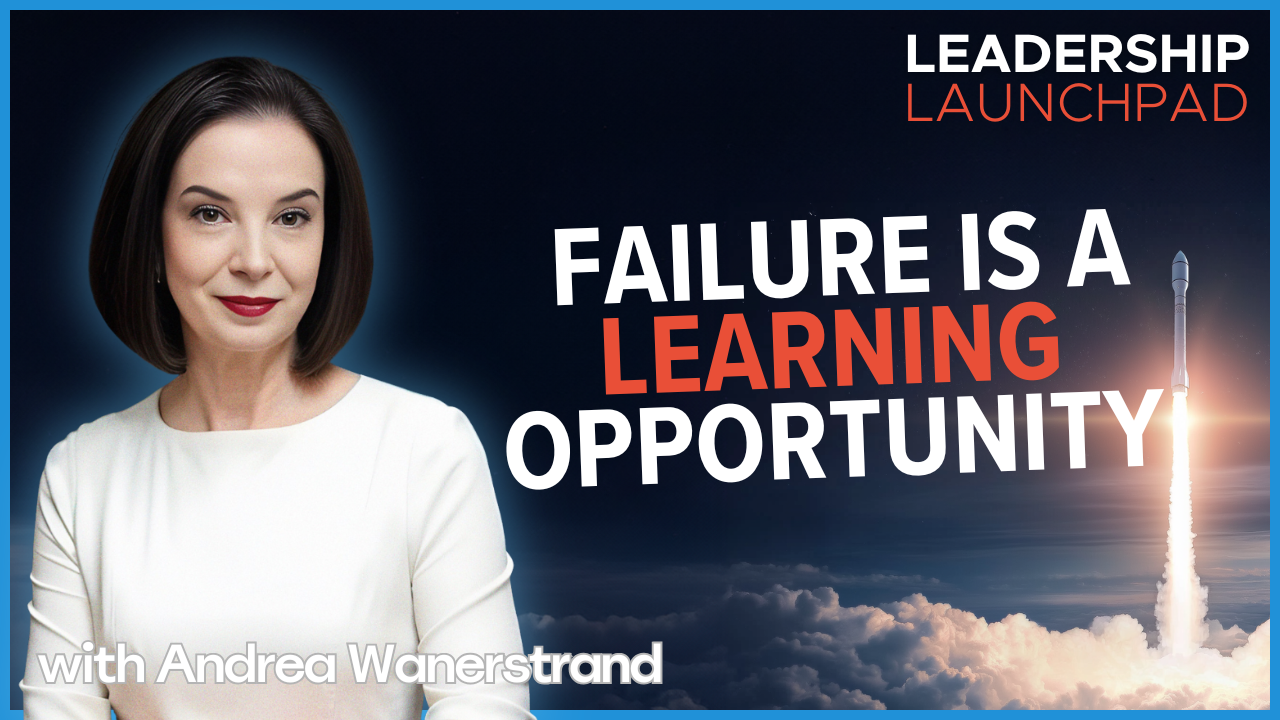
In this episode, leadership strategist and executive coach Andrea Wanerstrand shares insights from her experience inside global companies like Microsoft, Meta, and T-Mobile. Andrea discusses the cultural and leadership transformation at Microsoft, highlighting the shift from a know-it-all to a learn-it-all mindset and the importance of psychological safety, growth mindset, and resilience. The conversation also covers her A3 philosophy—authentic, autonomous, and accountable leadership—and practical ways leaders can build trust, give effective feedback, and foster autonomy in their teams. Andrea emphasizes the value of consistent authenticity, clear communication, and caring leadership that balances kindness with accountability. The episode also touches on Andrea’s experience running a lavender farm as a way to find balance and stay grounded outside the corporate world.
 Automated Transcription
Andrea Wanerstrand [00:00:00]:
You cannot get to success without some form of failure. Now we have to keep it in business context. There is a bottom line for all the companies that we've worked for. And you know, it's not like every failure is acceptable.
Matt Gjertsen [00:00:29]:
Hello and welcome to the Leadership L Pad. Today's discussion, though we scheduled it several weeks ago, it's actually really timely. So I'm extremely excited for our guest today, Andrea Wannerstrand. Let me start by telling you a little bit about her and then I'll tell you why I am so excited for this discussion. Andrea is a seasoned leadership strategist, executive coach and founder of A3 Culture Lab with over 25 years of experience and inside global giants like Microsoft, Meta T Mobile and Hitachi. She helps leaders shift from burnout to bold influence through her mindset, maven method and A3 philosophy, which stands for authentic, autonomous and accountable. She blends neuroscience, behavioral strategy and business insight to drive powerful cultural change, enabling organizations to build high performing human centric workplaces where people truly thrive. Over the past few weeks, I've been reflecting a lot on the kinds of companies that I tend to work with.
Matt Gjertsen [00:01:35]:
And there are some of them that are really struggling in these ever changing times and there are others that are really thriving. And so last week I actually sat down and spent a lot of time thinking through what makes the difference between these two organizations, what are some of the commonalities between them. And Andrea has been on the inside of one of those transformations. She spent a number of years at Microsoft and over the last couple decades, Microsoft really went full circle from being a company that was an industry leader to a company that was struggling to now a company that is an industry leader again. And she saw that from the inside. So we're definitely going to be talking about that. We're also going to dive a bit into her A3 methodology to understand how every leader can use it to help their team's performance. Before we get into the discussion, I do want to remind you that if this is your first time listening to the show, make sure you subscribe so that you never miss a future episode.
Matt Gjertsen [00:02:33]:
And if you're already subscribed and you know someone else who you think might benefit from this conversation, I humbly ask that you share it with them because that is how we grow. So with that, let's get into the discussion. Andrea, how are you doing today?
Andrea Wanerstrand [00:02:49]:
I'm doing great, Matt. It's wonderful to be here. I'm looking forward to this discussion.
Matt Gjertsen [00:02:54]:
Yeah, I'm, I'm really excited for it. I know. I. I know I talked a lot about your background, but there is one thing that I want to bring up as we get started. So, on. On LinkedIn, you describe yourself as a few different things. You describe yourself as a coach, a speaker, and an author. I.
Matt Gjertsen [00:03:09]:
I get all that. I think anybody's going to understand that. But then you also say you are a lavender farm owner. Tell, like, what you. What, what's that? Like, how did you be. How'd you start? How did you own a lavender farm?
Andrea Wanerstrand [00:03:21]:
Lived in the city here in Seattle for about 22 years, and we were looking to make that change. Our son had graduated from college, and so we were looking at properties on the various islands outside of Seattle, here on the Salish Sea in Puget Sound, and the last house we visited on one of our tours on an island called Maury island, which is part of Vashon here, it was a working pig farm. And we were like, okay, let's just go take a look. And we walked the property, and it felt like home. And we're like, okay, what would we do with all the land? We really hadn't been searching for a property to have a lavender farm on. The pigs were going away. We were not going to be pig farmers.
Matt Gjertsen [00:04:08]:
Okay, okay.
Andrea Wanerstrand [00:04:09]:
And so we kind of looked at. I've been doing a lot of biohacking because I did hit burnout in 2017 to the point where I got hospitalized. So I work with a lot of different types of professionals in the biohacking industry and medical industry to understand insomnia and how we manage our nervous system. I was like, I love lavender oil. It's really good for the environment, really good for the bees. So we started learning everything about lavender, and we now have over a thousand plants here on our farm, and that'll be doubling in the next year. Each plant is about when it gets to full maturity, about 4ft round. So it's like huge hedges of lavenders with hundreds of thousands of bees in the summertime.
Andrea Wanerstrand [00:05:03]:
And long story short, I also got the opportunity to buy a tractor, learn to drive a tractor, which is kind of fun. You've. You've. You've piloted, I guess, because you don't necessarily. Well, I guess you drive a plane, but, you know, a big piece of equipment, it's. It's a lot of fun. So when they see little five foot three me on the stage, and I say, yeah, and I also own a lavender farm and I drive a tractor for my other part of my farm, folks are like, huh? But it's really Connected us to nature and it's really just been a good grounding force. And I get my lavender oil free these days.
Matt Gjertsen [00:05:47]:
That's incredible. Yeah, I think especially for those of us that work a lot in the technology industry, grounding is the right word. It can be really great to kind of get out and have those experiences. That's, that's, that's incredible. So, so do you sell it then too? It sounds like.
Andrea Wanerstrand [00:06:03]:
Yeah, we actually distill the oil here. It's very. Any engineer that's listening to you would like it. It's, it's a still that we got out of a great company out of the Ukraine. It's very Chitty Chitty Bang Bang if any of your viewers know that old movie. But it is a lot of fun and a lot of science and it feeds my science side as well as my biohacking side.
Matt Gjertsen [00:06:31]:
Yeah, that sounds, sounds like a very kind of full circle experience. That's great. Well, let's dive in with the story of Microsoft because when we chatted a few weeks ago, you know, you had said, you know, you saw like, like I mentioned in the introduction, kind of the inside journey of that company. And one of the things that I think is interesting is, you know, when we talk about technology companies, whether they succeed or fail, so often the stories about the technology itself and the things that they're doing or not doing or the sales, but all of that is downstream from the culture, the leadership decisions. What are some of the things I think most people are probably aware of kind of that, that change that happened within Microsoft, but from inside, you know, like what were, what role did leadership and culture play in them going through that cycle?
Andrea Wanerstrand [00:07:25]:
Well, it was a complete mindset shift and that determined the culture. What I mean by that is when I started, Bill Gates was still CEO and it was a very prosperous time for Microsoft in the early aughts of the 2000s. And yet we were starting to get to the point where, you know, the iPhone was getting ready to come out. Right. So everybody's got to like put your place in time. This is pre iPhone and everyone didn't have a handheld computer yet that way. Because the original, the original mission of Microsoft was to have a computer on every desktop. Now we have a computer in every palm, right? So Bill left, Steve Ballmer came in very similar leadership approach and methodology.
Andrea Wanerstrand [00:08:22]:
It was really about getting things done. Sales processes were taking orders. We were the leading company in our space. So it was not about solution selling. At that point. The cloud hadn't come yet to Be what it is today. Internet was just coming. You know, it was there, but it wasn't there.
Andrea Wanerstrand [00:08:46]:
So you have to put the place and time with what the tools were and what it was. But as Satya Nadella was coming into leadership and he was coming from Azure and the waves of technology that would be coming were very much top of mind, he knew that our current mindset of a bit of arrogance it was. He used to say we need to move from a know it all to a learn it all culture because we were breaking on the dawn of this new era of technology explosion, even coming to what we have today with AI. And so he could have done it inside out, but he brought outside in with Carol Dweck the growth mindset. And this is all about curiosity. It's not about arrogance, it's not about knowing it all and being the expert, which in a technical company a lot of folks take pride in their technical expertise. So it was a bit of a shift. Also, how do you lead through that Emotional intelligence back in 2010 wasn't really talked about 2011, 2012 when this shift was starting to occur.
Andrea Wanerstrand [00:09:54]:
So it required not only systems thinking of how are we going to lean into the new tech, how are we going to become solution sellers rather than transactional sellers, like how many office packages are you going to order? But we were leaning more into that solution selling space. And the Internet of things was coming into being like the idea of extended technology and having things in devices that are wearables. So we had to start thinking more creative and more innovative. And that meant listening to our customers differently. And so the idea of a growth mindset is that every failure is a learning opportunity. And from that learning opportunity you will get to success. You cannot get to success without some form of failure. Now we have to keep it in business context.
Andrea Wanerstrand [00:10:52]:
There is a bottom line for all of the companies that we've worked for and it's not like every failure is acceptable. That said, it's this kind of rebound, resilience type mindset that was the lead shift in the culture and it required a different type of leadership in order to go from transactional to really solutions.
Matt Gjertsen [00:11:15]:
I'd be really interested to know because as you said, I think you're spot on in what I've seen is that technical companies, technical leaders, that having the answer is so prized, it's a really big shift to make. What were some of the. When you say new leadership was required, how did that manifest itself? Was. Was it just Satya Nadella like, you know, because the CEO can say a lot of things, but there's a lot of stuff that trickles down from that. What were some of the things that Microsoft used to help actively change that culture over, over time?
Andrea Wanerstrand [00:11:52]:
Yeah, it was the, the start of the concept of a coaching culture manager as coach. And I'm not talking the sports coach yelling on the sidelines, although great sports coaches are included here. But it's this idea of curiosity, the idea of being coach, like as part of your everyday presence, rather than you telling. It's not a command and control, it's building autonomy so you can scale. Microsoft is a quarter of a million people today for employee base. At the time we're looking at half that population. Right. And so even with the global presence that they have today, you're still doing more with less in order to scale.
Andrea Wanerstrand [00:12:47]:
That's always an objective, especially for public traded companies. So if you're moving and your customer base is looking at your competition and it's not just about taking orders anymore, how do you create a salesforce? How do you create a product development workforce that is able to look at the next great thing, not just be the great thing? And so hiring processes, management expectations came in. The idea of model coach care, those are the manager expectations at Microsoft. Walk the talk, coach your team and care. And people struggled around care. And it's like, do I have to throw a party? Do I have to do anything? And it was no. You simply have to treat them as human. And this is where more of the human centricity comes in.
Andrea Wanerstrand [00:13:45]:
You don't even have to like them at the end of the day, is what the chief marketing officer said at the time, although you'd hope that you would. Right. But you have to be kind, which means being courageous and saying the hard thing, but in a respectful, constructive way. And so this humanness and how do you feel about things and understanding that we as humans do have feelings in the workplace place, and whether we want to or not, yes, we can be professional, but we're selling to humans. We are humans. So how does that human centricity come in, which in the early 2000s or late in the 1990s, that it was all about just sell, sell, sell, which is not unique to Microsoft, was a global phenomenon. Right?
Matt Gjertsen [00:14:37]:
Yeah. I think you're touching on exactly one of the hardest points around building new leaders in many ways is that balancing that human centeredness of, you know, what is caring mean? Does that mean I like everybody? How do I connect with them? You know, in, in our line of work, when I When I work with companies, I use the word trust a lot. Where you have to build these trusting relationships. I think that's the first role of a manager is to not just make sure your team trusts you, but that the team members trust each other. And a big part of developing that trust is having some kind of human connection. But especially for people who maybe aren't used to that kind of thinking or want, don't want to, they say they don't want to bring themselves to work. Finding their unique or I think using your terms, authentic way to connect with their people can't. Can be a real struggle.
Matt Gjertsen [00:15:36]:
So for, for you when you're working, you know, whether it's the times that you, what you saw in that change in Microsoft or now as you're working with organizations, what are some of the ways that you kind of coach leaders to find their authentic way to, to connect with people so that it doesn't seem too like form formulaic.
Andrea Wanerstrand [00:15:55]:
Yeah, I think people, when we say you bring your wholesale to work, people confuse that with their, their vulnerable side at all times. And what I mean by that is, you know, the person on a Saturday morning that's really tired and just wants to like have their cup of coffee and hang out with the family or the kids and, and not do anything or might have an opinion or might have more emotions shown. So I'm a big fan of Brene Brown when she says there's no oversharing and no folk, nor is there a for faux crying. Right. So it's, it's not about being, sharing all your emotions and your vulnerability. In order to have trust, people have to understand and your consistency. And so what I mean by that is when you walk into a room, how do people feel? Are they anxious because you've come there and they're gonna, you know, get drilled or are they like looking forward to getting clarity? So when we're authentic, we're just simply showing up as the best selves that we can and understanding some filters might need to be in place. When you're in a point of leadership, everything that you say holds weight.
Andrea Wanerstrand [00:17:17]:
Whether you know it or not. Folks are looking to you for how you maneuver, how you navigate. And we are storytellers at heart, so we're going to fill in the blanks. But if you're having a bad day and it might be on the personal side, no, you don't have to share everything, but you do have to make it clear that any energy that you're bringing in, that you're like, you've got a sour face or anything. It's not about the other person. So fake it to make. It doesn't work because your body gives signals. And the FBI and, you know, folks have done.
Andrea Wanerstrand [00:17:56]:
There's a lot of science on our micro body signals and the energy that we put out before it ever comes out of our mouth and or even hits our thinking brain. So being authentic is being really intentional in how you want to show up, how you want to make people feel and doing that in a consistent, consistent way so they know what to expect. And then when you're off your game, if you will, letting them know in some way, hey, I'm just having an off day. It's nothing to do with you in whatever style and communication way that fits you. That's what authentic is being. It's not like they don't have to know every hobby you have or every trial and tribulation you had as a kid. It's just you showing up with consistency and being human. Because when you're perfect, they don't.
Andrea Wanerstrand [00:18:52]:
And you do fall and you will fail. We all fail at some point. Yeah, it's a harder fall and it's harder to get that trust back. People trust folks that are consistent. And the flip side of that, Matt, is if you're consistently in, in an aggressive stance or really drilling people, that's what they remember and feel from you as well. So be intentional. How do you want to be remembered? How do you want to make people feel and make those choices? And that's being authentic.
Matt Gjertsen [00:19:24]:
Yeah. So it's that kind of authentic. That consistent curiosity is really helpful. Finding your own way to do it. What about when you mentioned before, you don't even have to like these people, you know, you need to connect with them. You need, you need to care about them. But caring doesn't. You know, when.
Matt Gjertsen [00:19:41]:
Let me ask you this way. There are always going to be people on your team where you're just different. You have different interests, you have different styles, you have different energies. How do you maintain your authenticity? While also I think it's a big job of a leader to kind of adapt their leadership style in many ways to the individual that they're that they're working with. And so how do you find that line of being authentic and true to yourself while also realizing that different people will need you to show up in different ways?
Andrea Wanerstrand [00:20:15]:
It's, it's having that interpersonal awareness. If you're dealing with someone who's a introvert, don't publicly proclaim even the good stuff Folks might not be comfortable with get to know your people on that stance. But the aspect of being kind and being clear in what you're doing and it's not about. And when you're kind, it's about the other person. So how are you going to help them grow? How is their growth going to help the team grow and how are you going to help them perform at their best? You're doing work as a leader through other people and so care about that other individual enough so that you're giving them constructive insight. I see leaders that they try to be liked and so they're really super nice, but that's all about them. So when we care, it's about the other person and it's about moving that other person into performing as best as they can in the environment. So you provide them clarity, you provide them timely feedback.
Andrea Wanerstrand [00:21:34]:
You do so in a way that is how can I help? Versus you got that wrong. So are you trying to build them up or you're trying to take them down? And if your intent is to take them down, I would say you're not caring at all about that other human. But if you're trying to build them up in a constructive, honest way, that.
Matt Gjertsen [00:22:00]:
Is care, I really like that. I think it's a really clear way that before any interaction, before you write an email, before you get ready for a one on one, as you're, as you're planning out what you're going to say, it's just kind of doing a quick check to think through. Are they the center of this or am I the center of this? Am I doing this because of something about me or am I doing this to the, to the betterment of them? And just to add on to that, I do think a couple things that you've mentioned a few times that I want to kind of foot stomp on of how. Because everything we do gets filtered through kind of our view of the world. Like if you, if you don't like somebody or to put a different way, if you, if you already are having have decided that somebody's bad for your team, that they're not going to be a performer, you just got in your brain like they're not going to succeed here, you're never going to be able to give them good like feedback that's successful. Like you're just not you, you have to get into a mindset, as you say of you want the best for this person. What is going to make them improve, what is going to make build them up. And because if you don't have that as the centerpiece.
Matt Gjertsen [00:23:15]:
Then kind of no matter what language you say or what you try to do with your body, it's always going to get filtered through that lens and they're going to, and they're going to know it. And so taking a little bit of time to just reflect back on that to make sure you're ready for this email, to make sure you're ready for this conversation, I think goes a long way to make sure all the other elements, the non verbal elements kind of, kind of fall into line. If I kind of ramble there, does that make any sense?
Andrea Wanerstrand [00:23:40]:
No, it totally makes sense. And I think some people would get confused when I say, like, how do you want to make them feel? Well, I don't want them to feel bad, I want them to feel good. Great. But they still might feel bad because you're going to have to tell them something that's hard to hear, that's going to be something that they need to change. But if you don't diminish them as humans and let them know when I say build them up, hey, I believe in you, I believe we can get there. Or even if you didn't believe in them, I believe there's another path for you. And how do you help them on that path? Right?
Matt Gjertsen [00:24:18]:
Yes.
Andrea Wanerstrand [00:24:20]:
It's not about building them up and making them feel all good and warm and fuzzy. The kind leader has to be really courageous. And the folks that stay with, I'm going to make them feel warm and fuzzy and I'm going to be really nice and they're really going to like me, but they're still not meeting expectations and I'm going to have to do something hard they're avoiding. I think you've talked about that. When we talk about like staying in our technical expertise or you know, staying in our comfort zone and we, we can't avoid when we really care, when we're really being authentic, we step in and we say the hard thing, but in a way that is going to help move things forward.
Matt Gjertsen [00:25:05]:
Yeah, I, since I come from more of a, like a hardware engineering background with, with this kind of conversation, I always think of it like a relief valve because to, as you say, you know, like the pressure comes out eventually. Right. Like, like they're gonna find, if somebody's not performing, they're gonna find out. The question is, do they find out the first time they don't perform and you just have a, a little side conversation or the fifth time they don't perform and now you're talking about termination, you know, like the, the truth comes out eventually. And so as leaders, we need to make sure that relief valve is set pretty low so that we get through that friction, deliver the clear feedback so that the pressure doesn't build up, and then get let out in kind of a mess, a mass explosion. That whole discussion really does tie well into another one of your A's. Accountability, another one of those. And I want to talk about kind of autonomous and accountable kind of together.
Matt Gjertsen [00:26:04]:
Because outside of trust, another thing I talk a lot about is clarity. And namely really in this, in setting clear expectations. Because when I talk to engineers, the number one problem they always talk about when, when you first become an engineer is delegation. You spend your entire career wanting to be the one that solves the problems, and now all of a sudden you're supposed to kind of take a back seat and be the one who helps others solve problems. And it's a really hard thing to do. But I think the center of that is autonomy and accountability. Does that, does that sound right? Have you, have you faced some of those same struggles with people struggling with the delegation?
Andrea Wanerstrand [00:26:42]:
Oh, absolutely, because you move from being in excellent expert and doing the execution to still being an expert. That's part of the credibility that you bring in leading a group of experts. But you are now moving into more of the visionary versus the executor. And you're enabling your team of experts, or whatever the combination might be, to do great things so they won't always do it exactly the way that you would have done it. So you have to set expectations, be very clear on the expectations. And the third step most people skip, Matt, is validate that they heard the expectations that you think you set. Because sometimes more often than not, what they heard is not what you said.
Matt Gjertsen [00:27:39]:
Yes.
Andrea Wanerstrand [00:27:40]:
So I work with my clients in particular in setting up autonomy so that they understand as a leader is trying to set expectations, and that leader gets a confirmation that the comprehension's been given. And it's not by simply saying, repeat back what I just told you so we're clear. It's more getting curious about how are you thinking about taking this forward? What does success look like? How, you know, what are times that we should be meeting to, you know, what are some of the milestones coming up that we should be looking at for, you know, check ins to make sure we're moving in the right direction, understanding how they're thinking, because again, they're not going to do it, you know, A through Z exactly the way you would. But you can create that autonomy and let them know, okay, you've got this. And autonomy also gets confused with abandonment. I just hand it over, it's done. And it's not about that. It's about enabling your team, being hands off, but being available.
Andrea Wanerstrand [00:28:50]:
It's a form of stewardship and guiding, if you will, as a leader versus that hands on, dive in. And there will be moments because you are the technical expert that's been now moved into leadership where you know that something's going to happen that shouldn't. So you can either jump in and take it over, which is going to diminish everybody's belief in themselves and put you into a micromanaging role and they're not going to trust you, or you can get curious and talk about different options and how could this work? So how you stylistically show up and let go. And that let go is hard. It's acknowledging it. It's a change for you as you've moved from expert to leader of experts. That is autonomy. And when you do all those things, Matt, it sets you up to hold them accountable because they're going to hold themselves accountable for the things they told you they were going to do well.
Matt Gjertsen [00:29:50]:
And I really like what you said earlier about, you know, a lot of times when I think about setting expectations, it is still doing a lot of that pre work, you know, like this is when we're going to check in or this is how far we can go. But I love kind of the redirect that you have of like do that. But as more of like a coaching conversation, you don't provide the answer. You let them provide you the answer and then you can decide whether or not to kind of adjust it. It really reminds me actually of learning theory that I'm really trying hard to implement in the courses that we have and that I always have to push back against subject matter experts on because very often I'll create a course and I'll. Learning theory says that it's actually good if you ask somebody a question before you've given them the answer because and their brain has to like really think through it and then. And then they provide you something maybe completely off base, but that's still okay. It's still going to help them learn in the long run.
Matt Gjertsen [00:30:45]:
And so when we're making courses for. For companies, very often I'll have those kind of like, you know, pre questions and I'll get pushback from subject matter experts. Will they say, well, we haven't told them any of this yet, so we can't ask them. And I have to remind them that's, that's actually the point. We are still going to tell them, but it just, it flowed really well with this in that I think my first inclination, especially if I'm dealing with more junior folks, is to assume that they're not going to know the answer that first time. And so I'm going to tell them, but how do I know that unless I ask? So giving them that space to come up with these answer themselves. Well, I still have the ability to, you know, like, actually I'd prefer if we met every week instead of every two weeks. You know, that's still an option if you want to, but you might as well let them take the first step.
Andrea Wanerstrand [00:31:31]:
And it's a form of data for you. What I love you. And I create courses very similarly. I would ask questions at the beginning of the learning audience to get their perspectives. What's their beliefs around this? Is there any limiting beliefs that we're going to have to myth bust, if you will, going forward. And leaders can do that too in understanding. Especially if you got a question like, I don't know if they're going to be able to handle this part. Ask them how they're going to handle it, but not in a way that is very inspection.
Andrea Wanerstrand [00:32:08]:
Like get curious and go, you know, what are your thoughts on how you're going to break this down and what obstacles do you think you're gonna see? You can teach in the moment, still. You're not barred from it. But when you come out of the gate and this is how I think you should do it, and I want you to do A, B and C, A, that's not autonomy. B, you can't scale. So you're creating more stress for yourself if you're also limiting the possibility that maybe they have an idea that is different than yours, that will actually be better than yours. And so innovation gets stifled. Also, you're creating more stress. And when we as humans are in stress, our brains cannot be creative.
Andrea Wanerstrand [00:32:56]:
Our brains actually go in flight or fight and really don't want to move forward. And so you're actually being counterproductive in moment.
Matt Gjertsen [00:33:08]:
Yeah, yeah, 100%. I always think about that regarding, you know, feedback and giving feedback. And our, our brains are really wired to latch on to feedback, assume that it's negative, assume that it's like threatening to our physical being and just immediately go into that fight orf flight response. And yeah, that's why it's the whole, the whole job of a manager is to Figure out how to have these discussions without activating that response, that that's the only way, only way you can learn and move forward. So framing them in those ways makes, makes a lot of sense. One, the one final question I have for you that I'd love to dive into is again, around this idea of delegation. I think we touched on this the last time we chatted was the idea of when you're making that change, when you're creating these teams that are autonomous, that they can, and you can hold them accountable and you can do bigger things, it's a very different way of working. And how do people who, how do engineers, how do technical people who have spent their life, you know, getting fulfilled by solving problems shift their mindset to being fulfilled by helping other people solve their problems?
Andrea Wanerstrand [00:34:22]:
I would still look at it as a puzzle.
Matt Gjertsen [00:34:25]:
Okay.
Andrea Wanerstrand [00:34:26]:
It's a complex people puzzle. It's not necessarily a piece of hardware to design. And when you can get curious about the different levers, what's really going on here? Take a look for clues and the emotions going on. Are people feeling insecure, people feeling overly secure, and maybe they're at risk of that. What's the, the dynamic going on in your team? And make a puzzle out of how do I get this to be the, you know, highest performing group of individuals that I can take those superpowers of your, your expertise, stay data driven. I'm all about what are the facts, don't make assumptions. Favorite book of mine is the Four Agreements, and one of them is don't take things well. Two of them, don't take things personally and don't make assumptions.
Andrea Wanerstrand [00:35:24]:
So tech folks tend to be data driven, use the data, and when there's missing data or gaps, get curious, ask questions, and do so in a way that's gonna help you solve the puzzle of creating a very dynamic, high performing team. And I would argue understanding humans and how to move that forward is one of the biggest puzzles you can ever solve. So it should play right into strengths, if you will.
Matt Gjertsen [00:35:55]:
That. That's exactly what I was thinking. As long as you can frame it that way in your mind. Yeah, there's, there's no greater puzzle to solve out there. So it's just intricately, you know, infinitely complex and can have infinite gains if, when you, when you figure out how to solve it for, for each individual person. So I couldn't agree with you, with you more there, Andrea. I know you do, you do a lot of work with executive teams. You do a lot of coaching who, who should be reaching out to you and how should they reach out to you?
Andrea Wanerstrand [00:36:24]:
I do some one on one coaching on occasion. I open up those windows and I post that on LinkedIn. I'm primarily these days meeting with teams and speaking on stages or at all hands to talk about how you can really be successful without burning out and being able to hold yourself to being authentic, accountable and really creating that autonomy within your team. So you can reach out to me on LinkedIn or at a3culturelab.com and on LinkedIn. I've had several podcast folks asked me to spell my name because when you're listening to this. So it's Andrea Water Strand. It's a Swedish name that I married, our clan name and it's W A N E R S T R A N D. And I'm the only one there on LinkedIn so you can find me there.
Matt Gjertsen [00:37:26]:
Fantastic. Well, we'll make sure to put a link in the description so hopefully if they can, they can just go there. Hopefully that'll make it easier. But yes, that's, that's fantastic. So Andrea, this has been a great discussion. I think we dove into, you know, some really balanced topics where it's like understanding, how do you care? What does caring mean? How do you validate what people heard? How do you become a co. A better coach as a manager? So this has been a fantastic discussion. I look forward to the next one and I hope you have a great rest of your day.
Andrea Wanerstrand [00:37:53]:
Thanks, Matt. I love being here. Thank you.
Matt Gjertsen [00:37:57]:
Thank you so much for listening to today's show. If you are looking for help turning your organization's great engineers into great managers, me and my team at Better Everyday Studios would love to help. We deliver targeted and interactive training workshops that are designed to help build the three fundamental skills of any new manager. Building trust, giving feedback and setting goals. Reach out to me through mattreverydaystudios.com so we can start making your organization better every day.


