
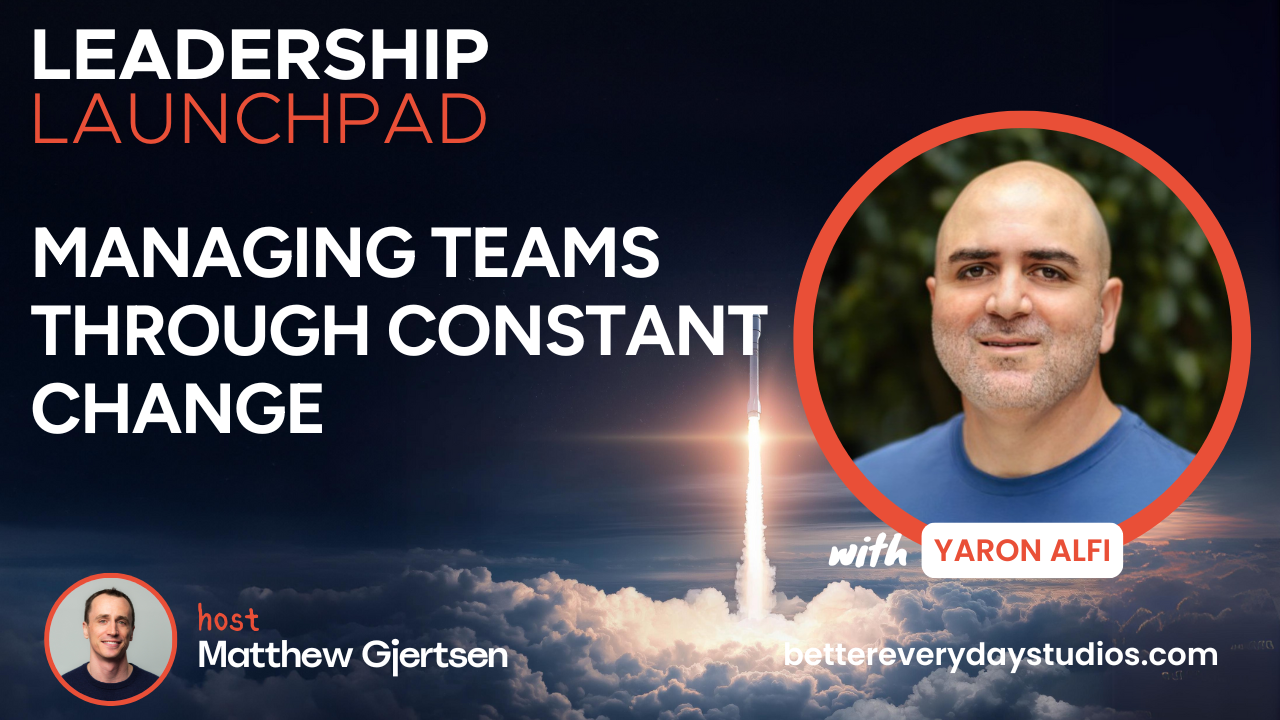
In this episode, Yaron Alfi, co-founder and CEO of Magenta, discusses his experiences in software and manufacturing at companies like SpaceX and ABL Space Systems. He explains why legacy software can be a limiting factor in manufacturing, the importance of building tailored software solutions, and how Magenta is leveraging AI to streamline manufacturing workflows. Yaron also shares leadership lessons from his time at SpaceX, his approach to building and scaling teams, and the value of trust in both formal and informal leadership roles. The conversation covers challenges in hiring for software roles, managing change, and providing effective support to technical teams in high-pressure environments.
 Automated Transcription
Yaron Alfi [00:00:00]:
There's a lot of pressure on the ic, sometimes in demands and figuring out something that may not necessarily exist yet. So it's giving them the air cover where they don't have to like worry about any sort of repercussions if something bad happened.
Matt Gjertsen [00:00:34]:
Hello and welcome to the Leadership Launchpad. I am so excited you are here with me today because I know we are about to have an amazing conversation with our guest today, Jeroen Alfie. Jeroen is the co founder and CEO of Magenta, a company started with a simple belief that busy work should never get in the way of innovation. Yaron started his career as a quality engineer at Parker aerospace and in 2013 he left Parker to join SpaceX to become what is now called a build reliability engineer. From 2013 to 2015, he was working the night shift supporting the production of just about every SpaceX component from Falcon to Dragon, avionics to composites and propulsion. This experience gave him a great view of the entire manufacturing system, which is why he transitioned into the role of lead product manager for manufacturing systems. This is when I got to meet Jeroen while he was helping to build some of the key components of what those in the industry know as Warp Drive, the internally built software system that SpaceX uses to control just about all aspects of their internal operations, but especially manufacturing. In 2021, Jerome left SpaceX to join ABL Space Systems, where he set out to do the same thing he did at SpaceX, just do it better and faster.
Matt Gjertsen [00:01:56]:
Build software that could help companies be more help the company be more productive. And despite some amazing efforts at abl, they ran into some struggles and laid off most of their staff in 2024, which meant your own had to decide what to do next. At the beginning of 2025, magenta is what he landed on. He and his co founders are working from the ground up to build AI systems for manufacturing workflows with the goal of allowing American manufacturing to scale faster and not be limited by traditional software solutions. In today's discussion, we're going to get Jaron's take on why software seems to be such a limiting factor for manufacturing, what leadership lessons he took from SpaceX, how he went about building his own team at ABL, and of course as a product manager. We're going to make sure to talk about informal leadership roles and how to be effective without explicit authority before we get into the discussion. If this sounds like an exciting conversation and you're not already subscribed to the show, please make sure you subscribe so you never miss a future episode. And if there's somebody in your life who you think should listen to this conversation, I would humbly appreciate it if you would share this show with them because that is how we grow.
Matt Gjertsen [00:03:12]:
So with that, let's get into the discussion. Your own. How are you doing today?
Yaron Alfi [00:03:18]:
Doing well, Matt, thanks for having me. Really excited about this.
Matt Gjertsen [00:03:22]:
Yeah, I'm really excited to chat with you, especially like I mentioned, to get your take on this, because I, I gotta say, it's funny, when I talk to people who are outside the industry or people who haven't spent a lot of time in aerospace in particular, they're always surprised at how many hardware manufacturing companies spend a ton of resources building software. We mentioned Warp Drive. You were obviously doing this at abl. Stokespace is building their. Has built their own system. Like so many of these companies have to build it themselves. And so I have to start with the question of why, like, why is it that software ends up being such a limiting factor for manufacturing?
Yaron Alfi [00:04:02]:
I think that's a great question. When you look at a lot of the legacy pieces of software that are out there, a lot of them have a bajillion customers. Over time just continue to expand their product line to support all of those. And in doing that, they continue to bolt on features and functionality and it becomes harder and harder over time, especially when you have all those people using it to effectively make rapid change and keep up with the times. So generally when you look at legacy software and so like your big box solutions, generally the things that people find problematic with it are the ux, potentially it's slow, and I think ultimately how well it actually supports your processes. And I would say processes and workflows, to me, when it comes to manufacturing, software are the most important thing.
Matt Gjertsen [00:05:05]:
Yeah.
Yaron Alfi [00:05:05]:
And a big reason why companies have decided to go through and build software is the only way to actually ensure. At least that was the thought. The only way to actually ensure that it meets your process and needs is to have full control over it. I think a lot of that's shifting now.
Matt Gjertsen [00:05:24]:
Yeah, I'm really interested because I see the exact same thing in the HR space as well. It's the same kind of thing with manufacturing as you have all these really big players that have really big systems. And you know, I, I remember I was being really surprised. Like one, one of the biggest players in hris is a company called Workday. And you know, tons of enterprise companies, you know, Fortune 500 companies use them. And I remember at a company I was working at previously we were implementing workday and I was really surprised that there was never, there was no guidance on like, this is how you should use workday. Right. This is the best way to get things done.
Matt Gjertsen [00:06:02]:
They, they were simply making a system that could be used however you wanted to use it. And so that, that then meant one, we had to figure out how we wanted to use it. But to that, as you said, like, it just ultimately means that, yeah, the system has a bajillion different things that you can change or you can tweak. And this is what ultimately led my decision when, when I started talking to a lot of learning management system providers, specifically whenever I would ask them, can your system do this? If they said we can build that for you? I was out. I was like, no, because that means no, because you don't have like a thesis for what a good learning management system is. You're just building whatever software features people want. So it sounds like that's kind of part of the heart of this problem of what makes it so difficult.
Yaron Alfi [00:06:52]:
And I think you bring up a good point there. And one thing is when a software, a software company says we could build that for you versus the person that you're talking to on the other end having a deep understanding of the problem that you talked about. Yes, because I could be. I, there's plenty of times that I look in the past, look in the past where there are features or functionalities in the system that didn't exist. But I knew absolutely well that like it was going to be no problem for my team to build it. And I think that's the struggle that I see is it's a lot of these solutions don't necessarily have a deep understanding of their customers problems.
Matt Gjertsen [00:07:32]:
That makes sense. That makes sense. And it's to bring this to what you're working on right now with Magenta. You know, there's, there's a lot, there's actually quite a few companies out there right now that are trying to like, I guess like make the next generation of erp. But you're doing something a little bit different at Magenta, is that right? Yep.
Yaron Alfi [00:07:50]:
A big thing that we noticed as we scanned the market, there's a lot of companies that already have software stacks set up and their software that they like, their software that they don't like, whatever that might be. What we're noticing is that a lot of companies regardless have multiple pieces of software, which means data exists in multiple locations. And really what we have become as like engineers and workers, employees is taking information from one System, assessing it, taking information from another system, assessing it, compiling that like looking for differences, all the tasks that you do with data, synthesizing it and then taking action on it. And our. As AI has started to develop and become what it is today with the, with the foundation models or LLMs, there's a lot of stuff that we're. You mix this new technology that unlocks a ton of functionality that's possible now with deep understanding of these workflows and the pain that some of these manufacturers have to go through with navigating these different pieces of software that gives us the ability to build AI agents that understand workflows that could, that are, that are nimble enough to deal with like minor variation and in some cases pretty, pretty drastic variation.
Matt Gjertsen [00:09:15]:
Yeah.
Yaron Alfi [00:09:16]:
And ultimately help and assist engineers like you said before, to focus on, on innovating versus busy work.
Matt Gjertsen [00:09:26]:
Because the experience that I've seen with this kind of thing was pre the AI revolution and it was. A friend of mine actually started a company on the HRIS side because he saw the same thing and built, just building direct integrations. I think that's the traditional way to handle the fact that you have data in one system, data in another system, and you kind of purpose built pipelines between those two systems. I'm assuming the, the hope, the expectation is that AI does that, but it doesn't have to be purpose built. It's much more just you just release it on the system. Am I understanding that correctly?
Yaron Alfi [00:10:03]:
Yeah. So a big part of Magenta are connectors, like being able to connect into systems. But even if you don't have, even if there isn't a connector built yet, a lot of people in manufacturing are still using Excel spreadsheets to do stuff. It may not be they're not managing their ERP somewhere, but, but the fact that you could even deal with unstructured data that's not necessarily in a system is also pretty huge.
Matt Gjertsen [00:10:35]:
Got it.
Yaron Alfi [00:10:35]:
So there's companies that we're talking to that, that are able to see value out of what we're building that don't even necessarily have robust system set up. And then there's, there's companies that do. And so basically it's building a tool that helps assist in doing tasks that traditionally it was a person had to do by just brute force. And so some workflows lend themselves better to others in, in that regards.
Matt Gjertsen [00:11:06]:
Yeah. Well, I hope, I'm hopeful that this is kind of the future of AI because I feel, I feel like so many fields I see it in learning you see it in manufacturing, you hear about all the time in doctor. In medicine, like doctors spend something like 70% of their time just like in inputting data and stuff. And yeah, I mean, if we've built up all this technology, but just like the interface, the human to technology interface is still so slow that it's taking all of our time just doing these, like, these little busy, as you said, the busy work. And so yeah, hopefully if we get rid of that, it just allows us to spend more time doing what we meant to do anyway, whether it's designing stuff, being a doctor, you know.
Yaron Alfi [00:11:50]:
You know, yeah, we, my co founders and I spent a bit of time just even understanding how AI affects us in the software world before we even started applying it to manufacturing. And the goal there was like, how do we become 4 or 5x more productive than we currently are? And there's a lot of interesting ways, and I'll probably share this in a series of posts about how I use AI in my daily life and how it's changed the way that I, that I work and how I use it as a tool. But a lot of that magic that the software industry has with AI, it's like figuring out how to bring some of that magic into, into manufacturing and hard tech.
Matt Gjertsen [00:12:34]:
Absolutely, absolutely. With that, that, that was. Thank you for letting us go down that, that dive there.
Yaron Alfi [00:12:39]:
Yeah.
Matt Gjertsen [00:12:40]:
I want to shift into more of kind of the management leadership aspect. And if we could just kind of start at the beginning. You know, your first formal leadership role was at SpaceX, which is a crucible in a lot of ways for a lot of people. What are some of the things you learned about leadership in a place like SpaceX?
Yaron Alfi [00:13:01]:
Yeah, there's a, you know, there's an element of SpaceX that was like, you know, controlled chaos. There was just a lot going on. When you talk about prioritization, just team sizes, like the, the just like the criticality of stuff, there's a lot to be aside from like when you go into management just as an individual in a company like that, there's just, there's just like a lot to balance, which was cool. You have a lot of people and you're seeing this with all the folks at SpaceX that have started their own companies and there's this like diaspora of, of, of SpaceXers that are just building the new wave of technology in LA and other parts of the other parts of the country. And it's just like the lessons that it teaches you. It's like you can't spend way too much time on a project because there's too much stuff to do. But you also can't necessarily do a poor job on that project because no one's going to trust you to do another project. And, and then you're also surrounded by a lot of young, hungry, like folks that are willing to work literally every hour, every minute of the day.
Yaron Alfi [00:14:16]:
And even though I wouldn't say that it's, it was negatively competitive, but you, there was always someone and like lots of people working much harder than you. And that was like very inspiring. And it just made people want to do more and get more done and innovate.
Matt Gjertsen [00:14:35]:
There's two pieces of that that I'd love to dive into and the first one is that idea of, of constant change because I was asked to do a talk on this about a month ago. In a couple weeks I'm doing another one. And it's specifically about the topic of leading in times of change and managing in times of change because I think historically at a lot of organizations, you know, we're just used to a slower pace of things. And a big part of your role as a manager is to kind of keep some continuity, make people feel comfortable, make sure you, you absorb the change of the information coming in and pass to your folks. And I think now the rest of the world, whether it's because of AI, because of the economy, because of just technology in general, they're getting a little taste of the way it's been at companies like SpaceX and others, you know, and you know, for, for a long time where it's just like constant change. How did you think about, you know, like, like from a prioritization perspective. As an example, as a manager at SpaceX, how did you think about that with your team of when there are constantly changing priorities, did you have to work with people who keep them from freaking out, keep em from stressing out? I don't know. What, how did you approach that with your team?
Yaron Alfi [00:15:46]:
Yeah, I would say that that's a good point. And yeah, it's being a manager, it's providing the right amount of air cover for your, for your team and it's. Yeah, especially for folks that are. There's a lot of pressure on the IC sometimes in demands and figuring out something that may not necessarily exist yet. So it's giving them the air cover where they don't have to like worry about any sort of repercussions if something bad happened or there, there are plenty of examples where you know, someone on the team made an update and to the system and it caused problems and brought the system down. And I think again, it's like giving the air cover, having their back, not throwing teammates or other folks on the team under the bus when things like that happen, because that just adds to the stress. Yeah, it's more of. As a manager, I feel like sometimes it is your job to be the punching bag to external teams and it's hard.
Yaron Alfi [00:16:51]:
Like, a lot of people don't want to do that, A lot of people are afraid to do that. But that is literally your job as a manager is to support your team and be there for them. And so I, I think in a world of constant change, a lot of things could get broken. Your team might be at the center of an outage or something like that, but as a manager, you really have to support them.
Matt Gjertsen [00:17:13]:
I love that because it, it does recognize it kind of brings a new responsibility. The, the, the main. I, I would agree with everything that you just said, that that's kind of always a manager's job is to provide that top cover. But in a comp, when there is less change or when change isn't being as demanded, maybe it's not as critical of a function where in any organization, if you want high change, yeah. There's going to be higher chances, higher risk. And so if you want people to perform, then a manager needs to provide that protection. That makes sense.
Yaron Alfi [00:17:47]:
Yeah, I would say to add to that, you know, and I think on the other end, it's after, let's say, an incident like that happens, it's also the manager's job to figure out why that happened and ensure it doesn't happen again. And sure, we'll get into other topics on that through this podcast, but there's a, there's a lot of. I always felt that, I felt as a manager, it's one, you're managing people, but you're also managing like your portion of the company, your portion of deliverables for the mission. So it's, there's that dual purpose. It's not just management you're also responsible for delivering, whether it's a product, whether it's software, whether it's any sort of function to the organization.
Matt Gjertsen [00:18:29]:
Yeah, yeah. The other item that you brought up about kind of management at SpaceX was about this idea of competitiveness. And I always found it interesting because in the, When I was in the military, I was always surprised because the military, the competition between members is extremely explicit because you go, there are promotion boards, you know who's going to the promotion board. There are School boards, you know, and you know exactly who it is. And there's so many slots. Some people get them, some people don't. And yet somehow there's not a lot of poisonous competition between people. And I think there's a few reasons for that that are specific to the military, some of them good, some of them bad.
Matt Gjertsen [00:19:13]:
But it, it's not there. I think in, in the corporate world it's much less explicit, but it clearly is still there. And I think it, but despite that there tends to be more of that like poisonous competition. But you, you said that that isn't what. There was lots of competition, but it was generally productive competition. Is that, was that natural to the people who were there or do you, did you do, was there anything that you did to try to promote that?
Yaron Alfi [00:19:48]:
Yeah, I just think back, it's. You're just surrounded by a lot of action oriented people that are there to solve problems, that love space. And I, I think it was more of. Yeah, it's just more that the default was everybody just wanted to get stuff done as, as fast as possible.
Matt Gjertsen [00:20:08]:
Yeah.
Yaron Alfi [00:20:09]:
So it wasn't like. Yeah, I never felt this way. I'm. There's. Everyone has their experiences, but my experience working within the Build Reliability Org and within, within the, the software team was always like very much around people. People just wanted to solve problems.
Matt Gjertsen [00:20:27]:
Yeah. Just fostering that focus on the outcome.
Yaron Alfi [00:20:30]:
Yeah. And it's, you don't want to be the one not solving problems. So creates, it creates that kind of aura of a. Yeah. Positive competition.
Matt Gjertsen [00:20:38]:
But I mean it really, it highlights the importance of alignment in terms of like what you're talking about and drives what actually drives promotion. If you're promoting people who solve problems, then you'll want people to solve problems or then people will want to solve problems. If you're promoting people because they go to lunch with the CEO or they have a personal connection, then then that's what you're gonna, that's what you're gonna get. And so it's just, you know, aligning.
Yaron Alfi [00:21:02]:
With that and SpaceX in general was good about like not rewarding those behaviors.
Matt Gjertsen [00:21:09]:
Yeah, yeah, yeah, that makes sense. You grew as a leader at SpaceX, you then went to ABL and in ABL you got the started from zero, you know, like, like there wasn't a software team or much or much of one in place. I believe you, you just kind of built your own team from scratch. What, how did you start thinking about that when you, when you went there? How'd that go?
Yaron Alfi [00:21:31]:
Yeah, so there There was a software team but they were pretty stretched stretch thin. One of my co founders, Dave Wilson was leading the effort before I joined but they. It was a very ambitious project. Yeah, building, building an ERP system. MES system ABL also built telemetry software and ground control software. So it was very ambitious and the team was not sized correctly for that. Yeah, so a big part of a part of my role when I joined was help steer the. Primarily on the ERP MES side.
Yaron Alfi [00:22:08]:
Help steer that to, to support the goals of the company.
Matt Gjertsen [00:22:12]:
Can you define those two terms for anybody who's not familiar with them?
Yaron Alfi [00:22:15]:
Yes, sorry about that. So ERP is Enterprise Resource Planning. So that's your system that handles all financial transactions like master records, purchase orders, all that type of stuff. Mrp which helps balance supply and demand. So you know what you need to order, what you have in stock, what's being demanded. So that's material requirements planning and then MES is a manufacturing execution system. So that's the system that has all your work instructions that engineers write but then technicians and folks out in the shop go through and execute and does the record of the work being done.
Matt Gjertsen [00:22:55]:
Yeah.
Yaron Alfi [00:22:58]:
Yeah, yeah. Figuring out where the gaps were. How do we introduce necessary process to make sure that we're not releasing updates that cause. Cause outages. Putting together basically like a service level agreements or SLAs with the rest of the company to make sure hey, if this problem happens or if, if a bug is found or an enhancement requested, what is the contract between us on. On when those things get fixed? Because it's like these systems like this is what people are using every day in these companies. So yeah it could be and when I was on the user side of these systems back when I was at Parker and early at SpaceX, it's. It could be really frustrating using a system that doesn't actually help you that creates more roadblocks than actual, than actually paves paths for you.
Yaron Alfi [00:23:47]:
So yes, it was great and we basically built the team up. I think initially it was like seven. I'm trying to think like across all of those. The software that I mentioned it was six or seven people and we built it up to 17 or 18.
Matt Gjertsen [00:24:03]:
Any. What were some of the biggest challenges you had in, in scaling that was it. Was there anything that sticks out in your mind?
Yaron Alfi [00:24:10]:
Yeah.
Matt Gjertsen [00:24:12]:
From a technical perspective but more.
Yaron Alfi [00:24:13]:
Yeah, hiring and interviewing is. Could be elusive sometimes. Like it's. I like referrals and I think some people see referrals as like nepotism or something. I See referrals as hey, like one, it's like I have a trusted relationship with this person. Like we've worked on projects, I've spent thousands of hours doing stuff with this person. We know how to have discourse and disagreements and like we, we know how to resolve that. Right.
Yaron Alfi [00:24:46]:
I think the other thing is when you have other folks on your team referring people, it's like there's a sense of like responsibility when you refer someone, if that person does great, cheers you on and are like, wow, you brought an all star to the team. If you bring someone that creates more work for people then so that, that stuff is known and seen. But yeah, I mean it's challenging. Some roles are easier to hire than others. Other ones are also difficult. Software has its, has its challenges with hiring. There's also convincing an organization because like the average salary for a software engineer is higher than the average salary for a hardware engineer. So it's like how do you prove to leadership and justify that it's even to other people like in the organization, like company overall, knowing that.
Yaron Alfi [00:25:36]:
So yeah, there's a lot of challenges finding the right skill sets, making sure that you set that person up for success, setting expectations and yeah, yeah, yeah.
Matt Gjertsen [00:25:45]:
Hiring is such a, a key component. Out of curiosity, since you, since you specifically call it out, like what is it that's more challenging about hiring software or what is a particular challenge about hiring in software?
Yaron Alfi [00:25:59]:
In hiring software, you said yeah, yeah.
Matt Gjertsen [00:26:01]:
Hiring in like hiring a software engineer. What's a particular challenge about that?
Yaron Alfi [00:26:05]:
I think the challenge that I generally have and it's like I'm, I always, when I build software I always see it through the user's eyes like the person using the, the software. And it's finding software engineers that, that share that goal that are.
Matt Gjertsen [00:26:23]:
Yeah.
Yaron Alfi [00:26:24]:
The only thing that ultimately matters is that the person using your software actually receives benefit from your software. There are a lot of, and this is just every technical field, there's people that care about things being technically perfect. They care about. They don't want to ship something that's like half done, even if that half is the half that we need right now. So it's finding engineers. And again this isn't just software engineering. It's finding, finding engineers that understand where on the pendulum you need a swing with completeness, quality. And that was a thing that I do feel SpaceX helped ingrain in anybody that worked there.
Yaron Alfi [00:27:04]:
Yeah, it's being able to make those calculations and but yeah, I'd say that's the hardest part because it's Everyone gets into their field for various reasons and stuff like that and it's. Some people want to optimize this one thing but it's. Yeah. I generally liked hiring full stack software engineers because I wanted them to own the solution that they're building from different angles of software development.
Matt Gjertsen [00:27:26]:
Yeah, that, that really resonates with me even from the non technical fields. You know, when I think about hiring at better everyday studios or just hiring in general at a. In, in talent development, I'm always looking for people who at some point in their career had experience out in the business because I, I need them to remember like we're here to support the business like it does. Like we don't make learning for learning's sake. We make learning that helps the business in some way. And yeah, it's a. Having somebody with that lens is always. Is.
Matt Gjertsen [00:27:57]:
It can be tricky to find sometimes.
Yaron Alfi [00:27:59]:
Yeah. The unfortunate way to find who's there for those reasons are when there is a problem or an outage, it's who's there working on it, who. Who's not going to bed until they figure it out. Yeah, like who stays up till four in the morning versus who, who goes to bed and just lets the problem linger.
Matt Gjertsen [00:28:19]:
Highlighting exactly why I like to stay on the learning side of the fence. Because problems in learning don't require that kind of stuff generally.
Yaron Alfi [00:28:27]:
The thing is with software it's just like if you have an outage, it's just like it's.
Matt Gjertsen [00:28:31]:
Yes, it's critical.
Yaron Alfi [00:28:32]:
Yeah. Especially at SpaceX, you don't want to, you don't want to be at the center of an outage there.
Matt Gjertsen [00:28:36]:
Yeah, absolutely. Well, speaking then I want to zoom out a little bit to a different kind of take on management because since you've spent all your time as, you know, a product manager as well, like I do think it's really important to remember that like there's a lot of manager roles out there where you have a lot of stakeholders and you have explicit control over your team, but there's all these other people that you have to manage and you don't have clear control over them. You need to. Probably, probably. There's plenty of times I'm betting where there's been two parties, they want different things and you're the one that's kind of ultimately choosing. We're building the software to support this one, not that one. And you got to figure out that relationship. So how do you navigate this? You know, I think it's often called, it's.
Matt Gjertsen [00:29:22]:
In this case, it's probably more than informal leadership, but it's certainly not explicit leadership.
Yaron Alfi [00:29:27]:
Yeah, I've always been in this role of implicit leadership, you know, whatever the term is there. When I was at Parker Hanifin I had a role where I would be sent out to some divisions that had some struggles, whether it was on time, delivery, and then, then I was told that I couldn't really come back home until those were resolved and I'd be dropped into a place where I didn't really know anybody, no one had any reason to trust me, but I had to be able to accomplish this wild goal. Um, and obviously there was a team that I was working with and whatnot, but I literally had no authority. And so the way that I always work is, and it doesn't matter where I started, it was the same thing when I went to ABL when I was at SpaceX. It's, I like to work on projects with people for them to understand where I'm coming from, how I see the world, what my technical skill is. So it's, it's just because I'm a manager that doesn't mean I can't get my hands dirty and, and do the work. So I think it's really important for me to, for people to see that I could do the work. I think that helps a lot.
Yaron Alfi [00:30:40]:
But ultimately it is trust. It's when you leave a conversation with me and you tell me about this problem that you're having, do you actually think, are you confident that I'm going to take that information and do something with that? And so building that trust is very difficult. And it was hard at SpaceX like that meant, hey, when I was out at the launch site and a launch engineer was complaining about a fit up issue that I got on the phone with the design engineer, worked with them to update the drawing, release the drawing and then cut work orders to go and rework all those parts, there's trust that gets built there that, hey, when I say that I'm going to help you, I'm actually going to help you and you have to do a lot of those things. And fortunately I just like solving problems. So it, there's like the, there's the overlap of I really like solving problems and apparently that helps build trust with, with people. And I'd say from implicit leadership that's the most important because you have zero authority over that person. Yeah, maybe you could be the most charismatic like person and somehow convince people to, to, to want to follow you and listen to you. But I've seen that yeah, it exists.
Matt Gjertsen [00:31:50]:
Yeah.
Yaron Alfi [00:31:51]:
I'm gonna say I'm not. Like, I wouldn't consider myself the most charismatic person, but I think people know that when they work with me that I'm gonna follow up. There's tight feedback loops and I'll tell them if I don't know, and if I don't, then I'll pull the right person into the picture and have them help.
Matt Gjertsen [00:32:07]:
Yeah. Yeah. That makes a lot of sense.
Yaron Alfi [00:32:09]:
Really?
Matt Gjertsen [00:32:11]:
Yeah. And again, bring this back to kind of the learning space sometimes. Yeah. Training people often feel like we're order takers. People come to us and be like, hey, I need a course, I need a course. And there's all this discussion of. In fact, a friend of mine just wrote a book that's like, how to Stop being an Order Taker. And my take on it always, if you want to stop being an order taker, you have to start by being really good at taking orders.
Matt Gjertsen [00:32:35]:
You have to be really good at solving people's problems, about listening to them, about giving them the solution. Even if maybe early in a relationship, what's the wrong solution? But it's the solution they want. So you do it. And then over time you build that relationship where you're trusted as somebody that can deliver, so then you get trusted as somebody who can talk to them and give them advice, and then that's how you build that relationship.
Yaron Alfi [00:32:56]:
It's just even like understanding. And it's like some of the times that I've been frustrated at work is when it's like I, I would explain something and the person on the other end either doesn't understand, doesn't ask the right questions to understand, and in some cases pretends to understand. And then something completely different happens. And it's like, where was the disconnect?
Matt Gjertsen [00:33:20]:
You know, I'm here, I'm seeing the myriad of TikToks and YouTube shorts I've seen of the quote unquote bad product manager, the like or the non technical product manager that just doesn't ask the right questions, as you said.
Yaron Alfi [00:33:34]:
Yeah, there, there's a whole other podcast we could have on that. But in, in short, it's like.
Matt Gjertsen [00:33:41]:
Product.
Yaron Alfi [00:33:41]:
Management has, in, in some software circles, has gotten bad rap because it's a, it's easy to not. It's a hard role. Like you don't go to school to become a product manager. And a lot of the great product managers that I've worked with, follow or have a lot of respect for have come from like non traditional backgrounds. Like, I didn't Grow up thinking I was going to be a product manager.
Matt Gjertsen [00:34:07]:
Yeah. You know that many people do.
Yaron Alfi [00:34:10]:
Yeah. And yeah, there's generally a really good story behind a great product manager. But it's a, it's a hard, it's a hard role to do really well.
Matt Gjertsen [00:34:17]:
Yeah. Yeah. This has been a fantastic discussion you're on. I mean from early on we were talking about like one of the key roles of a, of a manager just being. Providing that air cover. I think that's something that I see all the time and that. But even that, you know, it's funny because the conversation kind of went full circle. We started with that, this idea of providing air cover but really what that is, it's about what we just talked about.
Matt Gjertsen [00:34:38]:
It's about building those trusting relationships. And so I think it's just maybe whether the leadership is implicit or explicit, it just kind of changes what you're doing to build that trust. But ultimately you're building trust. So that's all fantastic. To kind of close, close things out. Simple question of if somebody's listening to this like, like who is the idea who should be reaching out to you to get more information about. About Magenta? What's like the ideal case and how do they reach out to you?
Yaron Alfi [00:35:05]:
Yeah. So basically anyone that's manufacturing stuff, we like working with builders and we want to make it very easy for people to. To build stuff because it's unnecessarily difficult. I think any type of company ranging from a startup to a company that has full on production line set up and yeah and I think the area where Magenta actually really is starting to shine is on helping with change management with design changes. Nice. Understanding. Understanding the differences between those variations and setting up agents to create a. Create cross checks on.
Yaron Alfi [00:35:40]:
On various records to. To prevent things early in the process versus waiting till it's late. But at the end of the day it's a. We're looking to help builders, not necessarily for focused on aerospace. Yeah.
Matt Gjertsen [00:35:56]:
Perfect. Awesome. Well, this has been fantastic. I'm sure people really get a lot out of it. Thank you so much for your time and I look forward to the next time we chat.
Yaron Alfi [00:36:05]:
Awesome. Thanks for having me.
Matt Gjertsen [00:36:06]:
Thank you so much for listening to today's show. If you are looking for help turning your organization's great engineers into great managers, me and my team at Better Everyday Studios would love to help we deliver targeted and interactive training workshops. They're designed to help build the three fundamental skills of any new manager. Building trust, giving feedback and setting goals. Reach out to me through matt better everydaystudios.com so we can start making your organization better every day.


