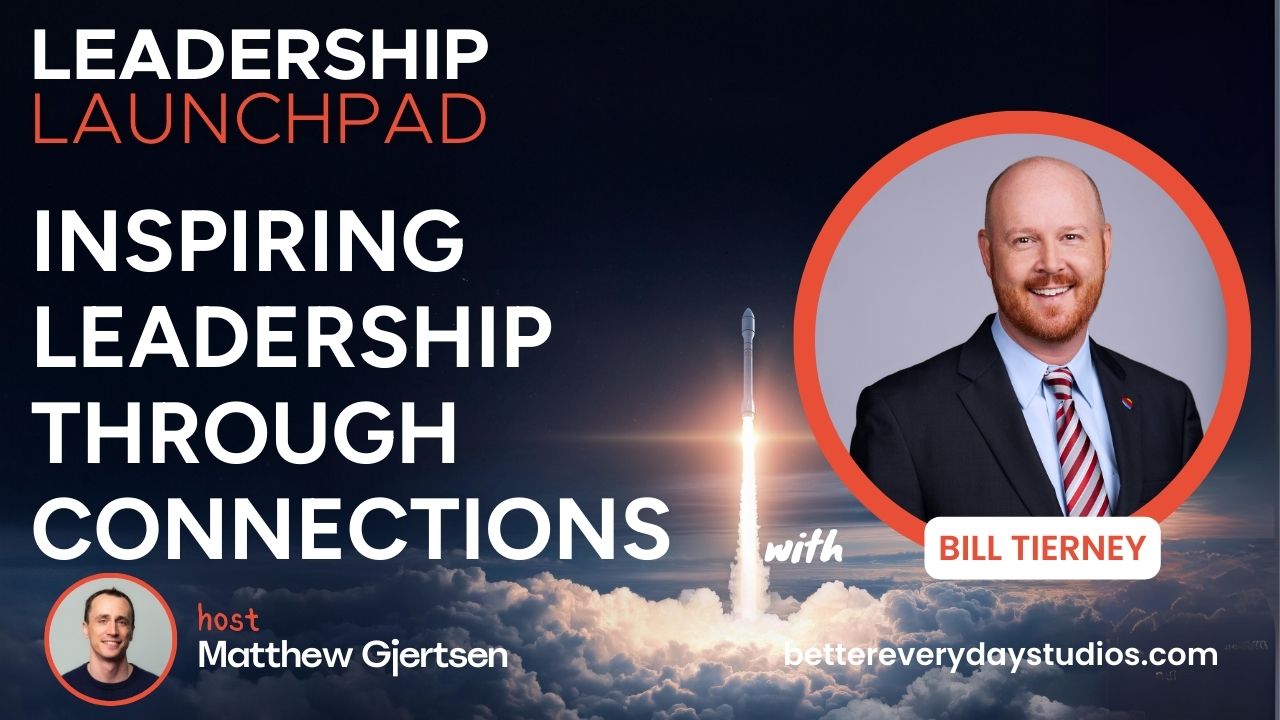
Episode Description
Welcome to the Leadership Launchpad! In this episode, I sit down with Bill Tierney, the Vice President of Customer Experience and Digital Experience at Southwest Airlines. We dive into the evolution of leadership skills, the power of communication, and bridging the gap between headquarters and frontline employees. Bill shares his journey at Southwest, revealing the intricacies of using data to drive actionable decisions and emphasizing the importance of local expertise.
Join us as we explore how to create an environment where employees thrive, the art of constructive dialogue, and the practice of "going to the gemba." Plus, we discuss the significance of understanding the customer's intent and fostering a culture of radical transparency.
Connect with Bill: https://www.linkedin.com/in/williamtierney/
---
Want more tips on effective training? Sign-up for our weekly newsletter: https://www.bettereverydaystudios.com/newsletter
Visit us at https://www.bettereverydaystudios.com
 Automated Transcription
Bill Tierney [00:00:00]:
In our chief operations officers meeting, one of the regular pieces that they all listen to all of our operators intently is this section I call voice of the customer, and I'll read, you know, a couple very positive comments about what went well, and then I'll read a couple negative comments with opportunity. And they always tell me it's the most nervous part of the meeting, right? Nobody wants their group to get called out, but they all love it because it's direct feedback that they can take and apply into their business unit. And I always am moved by all the officers and how intent they are. People take it seriously. They take it personally. Well, people shouldn't go through that. What are we doing to make that better for people? So it's very powerful. And the commentary, to your point earlier, is probably more powerful than the data because it's a story and it's something that people can relate to.
Matt Gjertsen [00:00:52]:
Hello, and welcome to the Leadership Launchpad, where we help managers improve themselves, their teams, and their organizations. On this show, I talk with industry leaders, coaches, authors and experts to give you actionable insights that will help improve your own performance and the performance of those around you. Our guest today is Bill Tierney. Bill is the vice president of customer experience and digital experience at Southwest Airlines. From this role, he oversees the entire end to end physical and digital customer experience of Southwest with an eagerness to delight customers. His leadership focus is on advancing the best overall experience for their customers throughout their entire journey in both human and digital interactions. This was an absolutely amazing conversation, and at its core, it was really about how to use both data and individual stories to understand the true customer experience. In this discussion, you can expect to learn how to make sure the right people are making the right decisions in your organization.
Matt Gjertsen [00:02:02]:
The impact stories can have to give you context to your data, how organizations can create an environment where it is okay to talk about what went wrong, and so much more. Before we get into that discussion, I do want to remind you that if this is your first time listening to the show, make sure you subscribe so that you never miss a future episode. And if you are already subscribed, then I would humbly ask that you share this show with just one other person, because that, after all, is how we grow. I can't tell you how much that means to me. And so with that, let's get into the discussion with Bill Tierney. Bill, welcome to the Leadership Launchpad. How are you doing today?
Bill Tierney [00:02:46]:
Excellent. Thanks for having me. I'm excited about this.
Matt Gjertsen [00:02:49]:
Yeah, I'm really excited to have this. We've been chatting about this for quite a while, you're a very busy person, as expected, with your role. And, you know, since we first started chatting, one thing that I wanted to kind of start with, that we can't get into tons of specifics because Southwest has announced, honestly, what seems like one of the bigger changes of recent times, probably for the airline in, you've changed kind of how seating is done in planes. I know you can't speak specifically, but you are, you know, responsible for customer care, customer experience. And I know, at least according to the announcements, this was a very customer driven decision. And so I'm guessing a lot of the information, the data for that decision came out of your organization. And so what I'd love to kind of start with is a question of when it comes to making big decisions like that, how do you as a leader, think about gathering the data needed from your team in order for the company to make decisions like that?
Bill Tierney [00:03:48]:
Sure. Well, anything like that is definitely a cross functional effort with a lot of colleagues that you have close partnerships with, and it is customer led. Nearly everything we do is driven by customer data and insights. That's the way it's been since I've been here about 21 years, and the way it's been here for over 50 years. When I think back to the decisions we made, this is one of the bigger ones. And, yes, you look into the research. You want to know how your different sort of customer segments feel about what you're delivering today. Have things evolved? And one thing that I'm very proud of is Southwest has always adapted, and we've always sought to listen to the customer, understand what they mean, and then take the action that's needed to be responsive, and that is data driven.
Bill Tierney [00:04:36]:
It's both qualitative and quantitative, and it's repetitive and it's iterative and it's refining. And so pulling that story together and working with several officers across the company, it's a fun exercise.
Matt Gjertsen [00:04:51]:
How does that process even start? You know, you mentioned it's repetitive and iterative. Do you start where you get kind of a hint of some kind of signal in the data and then you dive deeper? Was it, you know, I guess I always, especially for big changes like that, I always wonder how the momentums even get started for a big change like that.
Bill Tierney [00:05:12]:
Sure. Well, you're watching industry trends, for one thing, and then we survey our customers every day. So there's thousands of responses that are coming in, and you can identify friction points. And one of the things that I do is I look at open ended comments on a regular basis and try to get the context. I think that goes back to my days working in customer care and responding to inquiries from customers. They give you a pretty regular pulse, and then you sort of establish, I think you move from the inner loop of listening to the outer loop. You say, hey, is there something here? And has something changed industry wide with respect to people's preferences or even beyond the industry? I think coming out of the pandemic, there's a lot of different preferences for people. And so it was probably a time where several businesses were hyper focused on research and how they adapt and how they respond to evolving customer needs.
Bill Tierney [00:06:04]:
So it's a regular practice.
Matt Gjertsen [00:06:06]:
Yeah. It's interesting that you mentioned open comments. The first thing I think of when I think of analyzing data is I think of numbers and charts and the very hard numbers. What makes you start? Does that get, what do open comments give you that I don't know. Raw numbers don't give you?
Bill Tierney [00:06:28]:
Sure. Oh, they give context, which to me is always very important. And I think that that's, I'm a big believer that everyone's experience is unique, every employee's experience is unique. And without the context, I don't think you really know what to do. You can sort of identify, well, this issue or opportunity is a trend, but what is it that people want? What's the friction point? Or what's the opportunity to make it better? And by reading the comments, one, to be responsive to the customer immediately, you need to know what's going on. And I think to establish the pattern of what the opportunity really is that exists is through the context of the comments.
Matt Gjertsen [00:07:08]:
Interesting. Years ago, I remember about a study, and I wish I could go find it. I need to use chat, GPT or something to find this study from years ago where there was an elementary school that was really rigorous about data that they were collecting on all the students in order to improve how the teachers operated and when they started doing it, literally all of the data was collected on note cards and kept in, like, a closet. And so in order to do anything with it, the teachers would spend hours and hours in this closet, kind of like rifling through all these bits of data to kind of figure out what it all meant. And somebody came in and said, oh, we can clean this up. Let's automate this all. Let's put a system on it. Let's gather it all electronically.
Matt Gjertsen [00:07:52]:
And then with a snap of her fingers, we can create all these charts and know what to do. What they found the key thing of the study is that the most important thing about the data was actually the teachers themselves spending time immersed in the data. And so when you tried to automate it all, all the gains that they were getting in terms of improved outcomes went away because it was really, you had to kind of be in it to gather kind of. To your point, I think the context of it all, if you're just looking at charts, you don't have the context necessary to make informed decisions necessarily. And it sounds like that's. I mean. Cause I hear open comments, and I think that's gotta be kind of an immersive thing to really try to get insights from it.
Bill Tierney [00:08:45]:
It is, and I love your example. It makes me think of an example we have where we never had more data or more insights or more reporting, but you bring up a wonderful point that you first have to sort of synthesize it, and then you have to couple it with the expertise. So I love your example about the teacher. And the example I'll give to you is that we can run all the reports we want in headquarters about what our experience is like in Denver, in the airport. But one of the best people equipped to do anything with it, to make it actionable and to have a context of the why locally is the station manager there or station leader in Denver. And so our goal is to make the information digestible enough, but at the end of the day, the people who are going to take action have to be immersed in it. To your point, I think that's an excellent example.
Matt Gjertsen [00:09:37]:
Yeah, that's a really great point and really interesting, I'm sure, from your perspective. Yeah. You particularly have the ability to draw all this information from everywhere. And I think kind of what you're speaking of is, I hear this a lot in some of the conversations that we've had. We've had whole episodes on that disconnect between kind of the people on the ground and leadership of somewhere. There's just this lack of understanding of what's going on. And it sounds like for you, one of the ways you bridge that is you're gathering that data, you're helping create kind of the tools and the infrastructure to then feed back to the more. The closer to the frontline folks who can make potentially more relevant decisions.
Bill Tierney [00:10:19]:
Yes, and I think, you know, I'll use the example of sort of frontline and headquarters, because I think you're. You're hitting something exactly right. Headquarters is really a support function. That's the way that I view it.
Matt Gjertsen [00:10:31]:
I love that.
Bill Tierney [00:10:32]:
And you can see trends and patterns, which is nice, that's helpful. That can lead you to systemic solves. But the example we gave about the data being local as well as. One of my favorite things to do is station visits. As officers, we're each assigned airports that we adopt. And I do most of my learning. When I go to the airport and I'm standing at the ticket counter and they let me, you know, load the bags on the belt, or I go down to the break room and chat with our folks on the ramp, or they bring me out on the tarmac and show me, you know, the art of binstacking and loading a plane. The expertise for the actual business is always there.
Bill Tierney [00:11:12]:
It's always local. And those folks will tell you all kinds of things that then take the data and match it up with reality and you have the context you need. So there's the open ends, and then there's going to the gemba, as they say, the experts, and really learning from them.
Matt Gjertsen [00:11:27]:
Yeah, yeah, absolutely. Well, let's, let's step back a little bit because, you know, talking about the frontline stuff, you know, you've had quite the career at Southwest. How I'd love to kind of walk through that journey. So you started at the very front line of customer care, is that right? Kind of. How did you start at Southwest?
Bill Tierney [00:11:47]:
Yeah, it was customer relations at the time, and I was a writer. And as a writer, you would often correspond writing, but you would also correspond via phone. And sometimes you take inbound calls or sometimes you had a choice to respond to the customer by phone or letter. I often enjoyed chatting with the customer to the point we've been making about context and really understanding it, because sometimes there's degrees of separation in understanding what happened. And then from there I went into revenue management and pricing, where really learned the core business, this sort of traffic and revenue analytics and how we produce revenue as a company, and found that insightful and moved into marketing in a similar role. It was analytical, I guess analytics is sort of a home space for me. And then got to do a variety of different roles in marketing, branding, communications. I was the chief of staff for the CMO.
Bill Tierney [00:12:43]:
A lot of different roles. Marketing was a great place to work. And then more recently, I led the customer experience and digital teams, and then even more recently, I'm leading the customer experience and the data customer center of excellence team. So it's one of the many benefits of Southwest is you can move around and learn a lot.
Matt Gjertsen [00:13:03]:
Yeah. And honestly, that's not the kind of thing that you see at a lot of organizations these days, which is amazing when you, you know, thinking back to that kind of first jump, it's interesting. So you went from, you know, very, you're interfacing directly with the customer into a role where, as you put it, you kind of learned more about the bigger business of how we make money, which I feel like is almost like the two ends of the spectrum, like in a lot of companies. What did you learn from that jump? Is there anything in particular that you remember? Aha. Moments or things like, oh, that's why we do it this way? Once you learned the bigger picture about revenue generation, just how the business ran.
Bill Tierney [00:13:44]:
Yeah. Each stop has definitely filled in a piece in the puzzle for the bigger picture in customer relations. What I learned was the sort of core curriculum of who we are, what we stand for, and how we back it. And that gave me a sense of pride every time I responded to the customer, because we did what we'd say we do, and we'd had reasons, and they were good reasons. There were reasons for the customer or for the greater good. And so the core curriculum was learned there. I think the skill of sort of on your feet, quick decisions, assessing, listening, understanding, taking action, and then moving into revenue management. Yeah, there was the bigger picture of how we make money, but it was also very much in harmony with the brand that I learned in customer relations, the low fare brand, and our mission to democratize air travel.
Bill Tierney [00:14:36]:
And we would go into markets and people who were paying five or $600 to go between two northeast cities, you could now have $29 fares or $59 ferries. And we have a great example of that. Even recently, in the past five years, when we entered into Hawaii, I was not aware of how much it cost people to travel, enter island in Hawaii, and that they were so prohibitive, families couldn't even really see each other. Some had never been to the other islands. So we had the opportunity to go in there, and we had $49, $39, $29 fares, and it really enabled people, people to have human connection that didn't exist before. So when I was in revenue management, while it was certainly about optimizing revenue for the company, that was the job. You also always had that mission in mind with what we did and why we were in the market. So it was another piece of the puzzle that came into who we are.
Matt Gjertsen [00:15:35]:
Yeah, it's interesting segue. Since you brought up the flight to Hawaii, did you see, you probably didn't see this. It's probably like two in the weeds for you. But did you see the back and forth between Southwest X account and the CEO of Boom Supersonic a couple days ago.
Bill Tierney [00:15:52]:
I did not see that.
Matt Gjertsen [00:15:53]:
No, it was great because. So the CEO of Boom supersonic, he called. They were doing their fourth test flight of their plane, and he called out, hey, Southwest flight. Such and such, if you look to the right at this time, you might see our plane flying. And then, so your account or your company's account responded to him of like. It was. It was a good back and forth. It was.
Bill Tierney [00:16:18]:
We've got some talented people in that team, for sure.
Matt Gjertsen [00:16:20]:
Yeah, yeah, yeah. It was great. So when you're one thing, I'd be really interested because you mentioned how. So for you, starting at that front line, it really helped you understand the culture, the mission, the customer focus, which I think is always essential for a successful company. Like, you need as many employees as possible to understand who the customer is, how you are serving them, regardless of your role, how you know, and you can speak to this from a company perspective or even just for you as a leader perspective, what are some ways that you try to foster that in people who maybe don't start the way you did with that direct customer interface to help them understand who the customer is and how you're serving them?
Bill Tierney [00:17:10]:
Sure. Well, there's the data itself as a starting point sometimes for folks coming into one of these disciplines without the frontline experience. But I often encourage them to go sit with these teams, to go sit in reality or to go do a station visit. And there's certainly knowing our customers, but then also keeping in mind their intent of travel. And when you have 500,000 people every day that you're transporting, and you step back and think every one of them is going somewhere for a reason, and it's important, that's why they're traveling. And that could be for an event like a wedding, it could be for a sad event like a funeral. It could be for a business meeting. It could be for a vacation that people have saved up for years, but every time they're traveling, there is an important purpose.
Bill Tierney [00:18:00]:
And keeping that in mind, the sort of diversity of intent on our plane and how important it is for us to keep our promise and do everything we can to deliver to make sure they have a great experience and an on time experience in an industry where there's weather every day or there's ATC delays every day, and that customers trust us to do that, I think that's what I want my folks to know most as they're working on the experience is, hey, you know, traveling is high anxiety for a lot of people, and it's not always predictable. And so how do you take the friction out? How do you replace the unknowns with knowns? More importantly, how can you put people at ease, keep them connected if they want to be. If not, make sure they have a relaxing and a functional experience. But they all have different purposes and need to achieve different things. So it's not just sort of knowing our customer segments, I think, whether it's family or business or anyone else, but keeping in mind that everyone is traveling for a unique purpose that day and it's important. That's why they're traveling.
Matt Gjertsen [00:19:07]:
That's such a great point. And I think, yeah, if you can, again, it kind of goes back to what you talked about at the very beginning of this. It's like the difference between the data and the open comments. Yeah, we can see the customer trends, but behind all that is people with individual stories. And keeping that front and center is really essential.
Bill Tierney [00:19:27]:
Yeah, I'll tell you a quick story about that. I mentioned reading the open end comments in our chief operation officers meeting. So I'll go to our operations meeting and our commercial meeting every Monday. And one of the regular pieces that they all listen to all of our operators intently is this section I call voice of the customer. And I'll read a couple very positive comments about what went well. And then I'll read a couple negative comments with opportunity. And they always tell me it's the most nervous part of the meeting. Right.
Bill Tierney [00:19:57]:
Nobody wants their group to get called out, but they all love it because it's direct feedback that they can take and apply into their business unit. And I think the more that you can do that, and there's probably no better example than our CEO who responds to customers. Loves to know this came up. How did we handle it? Example of it, really immersing the feedback into the actual business. And I always am moved by all the officers and how intent they are. People take it seriously. They take it personally. Well, people shouldn't go through that.
Bill Tierney [00:20:32]:
What are we doing to make that better for people? So it's very powerful. And the commentary, to your point earlier, is probably more powerful than the data because it's a story and it's something that people can relate to.
Matt Gjertsen [00:20:44]:
Yeah, I love that you mentioned kind of the tension that can happen at the nerves of some of the senior leaders in that moment. Cause they don't want the bad story to be about, about their team. Is there anything in particular that is done or that has been done to create an environment where that's okay, where the leaders are able to kind of push through that nervousness and still wanna share the stories. Cause I can imagine kind of, especially when an initiative wants to get like that, wants to get started, leadership being like, I don't know, let's just. Let's not talk about that right now. We can. We can talk about that some other time. How does that.
Matt Gjertsen [00:21:20]:
How do you create that environment or keep that environment alive?
Bill Tierney [00:21:22]:
Well, it's. I credit the. The leadership of the company, the officers that I work for, my colleagues, because that's an environment we all participate in. We believe in radical transparency. And if your end mission is to be the best and be the best for the customer, we know that that feedback is truly a gift. So, you know, people are. No one likes to get called out or I think more than anything, it's just disappointment that we didn't come through in some of those cases. But a culture of fast failing, that's something I've certainly appreciated.
Bill Tierney [00:21:55]:
Working with the digital team, you have to test and learn, or we, as leaders, I know with your experience as well, you become a good leader, really, by failing, not necessarily by succeeding. And I think that's the environment we have, is, wow, that's just more opportunity. That means we can be that much better. And we've all been through it, so it's not, while it can be uncomfortable, it's not awkward, I guess, is the way I'd say it.
Matt Gjertsen [00:22:21]:
Yeah. Excellent. That's good. I think that's a good way to put it. Yeah, I like that. So as you going back kind of to your story, as you've been kind of growing in the company, you've obviously grown. I mean, I can only imagine kind of your span of control at this moment. What are some of the biggest things you've had to kind of improve about yourself as you've taken over these bigger teams, more diverse teams, in terms of what their responsibility is, how have you had to adjust as you've grown?
Bill Tierney [00:22:50]:
Sure. Constant learning. I mean, everything I've moved into, it's not as if I was an expert in that area. In the past year and a half, I've had to learn a lot about Wi Fi on the planes and the satellite system and everything else. And so you've got to be open to learning. You've got to be open to feedback. I keep this mind map. It's actually on my desk with me that an employee gave to me probably a decade ago.
Bill Tierney [00:23:19]:
I was doing what we call a skip level meeting where you meet with different employees, you don't get to see as often. And she had brought in this mind map from a class she took at our Southwest university. And it was all about trust at the center. And then there were these sort of spokes on it. And what she wanted me to know was that the commonality in the spokes was all about authenticity and leadership. And one, she was being very complimentary. But I also took it to heart of how important that is. I think a lot of people are taught that, well, you know, you can't be vulnerable or leaders need to know everything.
Bill Tierney [00:23:57]:
That's never been less true than it is now. I think you got to be able to connect with people, and so I think you've got to be able to learn. You've got to be open to feedback from, from your people who care about you, and then you've got to constantly improve how you communicate. And I will tell you this, I, even through college, it wasn't, it wasn't, it wasn't a strength of mine or desire to have the stage or to be the one talking. You know, I felt comfortable in a symposium, but to get up on a stage and give a speech was, was terrifying to me. And it was actually through feedback. We were doing these 360 surveys, and some of the feedback I got is people wanted more inspiration. They wanted me to get up and talk, and I knew I had to work on it.
Bill Tierney [00:24:43]:
And so I got a few different mentors who, you know, I thought were excellent speakers, learn some techniques. But at the end of the day, it comes back to just being yourself and being authentic, as, you know, with your podcast work and all the great work that you do. So I think the communication has been a constant focus, and it comes in so many different forms. As a leader, it comes in one on ones. Through the pandemic became more digital, connecting with a lot of different ways. It comes in speeches to hundreds and hundreds of people, and it comes in the moments when you pass them in the hall and you identify something is weighing on that person. Come on into my office for a few minutes. Let's have a chat.
Bill Tierney [00:25:27]:
It's a constant sort of assessment of trying to be in tune, I think, with your people, whether they report directly to you or you run into them on the aircraft when you're traveling. So communication, learning, being open to feedback and then improving communication would be three things, I think are a constant focus as you're changing your roles.
Matt Gjertsen [00:25:48]:
Yeah, that's interesting. And especially that communication piece, I think from your perspective as being part of that, kind of responsible for the company's communication as well. Obviously, it's a key part of your role, but when did I just be interested? When did that kind of inspirational piece kind of start to pop up in your career as a need, a skill that you needed to develop? Was it pretty early on or did it kind of come up a little bit later as you got into the more kind of higher level roles?
Bill Tierney [00:26:19]:
It came in later. I think it was honed early on. It's a very supportive environment.
Matt Gjertsen [00:26:25]:
Yeah.
Bill Tierney [00:26:26]:
And I've taken some of the practices that I was able to experience as an employee, and I put people in situations where they're going to have to do these things and they know I'm behind them. I want them to succeed. My folks, oftentimes when I do those skip levels and I do their sort of performance plan, one of the things I'll always ask them is, what strength are you going to amplify and what fear are you going to conquer? I need one of those, one each for everybody. And a lot of times that fear is public speaking. And so I said, well, you know what we're going to do about that? You're going to be running the next department meeting or this or that, and they feel the love and they feel people wanting them to win and getting around them and helping them prep, and so it becomes less about them being on the stage and more about them being supported by a community.
Matt Gjertsen [00:27:17]:
Yeah.
Bill Tierney [00:27:18]:
And for me, I think I had a couple experiences probably midway through the career where, well, I need to do this. This is something I need to work on. And so it's for them, not me. And so I need to do a really good job. I need to do a good job because they deserve a good job. And then, like anything else, it just sort of repeats. Right. And you find out it's just storytelling at the end of the day.
Bill Tierney [00:27:42]:
It's, how can you best tell a story and engage people, make it stick and leave them with something that they can use. It's not overly complicated, but probably came midway through the career and constantly honing it.
Matt Gjertsen [00:27:57]:
Yeah, yeah, yeah. It's interesting kind of how you put that in the middle there, that piece about, you know, pushing people and putting them kind of front and center of like, okay, this is the fear that you got to conquer. I think. I always think one of the things that is really important that sometimes people go down the wrong path on is it's not about making people feel comfortable. Right. Like, whether in, in my role in facilitation, right. Like, that's always, oh, we got to be careful. We don't want to push people too far.
Matt Gjertsen [00:28:23]:
No, it's not about making people feel comfortable. It's about creating a space where they're comfortable being uncomfortable.
Bill Tierney [00:28:31]:
Yes.
Matt Gjertsen [00:28:32]:
And that's all about how you set up that space, how you lead kind of your daily actions.
Bill Tierney [00:28:37]:
And that's become a more rare art, I think, in society today, having constructive conversation and dialogue, it's easy to have it when people agree with you on something, but to be able to have it when people disagree and have it be productive and respectful and constructive, I think, is something that probably necessarily, social media and all the technology has not necessarily benefited the fostering of that. So I appreciate what you're doing, and I think that's a very important discipline.
Matt Gjertsen [00:29:08]:
Yeah, for sure. Yeah. Well, this has been amazing. This has been a great conversation. Kind of to bring it to a close, if you're willing. Since you mentioned these questions that you ask your folks, you've had such an amazing career, what. What's next for you? Like, what strength are you amplifying and what fear are you trying to conquer right now?
Bill Tierney [00:29:28]:
Yeah. The strength I'm trying to amplify is around leadership. And, you know, in this industry, you go through ups and downs, and it's keeping people genuinely engaged and connected and informed and ensuring they know you care about them, they can trust you, and you're committed to excellence. Those three things. And to me, I'm always working on it, and I probably always feel like I'm failing it. I love leading people, and at night, I'm one of those people who, when the head hits the pillow, I start processing, and I'm thinking, oh, it was so and so's birthday. Okay, I covered that. I wonder how so and so's sister in law is doing, who's going through cancer.
Bill Tierney [00:30:10]:
And I'm at the point in my career where I worry far less about business initiatives or maybe what my leadership thinks of me or those kind of things, and worry a lot more about my people and the daily lives they have and understanding that this is a place that they spend a lot of time connected to and working and how are they doing. I think that motivates me for the most part. It's also. It's the strength I'm working on. It's also probably the fear that I have is that my folks might ever get the impression that I don't care about them or that I'm not interested in their development. And so I try to be very intentional about that on a regular basis. But of course, the more people you have, it's just harder to do. So it becomes more of, hey, every interaction you have, be intentional about it.
Matt Gjertsen [00:31:01]:
Yeah, I'm sure.
Bill Tierney [00:31:03]:
Yeah.
Matt Gjertsen [00:31:03]:
As that span of control increases, every interaction is all the more essential, I'm sure. Well, Bill, this has been, this has been a tremendous discussion. I really enjoyed it. I know you have. I'm sure especially for your organization. You have a lot of change that you're going to be working through over the, over the coming months. So I wish you the best of luck with that. As I mentioned before we started, I've been flying Southwest a lot lately and it's been great for me.
Matt Gjertsen [00:31:28]:
So thank you so much for that. And thank you so much for being on the show.
Bill Tierney [00:31:34]:
Well, we appreciate your loyalty. We don't take it for granted, and I appreciate the time today. It's been a lot of fun. Thanks for having me.
Matt Gjertsen [00:31:40]:
Absolutely. Thank you so much for listening to today's show. If you are looking for help turning your organization's great engineers into great managers, me and my team at better everyday studios would love to help. We deliver targeted and interactive training workshops that are designed to help build the three fundamental skills of any new manager, building trust, giving feedback, and setting goals. Reach out to me through Matt at better everydaystudios.com so we can start making your organization better every day.