
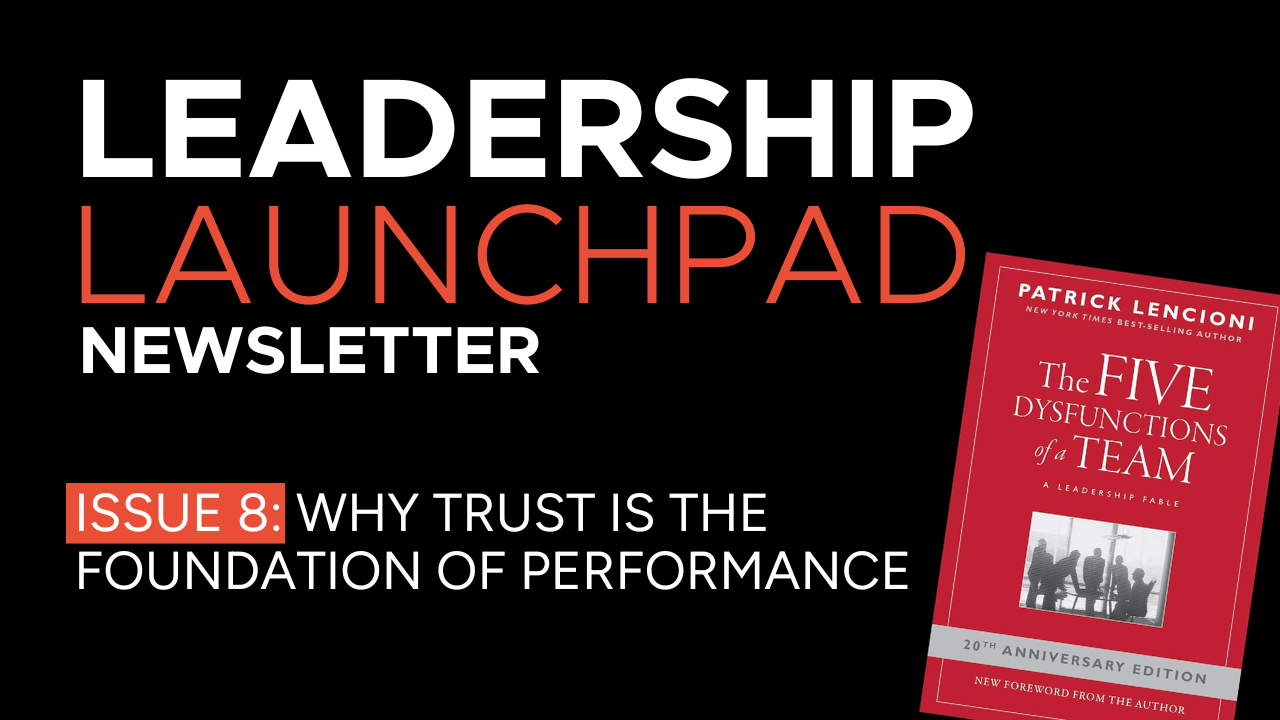
Every manager should read 5 Dysfunctions of a Team
I didn’t say that. That is what the vice president of software at a world leading aerospace company told me. He was getting ready to lead his team of managers through a day long off-site on the book and its teachings.
If you haven’t read it, 5 Dysfunctions of a Team by Patrick Lencioni tells the story of a corporate executive team that dramatically turns around company performance by working through each of five dysfunctions.
Patrick Lencioni isn’t the only person who believes trust is important. Amy Edmondson is a Harvard Researcher, author, and speaker who is famous for her work on psychological safety, a state of being that can’t exist on a team without trust. Similarly, Google’s Project Aristotle identified psychological safety as the number one fact determining team performance.
Why is this? Why is it that trust is so essential for a high performing team and how can building trust help your team?
Let me give you five potential answers to that question.
1. Less conflict
This is something that I have seen firsthand as a result of building trust on a team. When people are in trusting relationships, they likely know eachother better. They are more connected as people instead of just co-workers. This allows them to have much more empathy with one another and few arguments are the result.
2. More conflict
Not all conflict is bad. You may actually want conflict on your team as long as the conflict is about ideas and not about each other. Trust makes people more willing to voice dissenting opinions and debate topics without feeling like they are going to hurt someone’s feelings or be pushed out of the group.
3. More communication
Beyond debate on ideas, more trust will allow more communication in general. Without trust, people might worry how others will perceive their ideas or they might just not feel comfortable talking with those they don’t trust. This lack of information flow can slow your team down and increase the chances of bad decisions being made.
4. Less stress
This one specifically comes from people on your team feeling like you trust them. When people know you trust them, they don’t feel like you are always looking over their shoulder. They feel the freedom to do their work and know they can come to you if they are having problems. All leading to less stress for your whole team.
5. More collaboration
When people feel like they can share ideas, aren’t overly concerned with how they are perceived, and have strong bonds with their team members, they are much more likely to work together. This means they can support each other if someone is behind or needing back-up while they are away from work.
The bonus
For you as a manager, the bonus of all this is that you get more time. When a team doesn’t have trust, the manager tends to act as the hub, connecting all the spokes of the wheel. This means you are the limiting factor for your team. With trust, the team members just connect with one another, allowing the team to move faster.
Which is exactly what every manager should want.