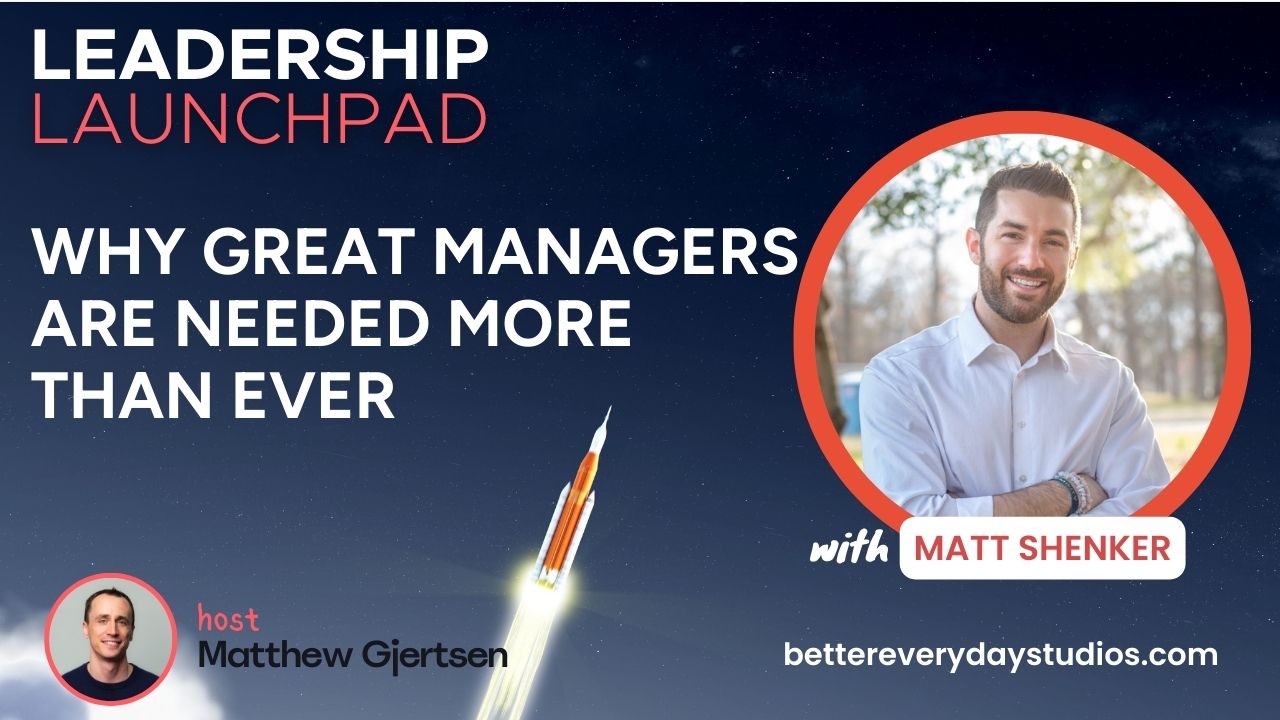
Episode Description
Ever wondered how to transform organizational culture from the ground up? My guest on today's episode of the Leadership Launchpad is here to help. Matt Shenker is a behavioral scientist and COO of Mattermore and today he shares his journey from a young therapist in schools to revolutionizing leadership development with AI and organizational psychology.
We'll delve into:
- How acknowledging trust debt and addressing resentments can foster effective learning.
- The limitations of traditional manager development processes and how AI can offer real-time insight and coaching.
- The importance of consistent leadership execution and basic principles over flashy new theories.
- The human need for connection, coherence, and contribution—and how leaders can support these needs.
Don't miss this insightful conversation that connects the dots between behavioral science, organizational psychology, and modern leadership. Tune in and start building a more engaged, supported, and productive team today.
Want practice developing your skills as a leader? Check out our Leadership Skill Accelerator sessions at www.bettereverydaystudios.com/accelerator.
Matt Shenker [00:00:00]:
At our core, as human beings, we are wired for three things that have been hardwired into the hardware of our nervous system through hundreds of thousands of years of evolution. And that is coherence, connection, and contribution. If you as a leader, are not clearly communicating what the purpose of business is and creating processes that allow people space to feel their experience and make sense of what they are doing, then ultimately you will overwhelm and burn them out. But that's the key. Oh, okay. And so then if you understand, if you take time to actually understand their identity, their story of who they are and what their core values are, what they actually say matters most to them, now, suddenly, work can be a place where they get to enact and express at least part of their hello, and.
Matt Gjertsen [00:00:52]:
Welcome to the leadership launchpad, where we are helping technical managers improve themselves, their teams, and their organizations. On this show, I talk with industry leaders, coaches, authors, and experts to help give you actual insights that will help improve your own performance and the performance of those around you. Our guest today is Matt Schenker. Matt is a behavioral scientist, licensed therapist, and the creator of the empowered well being and empowered leadership models. He is the COO and co founder of Mattermore, a company working on bringing work back to life with behavior, science, and AI. In today's episode, you can expect to learn what trust debt is, why modern leaders feel so overwhelmed, and the surprising truth that people need work today more than ever. Before we get into the discussion, I do want to remind you to make sure to use you subscribe to the show so you never miss a future episode. And if you are already subscribed, thank you.
Matt Gjertsen [00:01:55]:
And if I could ask you to share this show with just one other person, I can't tell you how much it would mean to me because that, after all, is how we grow. So with that out of the way, let's get into the discussion with Matt Schenker. Matt, welcome to the Leadership Launchpad. How are you doing today, Matt?
Matt Shenker [00:02:13]:
Hey, I'm good. It's good to see you. Always good to be with another mattress.
Matt Gjertsen [00:02:16]:
Always good to be with another mat and then to add a third mat to it. Your company is called Mattermore, is that correct?
Matt Shenker [00:02:23]:
Mattermore, that's right.
Matt Gjertsen [00:02:25]:
I love it. A lot of our discussion today, we already had a meeting before this. A lot of our discussion is going to be around the technology that you're doing and how the technology is applying to leadership. But before we get to that, just so people have a frame of reference, could you give a brief description of kind of Mattermore what it is, what you're trying to do with it.
Matt Shenker [00:02:48]:
Yeah. So at Mattermore, we're working to bring work back to life. So the way that we think about it is we are innovators in the learning and development space. We are here to empower people and structures and systems that anchor the way that people live their lives. Other than when people are spending time alone, the number one place that the modern human spends their time is at work. We have a public health crisis. People are the most depressed, lonely and stressed that the planet has ever seen. A big piece of that is because we're not designing and allocating our resources well, we are the richest people that the planet has ever seen, but that richness is not evenly distributed.
Matt Shenker [00:03:35]:
And so what we see in our workplaces is these rates of burnout that we're seeing across industries is a design problem. It's showcasing the gap in skills that we're missing. And so at Mattermore, we're using the latest technologies. We're experimenting with a few different things that we do with AI. But the core of it is that we work with companies to identify what their learning and development manager, support manager, onboarding needs are. And then we build people, operations, infrastructure. Our core product is a manager copilot that joins calls, like many of the note takers do, and then gives them personalized summaries and action items along with feedback. So I'm a behavior scientist.
Matt Shenker [00:04:22]:
We have a proprietary process for creating somebody's psychographic profile, what their values are, their leadership style, their skills, the skills that they want to cultivate. And then that roots into the feedback that they get in their one on ones and in their interactions with their employees. So we're trying to supercharge and augment management, and we're trying to transform and empower the workplace to be less destructive and more regenerative and sustainable. And none of that being fluffiness or just about coming in and talking about being nicer to people, all of it being about empowering people with scientific, scientifically rooted tools and data driven resources and technologies to help them get more work done and to empower their well being along the way.
Matt Gjertsen [00:05:14]:
I love it. I love that. I love especially that last part where you really focus in on this idea that it's not the fluffy stuff, it's the hard stuff, it's giving real practical things. And I think one of the main focuses how I'd love to start is because you started, I don't know, maybe saying you started fluffier is incorrect, but you did start with your career literally started with helping transform schools, public education, transforming schools. You moved into corporate leadership that for most people would feel pretty far away from anything to do with AI. So how did you make that shift from formal education, corporate education, corporate leadership development into AI?
Matt Shenker [00:06:01]:
Yeah, well, it's funny, because I actually. I'm not a fluffy guy. You won't find anybody throughout my life that really would have said, oh, you know what Matt's probably going to do? He's probably going to become a licensed therapist that's going to talk to people about their emotions. In fact, my very first year out of grad school, when I was working in a school and I had a private practice, I was working with clients. I was sitting in a meeting over the summer talking about something with a bunch of administrators, and one principal was running late, and I didn't recognize the name because she had gotten remarried. But she came in late, and it was my high school principal, and she came in late to the meeting, and she sat down at the table. She kind of glanced over at me, and then she looked again, and she said, matt Shanker, what the fuck are you doing here? It's funny, the way that I found myself in education was really because I got obsessed with behavior science and philosophy and psychology. And the deeper I went down that rabbit hole, the more I discovered how our systems aren't using the insights that we have cultivated in our society.
Matt Shenker [00:07:14]:
So a lot of people understand we've had a ridiculous rate of innovation when it comes to computer science, right? We've gone from typewriter to computer to Internet to AI in about 80 years. We've had that same rate of innovation when it comes to the behavior science. The question of how we change behavior, how we effectively help people to learn or transform behaviors or perform sustainably at a high level, those aren't unanswered questions that we need to go get a bunch more researchers funding for so they can answer. We have decades worth of research that answers that question really well. It's not a knowledge gap problem. It's an implementation gap problem. In fact, when I was in grad school, I went to Finland, and I studied the education system over there, and I asked them, I was like, how did you guys transform from being near the bottom of the barrel in the eighties to consistently being in the top three education systems in the world? And they said it was really easy, actually. And what we did was we just listened to and cultivated and read and applied all of the research that was funded by and completed within the United States.
Matt Shenker [00:08:19]:
And so other people are using our research, are taking our greatest insights and implementing them into our systems. We're not doing a good job of doing that. And so when I started to walk into our schools, while I was just like absorbing all this information about behavior, science and psychology and studying, and really I was obsessed. I sort of felt the way that I imagined a surgeon would if we sent him back in time 200 years ago and he saw the way that people were doing surgery without washing their hands. They're just basic foundational things that have been well established within the literature, best practice, things to do and things not to do. And it's just not implemented in modern manager development, modern workplace learning and development, modern education curricula design, or even training of educators, even training of mental health professionals. It takes a long time for all those things to watershed into the systems and they haven't been implemented well. And so that's where my passion then got into, okay, I want to see if I can start to implement this, some of this into the schools.
Matt Shenker [00:09:25]:
And then while I was working in the schools, I discovered none of the teachers really cared what the young hotshot therapist guy thought the science said about what they should do differently.
Matt Gjertsen [00:09:38]:
Okay.
Matt Shenker [00:09:39]:
You know, it's kind of that thing like no one know, no one cares how much you know until they know how much you care. And there's also a piece of, like, you're one of the youngest people in the building and you're going to come in here, and I've been doing this for 20 years or 40 years or 60 years, and you're going to tell me what to do differently. What makes you think you know what's really going on here is because you've read a bunch of research papers and maybe worked with kids or with schools a few places. And so that's really where. Then I started to dive deep in the organizational psychology literature and really constructed an entire framework for transforming organizational culture. Because it wasn't about me being able to lecture one time about what the science says is best practice. That doesn't work. It's why when people go to a Tony Robbins style event and they're really jazzed up and excited and they have the most amazing week of their lives, when you check in with them three months later, most of them, their life isn't any different because that's not how we learn.
Matt Shenker [00:10:37]:
We learn in systemized ways through repetition. And so I actually had to figure out a how do I transform this organizational culture where these teachers want? They're actually coming to me, asking me questions about what they could do, where they're actually asking each other for help, where they're actually interested in learning, where there's a bit more trust and excitement here as opposed to a lot of just complaining, blaming, shaming and closed offedness. And that really is then what led me into this place where I then started working with lots of different schools and my best friends who I was living with, were sales managers. And then they started asking me questions about how they run their teams and then I started working with other teams and they kind of all spiraled into a business.
Matt Gjertsen [00:11:22]:
Yeah. So that's kind of the transition from the schools into the, into the corporate world. I love.
Matt Shenker [00:11:26]:
Exactly.
Matt Gjertsen [00:11:27]:
I gotta find that clip from earlier where you just, you kind of pause for a second. We're just like, the teachers don't really care. And then you paused. We gotta like just. But I loved how it was about they didn't care about what you were thinking, which is great because I think the fact that you were in a hostile ish environment forced you to bring more rigor to bear and really come up with, you know, a real, a real framework. And then that's I imagining what allowed you to have the success as you transition into the corporate world as well.
Matt Shenker [00:12:02]:
Yeah. And honestly, with, with schools, the problem was really that the teachers cared a lot and what they cared a lot about was all of the things that they felt everyone else wasn't paying enough attention to. Because that's what happens when you have an education system where, you know, a principal and an assistant principal are responsible for managing all of the teachers in the building and they maybe get two feedback sessions in a year and those teachers don't have a lot of other support and they're not getting consistent feedback and they're consistently having more things added to their list of responsibilities. And so becomes this pileup of stuff where it's like, before you talk to me about what we should be doing differently, I'm actually walking in immediately with the defensiveness because there's a whole bunch of stuff that you have piled up. There's a bunch of what I call trust debt here that we need to address. I need to know that you've acknowledged and that you see what I've been holding. And until you do that, I'm going to be defensive. And my defensiveness is that I'm trying to redirect the conversation to this stuff that you have forced me to hold back.
Matt Shenker [00:13:10]:
And so I had to understand that piece and figure out how do I show up in a place that acknowledges that. And then there was a place of actually showing up and calling forward a conversation. And this isn't, I've found this to be true, obviously, not just in schools. This is any organization. Most workers and modern day organizations are walking around and have some of that trust debt that they're carrying. And that's what comes up with change management. When changes are coming up, people are scared of change. They're frustrated about new things, but also any resentments that somebody's carrying about other processes of the old ways.
Matt Shenker [00:13:46]:
They're also caring and they want to be acknowledged. And so with any change, you have to acknowledge some of that stuff. You have to find some space for that to get acknowledged, and then you have to do this other piece. When I was working with schools, the line I would use was, I would say, look, if we are talking about disarming explosives or we're talking about designing rocket ships that we send to space, it is not okay to avoid having conversations about what the science says, best practices. So why is it okay when we're talking about the way that we design these systems that nurture and teach our children our most valuable resource in society, ultimately, that's what the workplace, too. We can't avoid these conversations about what the science says about effective learning, skill development, workplace collaboration and management.
Matt Gjertsen [00:14:40]:
Yep. Yep. Okay, so that makes sense that I love that point of just that whole arc of we don't know it all, but we know a lot, and there's a lot that we're not doing. A friend of mine commonly says, you know, specific, specifically talking about, you know, leaders. Really, we don't need whole new transformations. We don't need any new theories. What we need is consistent execution of the basics. Like, that's what she always talks about.
Matt Gjertsen [00:15:14]:
So, so that, that makes sense. So that's the school route moving into the business world. Where did, where did AI come into this?
Matt Shenker [00:15:22]:
Yeah, well, really it was, you know, there was a very clear problem and AI just happened to be the best technology for empowering the solution. So the problem is it has several layers, right? One, manager development is wildly outdated. We just haven't innovated the space with what the modern behavior science has shown us through the last few decades, widely enough throughout the market. And so most managers, when I talk to them, I've talked to thousands, I say, like, what kind of training did you get for your first role? Most of them, it's something like somebody sent me an email with like a Google Drive folder and said, like, read this stuff. And then they introd me through email with a bunch of people I was supposed to go meet and hop on calls with. And then maybe throughout the next couple weeks, they checked in on me and said, hey, how are things going on? Some version of that, basically. And so not shocking that managers kind of feel like they are lacking feedback and are really unsure of themselves, on average, for the first four to five years of their first role. And most managers I talk to, when I say, how long did it take you before you felt like you were really effective in your first role? Most of them say nine to 18 months.
Matt Shenker [00:16:35]:
And when I say, how did you figure it out? I found some of them. About a third in the data from my interviews, about a third had a mentor that they found, not that they were necessarily provided, but they had a mentor. About half of that third were provided a mentor, but the other half went and they found them somewhere, somehow. The others, it was basically a smorgage board of, like, I watched YouTube videos. I found these courses. Some of them maybe got reimbursed or partially funded by their company. And then occasionally some companies had some, you know, courses internally, some trainings internally. Very few people, only about 8% of the thousands that we interviewed, actually said that they felt like the in house trainings and resources were supremely helpful and useful and made good use of their time.
Matt Shenker [00:17:28]:
And so we have a massive fracture within our manager development system, across our industries. And so that's one problem. The other problem is the expectations of leadership have continued to explode through the last few decades because, again, work is the place we're spending so much of our time. And the world has changed so drastically through the last few decades. With social media, the smartphone, the Internet, things have been drastically changing with how we live our lives and workers continually year over year. According to Gallup's polls, through the last four years, the stress rates have gone higher and higher and higher. So who's the person that ends up being responsible for that? Our workplace leaders, because they're the ones responsible for making those people productive somehow. And then, of course, you've got through the last couple decades a big initiative around diversity, equity and inclusion, and like, these trainings that kind of show up and people say, all right, now you're expected to do some of this stuff differently.
Matt Shenker [00:18:31]:
And then managers are sitting there saying, well, wait a second, this is not what I was promoted being told I was going to do. And now what kind of trainings am I getting? Oh, you want me to watch some videos and, like, do some surveys? And then I'm going to sort of feel like I'm now walking on eggshells because I'm worried about making mistakes. And so there are these new initiatives that are popping up left and right without actual substantive, systematic change to how onboarding and ongoing development for managers and leaders goes. You have just the leadership development onboarding system being broken as a whole, the expectations continuing to rise. And we're seeing through the last two decades, spending on leadership development has continued to skyrocket, whereas satisfaction with leadership outcomes has continued to go down. So we're willing to spend on it. We're not doing the right stuff. So then, you know, about the nine years ago when I started working with corporations, I got really curious.
Matt Shenker [00:19:28]:
So I started asking a bunch of CEO's, chief people, officers, CROs, ctos, C suites, and I said, when you have professional development dollars to spend and you want to bring in a trainer, how do you decide what to spend money on? And they would say, well, I basically do this stuff because I like it, or I get a good feeling about somebody and I bring them in. Or sometimes it'd be like, I kind of use our engagement survey data, but not really because only about 40% of the people really fill it out and it's kind of biased. And, well, sometimes it's just rooted in, like, what our goals are that year or those next few years, or it's influenced by, like, just what our shareholders think that we should be doing more of. And so sometimes it's just about appearances. And so all of those problems sort of turn into this question of, like, how do we solve this? So I was doing it with services, right? I was working as a consultant and a trainer and a coach. And I had a few other providers I had a Rev share model with where I would bring them in, and we had this culture diagnostic process, and I would help people identify their skills, and we would do leadership retreats and offsites. But ultimately it was sort of exhausting because it was just a massive consultancy, and over and over again, I'd work with organizations and there was so much that was happening that was the same or very similar. So I started to see there was real products that could be had here.
Matt Shenker [00:20:49]:
One of the core challenges is just, it's hard to identify places to focus intervention and systemized improvement or structure change because there's such little data around the interactions of how people are interacting. And so, you know, if you, it's all anecdotes. If you were to. It's all anecdotes. It's all, it's all, you know, qualitative perspective data.
Matt Gjertsen [00:21:15]:
Yes.
Matt Shenker [00:21:16]:
And so that's super muddy. So if you were to take, like, a gallon of water and you were to pour a bunch of sediment into it that had all kinds of stuff in it, assume it's not radioactive, but there's all kinds of stuff in it. And then I were to hand it to you, and I shook it up and I stirred it up so you could be sure every sip would have a little bit in there. You probably wouldn't want to drink it.
Matt Gjertsen [00:21:39]:
Yeah.
Matt Shenker [00:21:39]:
But I'll just ask you this question. Live, like, scale zero to 100. What is your confidence that there is somebody, somewhere that has the technology to filter that water and make it drinkable again?
Matt Gjertsen [00:21:52]:
Oh, 100. 100.
Matt Shenker [00:21:54]:
Great. And then how would you know that it was drinkable? Assuming. Assume you're a billionaire, even so, you can have any resources you need to. Like, how.
Matt Gjertsen [00:22:03]:
How would you know, mean, you. It was sure, you could test it in some way.
Matt Shenker [00:22:08]:
You'd test it, and then you would test it for, you know, whatever sort of metrics you'd be looking for. Right. The presence or absence of certain substances that would be toxic to your body. Yeah, we can do that now with organizational culture. Because culture is about behaviors that happen.
Matt Gjertsen [00:22:25]:
Yep.
Matt Shenker [00:22:26]:
Culture is a culture comes from the latin word cultists, which means what you care about. And so it's represented and drawn and shaped by the behaviors that you execute, reinforce, or disallow consistently. And so we have more data about the behaviors of what people are doing within organizations than ever because of the explosion of remote work, especially in a post Covid world. So we have all this data that's just going massively underutilized, where now we have the opportunity to make the waters of what our organizations look like, how people are interacting, the quality of our culture, to make it more measurable, so that then we can make it improvable. And so the deeper. I basically stumbled upon a few people about five years ago in Silicon Valley, as I was just doing a bunch of coaching and consulting, and I had met my co founder who had scaled and sold a mobile app development agency, and we were sort of just exploring what it feels like. There's a product here, and we're just talking to a lot of different folks and doing some user research along the way. And we met some folks that were working with LLMs.
Matt Shenker [00:23:32]:
They basically said, look, I don't think it's there yet, but this technology is changing everything, and it is exactly what I think it sounds like you want to work with so that you can work with linguistic data to tell more of the story of what's happening between relationships so that you can empower managers with more insight and feedback on what they're doing just personally for them. So you can empower business leaders with a little bit more visibility, not from a big brother standpoint, but from the same sort of standpoint that you would with just being able to see how much revenue you're bringing in, how many new users you have, any other data that's relevant to you, how much energy you're utilizing, inputs and outputs, you have to be able to strategically manage that, and you can't manage what you can't measure.
Matt Gjertsen [00:24:19]:
Yeah, you're reminding me of, there's a presentation I give from time to time that's just titled first principles leadership development. And we talk about the difference between reasoning by analogy and reasoning by first principles. And kind of what you were saying you were seeing again and again. And so often when you ask people like, how are you making these decisions? It's reasoning by analogy where we're just saying, like, oh, well, this is what we did before. Oh, these are the kinds of things that I like. You know, this is similar to the organization that I used to be in, where we're looking for things that are like we had before, whereas now we can reason by first principles, which is, you know, in. I do the whole thing with, like, a rocket analogy where we're going back to physics and, like, material sciences of, like, what are, you know, what is the steel capable of? What is. How much energy do you get when you.
Matt Gjertsen [00:25:13]:
When you combust liquid oxygen and liquid methane? You know, it can be. It's, like, very grounded. And the same thing is now starting to be possible in these other places because we're able to really quantify what is happening. You know, without AI, we can get back to. Even without AI, we can get back to still grounding it in psychology, in behaviors. But AI gives us this whole new lens to really drill down to make that all the more specific. Because even without it, even if we're saying we think we have these behavioral problems, that's still partially, like, anecdote or at best, anecdote.
Matt Shenker [00:25:59]:
It'S muddy, it's not clear data. Assuming you have seen everything that's going on in the business, that you have seen 100% of it, which is the first problem, but assume that you have, you're still filtering that by all of your biases and your knowledge, so you're limited by your ability to diagnose what you're seeing happen.
Matt Gjertsen [00:26:22]:
Yeah. Yeah. Exactly.
Matt Shenker [00:26:24]:
The way I describe it is like, if I were in an operating room and I were suddenly asked to do surgery, whoever's on that surgery table is shit out of luck. And you know what wouldn't really help me at all? You could go ahead and have me step out of the surgery room every once in a while, have me step out of the or and hop on a Zoom call with the world's greatest surgical teacher, and I can tell him everything I saw, and then he's going to tell me all kinds of stuff, and then I'm going to step back in there and guess what? Probably not going to be super helpful. But you know where it might stand a chance is if that guy or that lady can see exactly what I'm doing in real time and they can coach me up on exactly what I'm doing right, what I'm doing wrong, they can give me real time insight. And now learning is happening within the flow of my work. And so that's what we have the opportunity to move the modern workplace, to. To move modern performance management, to move modern learning and development into is actually, like, eroding this difference between training and work. It's not that. Oh, cool.
Matt Shenker [00:27:28]:
My company has some courses on their dashboard I can go to in my free time, which, like, ask. Ask workers, where do you feel like your free time is in your calendar? There's a reason no one's using those courses, because it ultimately is going to be a nice to have you erode that and instead figure out how can we weave skill development into the flow of work, where it actually becomes part of what we're doing here that's actually hyper relevant to you, and we can do that, so we should.
Matt Gjertsen [00:27:53]:
Yep. So now that you're getting plugged in. So, one, you were saying that, you know, even as a consulting service, you were seeing the same things again and again. Now you're much more connected, looking at things much more granularly when it comes to leaders. Like, what are some of the most common struggles you're seeing? Kind of. Especially with new leaders.
Matt Shenker [00:28:12]:
Yeah. Well, the first one that is just everywhere is dealing with overwhelm.
Matt Gjertsen [00:28:19]:
Mm hmm, mm hmm, mm hmm.
Matt Shenker [00:28:21]:
Right.
Matt Gjertsen [00:28:22]:
So why is that, like, what's making it so? Why is there so much overwhelming leaders?
Matt Shenker [00:28:27]:
I can get told to you really simply, actually, yeah. The rate of change with our technology has been rapidly speeding up to the point where socio culturally, we are not able to keep up. The way that people lived their lives 200 years ago is more similar to the way people lived 800 years ago than it is today. The average life expectancy 200 years ago was still 35 to 40. If you factor in infant mortality rates, then it still just raises it to people in their fifties and sixties. And so you know what they didn't have a massive group of people who were in their seventies, eighties, nineties, who were controlling all of the votes around what kind of tax legislation gets passed and what kind of programs get funded. And so no one's ever had to deal with that. You know what else they didn't have to deal with? The Internet, phones.
Matt Shenker [00:29:23]:
Their news happened in very structured places. Usually it was word of mouth, and then eventually it was written down. Only in the last hundred years has it gotten to this place where then first it was the radio, and then it was television, and it got to close to immediate. We've only had the 24 hours news cycle since the nineties with OJ Simpson. And so what you started to see was as technology rapidly innovated, there was a shift that happened for most of human history. The ratio between seconds of available attention that I have to spend and content that I could pay attention to. Content, meaning collection of information that exists outside of the heads, hands, or mouths of a person. Content was massively favorable to the seconds of available attention we had.
Matt Shenker [00:30:11]:
You could go into most people's homes and guess what? You would run out of stuff to look at and you'd have to say, okay, you know, we're gonna have to, let me, I'm gonna have to go talk to some people, or I'm gonna have to go do some stuff. Assuming that you could just be leisurely about even the richest people. The printing press was invented to the 14 hundreds. Most people weren't really literate and able to read, let alone having access to books. That's still fairly recent. And so in the seventies and eighties, as televisions became cheaper and more widespread, and the majority of Americans then had one, and television channels went from three to hundreds, and the Internet made it. So now anything that was published anytime was available all the time, everywhere. I the scales shifted and so overwhelm the definition is the feeling within your nervous system as though the world is unfolding too fast for you to catch up.
Matt Shenker [00:31:07]:
And so that is literally what people's experience is just of the modern day life, because our boundaries and structure for how we relate with content, information and each other are totally eroded. So we had the 24 hours news cycle that surged in the nineties. We started paying a lot of attention to the tv. Then 911 happened in 2001, and then people's anxiety rate skyrocketed, and they never came down. At that same time, because of the proliferation of the Internet and communication technologies, people were collaborating and talking at a rate and exchanging ideas globally more than ever before. Right? So, of course, the economy then started to massively shift, which then a bunch of sudden changes to a lot of communities, people now could be even more mobile than they had been, which is still a really new thing. Up until World War two, the majority of Americans lived in rural areas. It wasn't until after World War two when people came home.
Matt Shenker [00:32:01]:
And now there was a booming workforce with a booming economy that got rich because of the war and manufacturing weapons. Now you could have all kinds of jobs in a city center. You could have suburban areas that you could fund. People could go to college because it was funded by the government, because they served in the military. And so this boom created these cities. That's a really recent thing. And now you have this residential mobility for the vast majority of human existence, for the vast majority of just human civilization, which you could say goes back 10,000 or 14,000 years, we lived close to our most trusted and most closely related human beings. We knew intimately the names of our neighbors.
Matt Shenker [00:32:43]:
We connected with them in intentional ways on a daily and weekly basis. And so the residential mobility, the proliferation of communication technologies, and our inability to keep up socioculturally to figure out how do we legislate regulations and boundaries with those technologies? How do we live lifestyles where we can utilize the best of those technologies without the worst of them creating bad habits for ourselves? All of that has turned into this place where now children are being raised with less emotionally available adults around them at a time when they are surrounded by more information and more stimuli that they could be paying attention to. And trust in institutions has plummeted since the Nixon years because since that proliferation of communication technology, we're able to just see more. So we see the ways that the financial institutions or our politicians have lied to us. And so it's harder for us to trust the institutions. And that trust is what expands our platform, our ability to regulate stress. So our trust is shrinking our availability of having other emotionally available adults to help us co regulate our nervous systems. That availability is shrinking while there are more demands in our attention than ever.
Matt Shenker [00:33:57]:
And so from both directions, our capacity is minimizing while the demands on us are increasing. So, of course, we're overwhelmed. Yeah, of course we're overwhelmed. So, one is, you need to have skills for managing your own overwhelm. But then two you need to be able to have skills for managing other people's overwhelm and creating supportive structures that empower them to be productive and empower them to get to create trust together so that they're not as overwhelmed. So that's the number one thing that I see people struggling with across the board is how do I manage my own overwhelm as a leader with all these challenges happening right now, all these changes happening, call it AI, advances in biotechnology, accessibility of wearables, these sort of super cycles that are happening, what do I do about all these changes? How do I lead my team in a way where they can have hope that the quarterly planning that we're doing isn't going to be totally outdated and a total waste of their time because we don't know what technology OpenAI is going to release next month. Like, how do we just lead people through a time that is inherently overwhelming? That's the number one thing across the.
Matt Gjertsen [00:35:07]:
Board that makes sense. And then kind of to that point of it was interesting. So a couple days ago, I got the opportunity to watch a keynote from Dan Pink, the author of drive and several other books. It was a fantastic keynote. One of the things he was saying is he said that the number one way to the number one determining factor in like, satisfaction at work and driving engagement at work was making meaningful progress on work that matters. Yeah, that's what people want. They just, and you and I think. Cause so much of what you just said is absolutely true.
Matt Gjertsen [00:35:52]:
But also, as a manager, I'm like, well, I don't know. It's not like I can control the election or I can't stop AI or I can't do this stuff, but there is that. If you, but if you simplify it down and say, okay, that's all table sticks, that's all out there and happening. But still, who has the most control over whether or not the people on your team on a day to day basis can answer the question, can say, I have made meaningful progress on work that matters?
Matt Shenker [00:36:25]:
Yes.
Matt Gjertsen [00:36:26]:
So much of that can come back to the manager of are you bombarding them with emails? Are you bombarding them with slack messages and random meetings? And are you making it clear what they should be working on? So, you know, there's a thousand questions surrounding that, but it all comes back to making meaningful progress on work that matters. That, that is something that, and I.
Matt Shenker [00:36:48]:
Would add a piece to that, right. Because making meaningful progress on work that matters. So then the, the word there, that's doing a lot of the heavy lifting is matters.
Matt Gjertsen [00:36:59]:
Yes. Yes, it is.
Matt Shenker [00:37:01]:
Right. Because. Well. Well, okay, so. So what matters? Well, who are we talking about?
Matt Gjertsen [00:37:07]:
Yeah.
Matt Shenker [00:37:07]:
We're talking about human beings. And so the big unlock here for leaders and managers, the big thing I underline is not that, like, we're all screwed because things are just overwhelming and, like, sucks.
Matt Gjertsen [00:37:20]:
Right.
Matt Shenker [00:37:20]:
That's. That's not the story here. Yes, but the story here is we have such an amazing opportunity because people need their workplaces more than ever.
Matt Gjertsen [00:37:29]:
Yep.
Matt Shenker [00:37:30]:
And there are more resources than there ever have been that are accessible about how to be an effective leader and structure work in empowering ways. And so what that means is if you're a good leader and you're able to create what I call an empowering organizational culture, your people will run through walls for you. Your people will retain. They will work their hardest, because what we've seen is rates of loneliness and purposelessness have been skyrocketing.
Matt Gjertsen [00:38:02]:
Yeah.
Matt Shenker [00:38:03]:
In 1980, they did this study where they asked people in the last six months, how many people have you talked to about close personal matters? And the average answer was three. By 2006, when they did the follow up for that study, six years before the majority of teens had an iPhone, the average answer was zero. So in the. Have you. I'm sure you know the. The longest longitudinal study on happiness done by Harvard?
Matt Gjertsen [00:38:29]:
Yes.
Matt Shenker [00:38:30]:
So that study they've studied for four generations. They started off asking the question, what's the greatest predictor of health span?
Matt Gjertsen [00:38:38]:
And this is crazy, right?
Matt Shenker [00:38:40]:
The greatest predictor, what's it going to be? Is it how much money you make? Is it your zip code? Is it how much you smoke? How much you drink, what foods you eat, how often you exercise? And it wasn't any of that, but it was one metric, and it was the quality of relationships that you have access to.
Matt Gjertsen [00:38:56]:
Yeah.
Matt Shenker [00:38:57]:
And that's important because even if you just had one high quality relationship, that was a greater predictor of your happiness and your health span than anything else. And so there's a reason for that. And it connects to the work of, like, Daniel Pink and anyone else that dives into motivation. At our core, as human beings, we are wired for three things that have been hardwired into the hardware of our nervous system through hundreds of thousands of years of evolution, and that is coherence, connection and contribution. Coherence. We are story making creatures. We want to figure out what are we experiencing around us? How does that connect to the stuff that I experienced before? If you, as a leader, are not clearly communicating what the purpose of business is, and creating processes that allow people space to feel their experiences and make sense of what they are doing, then ultimately, you will overwhelm and burn them out. But that's the key.
Matt Shenker [00:39:59]:
Oh, okay. And so then if you understand, if you take time to actually understand their identity, their story of who they are and what their core values are, what they actually say matters most to them, now, suddenly, work can be a place where they get to enact and express at least part of their story. It doesn't get to be a place for their full expression. They don't get to come in and, you know, shirtless because they believe in being a nudist. But ultimately, if they deeply believe that they are meant to be a creative, that they deeply care about being creative and they're an engineer, there are ways you can design what they work on that actually acknowledge that. You can say, hey, so we've got this next project coming up, and I'm really curious because I know how much you care about really getting to be part of some of those creative decisions. And this is something where I need somebody with those skill sets. And so by understanding somebody's values now, instead of work being a place where you do stuff for me so that I can bribe you and you can avoid my criticism, instead, you show up to work so you can get my support to become more of who you are.
Matt Shenker [00:41:08]:
So that's important because that coherence is an intrinsic motivator. I don't have to bribe you to try to make sense of your experience. You're going to do that anyway. So how can I harness that? By building processes that allow for that. The other is connection. We are hardwired for connection. There was this study done when troops started coming back from Vietnam addicted to heroin. That's when a lot of studies around drug addiction boom.
Matt Shenker [00:41:35]:
And they found, like, well, if you take rats and you put them in a cage and there's water, that's just regular water, or there's a water bottle that has heroin in it, guess what? They're going to go to the heroin over and over again, and they are going to die of an overdose. And so that's sort of where our story, our mythology in our culture about addiction came from. What they don't tell you is that there's this guy, Bruce Perry, that did follow up research, and it's called the rat park study. You can google it, you can look it up. What he found was actually, if you take rats and you put them in a cage that has other rats and has some activities for them to do. Basically, if you give them some meaningful work with other rats so they get connection and they are able to make contribution to a shared space. What happened is almost all of them tried the heroin laced water. None of them overdosed and died.
Matt Shenker [00:42:31]:
Because addiction is a behavior that we enact in order to cope with needs not being met. And one of our deepest needs, intrinsically is connection.
Matt Gjertsen [00:42:45]:
Connection, yeah.
Matt Shenker [00:42:46]:
And so we're going to look for that. And if you're really honest and you just go and you just look around at what is going on in a workplace, it's almost hilarious how many things we as people do throughout our day that aren't strategically necessary in order to accomplish tasks.
Matt Gjertsen [00:43:07]:
Yep.
Matt Shenker [00:43:07]:
But the real purpose of why we do them is to get validation from someone else so that we can feel safe in our body.
Matt Gjertsen [00:43:13]:
Yep, yep.
Matt Shenker [00:43:15]:
Just going to somebody like, stopping by, like, oh, hey, how was your weekend? Like, are you doing that strategically so that you can acknowledge with that person that they've seen you and that you can continue to have a good, functional working relationship?
Matt Gjertsen [00:43:26]:
Maybe some people.
Matt Shenker [00:43:26]:
No, maybe some people. Did somebody show up to work with a yellow Lamborghini because it's like they needed the fastest car on the market? No, they probably wanted a little bit of attention and validation.
Matt Gjertsen [00:43:37]:
Right.
Matt Shenker [00:43:38]:
Ultimately, we evolved as hunter gatherer, nomads, and tribes of people. One person doesn't stand a chance against a lion, tiger, or a bear, but ten might and 100 certainly do. That's how we're wired. We're wired to process stress as a system. I call it a relational regulation matrix. We all carry one around in our minds. It's a process called socio stasis. And so if you don't create systems and you don't cultivate skills for building trust with the people that you work with, again, that doesn't mean being nice to them, it doesn't mean meeting all of their needs for them, it means building trust.
Matt Shenker [00:44:18]:
Following the braving model, meaning setting boundaries. When you can't commit to something, you communicate that you're clear about what is and what is not acceptable here at this workplace. Being reliable. When you say you're gonna do something, you do it. You don't over commit and under deliver. Being accountable. When you make a mistake, you apologize and you circle back about it being a vault, meaning if somebody tells you something that was personal information, you don't go around sharing it. Integrity, meaning someone can believe you're being your real self.
Matt Shenker [00:44:48]:
Non judgment. I feel like I could tell you something without you totally judging who I am and generosity, meaning I believe you're going to make the most generous assumptions about who I am and what my intentions are. Those are the key behaviors that the social science has established. Builds trust. So as a manager, you build skills for doing those things, you do them intentionally, and now you're supporting your people. And then that allows you to build this sort of process where people can feel like they're making contribution, where you can be supporting them. So I call it being an empowered leader. It's being clear about purpose.
Matt Shenker [00:45:27]:
Building structured processes and building the support skills for your people.
Matt Gjertsen [00:45:36]:
Yeah, there's so much in there, and I want to close by really calling out something that you said kind of at the beginning of that. This has reminded me of an episode I did recently with a coach named Justin Hills because we kind of wound up in the same, same place of you said people need work more than ever. And I think that's a super hot take because we're in a world where everybody's just like, ah, forget work. Like, no, we're not going to work anymore. No, it's all about quiet quitting. It's all about getting out of here. It's all about doing, you know, minimum work possible so that we can get out of here and that's all happening. But underneath that, because of everything that you outlined, because of how stressful the world is, because of how uncertain the world is, because of how much stuff is out there, if you are able to be a good leader, you can create this place of like, serenity and certainty and connection and, you know, productivity and getting it all done.
Matt Gjertsen [00:46:38]:
And you can by, you know, I think, you know better than, you know, the only tweak I would make to people need work more than ever that I would make is people need good managers more than ever. They need good and not even leaders because leaders is almost too high. Like, you know, when we think about the people who are setting these massive visions for the future, it's just like, no, they just need somebody who can create a place where they feel safe, where they can get stuff done, where they can have connection. And like you said, there's basic skills that can come down to that. And so I think that's, that's the charge is that, yes, there's lots going on. But if you're a manager, if you're a new manager, anywhere in an organization, top to bottom, your people need you more than ever.
Matt Shenker [00:47:22]:
If you're a manager, you've been given a gift.
Matt Gjertsen [00:47:24]:
Yeah.
Matt Shenker [00:47:25]:
There is a greater opportunity and a greater potential for you to make a contribution than ever before in a role as a manager.
Matt Gjertsen [00:47:35]:
I think that's a fantastic way to end. Matt. This was, this was a great conversation. Took us on a whole long arc through a ton of stuff, which was amazing. I think. I think there's some great stuff in there. There's so many good tidbits that I'm looking forward to pulling out of this afterwards as shorts or I see a bunch of blog posts in the future. So thank you so much.
Matt Gjertsen [00:47:55]:
I'm going to be sure to include the details of how people can reach out to you in the show notes below.
Matt Shenker [00:48:00]:
Cool.
Matt Gjertsen [00:48:01]:
So thank you so much. This has been great.
Matt Shenker [00:48:03]:
Of course. Thanks for having me. This was a ton of fun.
Matt Gjertsen [00:48:06]:
Thank you so much for listening to today's show. If you are looking for help turning your organization's great engineers into great managers, me and my team at better everyday studios would love to help. We deliver targeted and interactive training workshops that are designed to help build the three fundamental skills of any new manager, building trust, giving feedback, and setting goals. Reach out to me through matt@bettereverydaystudios.com so we can start making your organization better every day.