
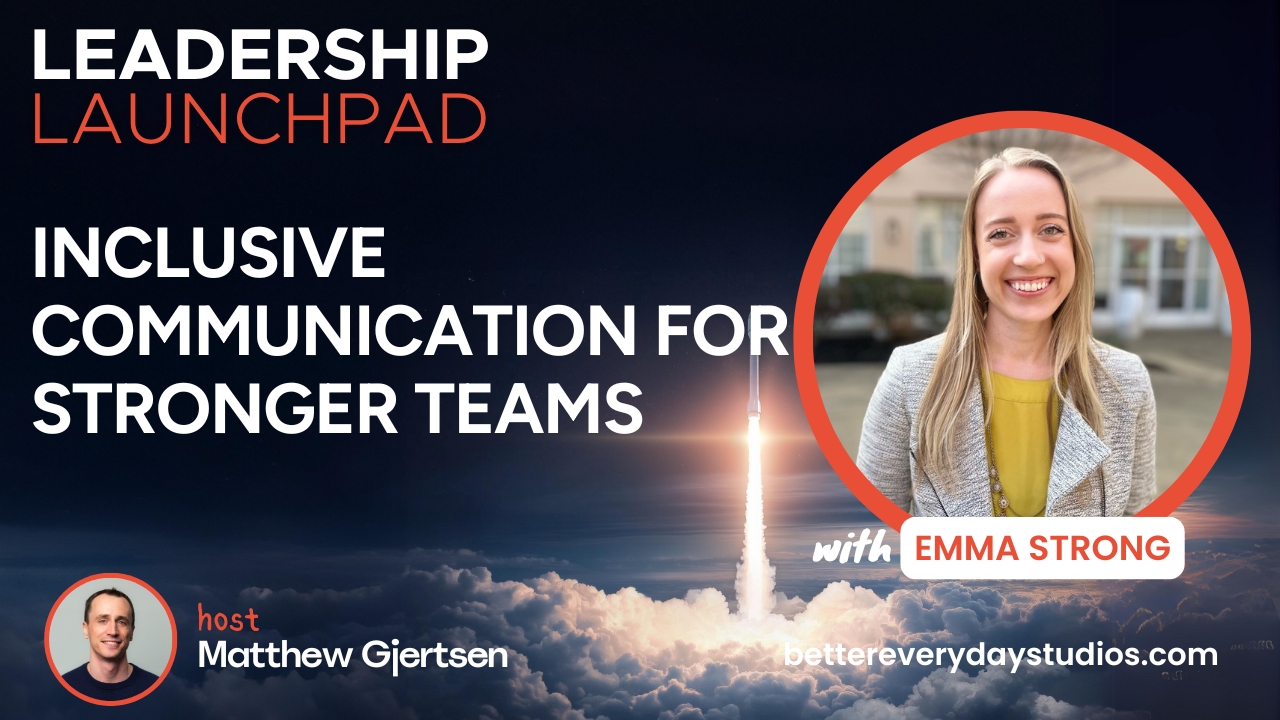
In this episode, guest Emma Strong, Senior Learning Development Program Manager at Veritex Legal Solutions, shares her approach to designing a leadership development program for new managers and leaders. Emma explains how the program was tailored with different tracks for team leads, managers, and supervisors, taking into account whether participants were promoted internally or hired externally. The conversation covers the importance of addressing unique challenges like transitioning from peer to leader, setting clear role expectations, and fostering inclusive communication. Emma also highlights balancing legal compliance topics with practical leadership skills and the value of continuous learning and open communication for new leaders. This episode offers practical insights for anyone developing or participating in leadership training.
 Automated Transcription
Emma Strong [00:00:00]:
It takes time to adjust to new circumstances. And just because your title has changed doesn't mean the relationships are going to magically change overnight. And to not be concerned if it's taking a little bit of time to transition into the new role, that's not a sign that anything's wrong. It just is the reality of the situation.
Matt Gjertsen [00:00:35]:
There are a lot of different flavors of leaders in a lot of organizations. Are you a people leader or a program leader? Were you promoted within the company or hired from outside the company? All of these flavors have slightly different responsibilities, but we often treat them all the same. When it comes to leadership development programs, that can often be a problem. And that's why I'm especially excited for today's conversation. My guest today is Emma Strong, the senior Learning Development Program Manager at Veritex Legal Solutions. She recently created a new leadership development program for her company, and in this program they actually split it into several different tracks so that each of those flavors could just go to the things that mattered to them and they didn't get caught up in in the many other requirements that didn't apply to them. In this conversation, we really walk through all the different tracks that they decided to create, why they created them, and then what the key lessons were that they were hoping to give to people from each one of those different tracks. It's a really great conversation that if you are a new manager, I think there's going to be a lot for you to think about of reflecting on your specific situation and which of these lessons might apply to you.
Matt Gjertsen [00:01:59]:
And then if you're an HR or L and D person, I think this conversation provides an excellent roadmap that you can apply to your leadership development programs. Before we get into the conversation, I do want to remind you that if this is your first time listening to the show, please make sure you subscribe so you never miss a future episode. And if you happen to be someone who is responsible for leadership development in your organization or I would love to talk with you, you can reach out to me through Matt better everyday studios.com so we can have a conversation about how we can make your leaders better for your organization. With that, let's get into the conversation with Emma Strong. Emma, welcome to the Leadership Launchpad. How are you doing today?
Emma Strong [00:02:45]:
I'm great. How are you?
Matt Gjertsen [00:02:47]:
I'm fantastic. It's been kind of a chaotic week, but it's going well. I'm really excited for this conversation. You connected a couple of months ago at the association for Talent Development Conference and you were at that Point in the midst of having launched a new leadership development program. And I think it's done now, right?
Emma Strong [00:03:10]:
Yeah, that's right. It's done now.
Matt Gjertsen [00:03:12]:
Awesome. Awesome. And the reason why I wanted to chat with you about it is because it sounds like you really broke apart the development program into several cohorts. That is different or maybe more precise than I had ever heard. And so for anybody listening, like, the reason why I'm excited to have this conversation is because I think as you and I talk through kind of the different branches that you had for your leadership development program, I think most people, when they're getting promoted, or even if they do have a development program in their company, it might be one uniform development program. And I think my hope is that this conversation will give people an opportunity to kind of think about which of these situations am I in? And, you know, what does that mean for me? Like, if this is my situation, what are the individual things? So I think if we could start off with it, how did you break apart the leadership development? Tell me some of the details about the leadership development program.
Emma Strong [00:04:10]:
Yeah, absolutely. So, first of all, this program was specifically for new managers and leaders. So the common thread for all of them is that they were either promoted after the. What was the end of the 2024 performance management cycle, or they were hired in at some point during 2024 into their roles, whether they were hired internally or from externally, they had been in their leadership role for less than a year, or they were very recently promoted. So that was a commonality that they all had. But then within that, we have some differentiation. So we have team leads, managers and supervisors at my company. And then above that, we have directors and, you know, VPs and all that.
Emma Strong [00:04:54]:
But this was specifically for team leads, managers, and supervisors. The team leads don't have direct reports, but they have a leadership role on their team. So that's one category. Managers and supervisors usually have direct reports, but sometimes don't. And then the other piece that we took into account was how someone arrived in their leadership position. So were they promoted from within their existing team? And so they're now in a leadership position relative to people that used to be their peers, or were they from another team from outside the organization? And therefore they're managing people who they did not used to be peers with. So those are the factors that we took into account when forming the different tracks. So essentially, the way it worked was kind of a phased program.
Emma Strong [00:05:43]:
We started with a session called colleague to leader, which was for those folks that were promoted from within their existing teams and was all about managing former peers because that's a very unique and can be challenging situation. Then we moved on to more kind of general leadership skills that everybody was included in. So basic leadership expectations for the organization, inclusive communication as a leader, and just general like support and resources for people leaders. So things like, you know, health and well being, who to go to with different types of questions, all that kind of stuff. And then we moved on to the third phase, which was specifically for folks who have direct reports. So that was only managers and supervisors with direct reports that got into the more technical leadership skills like leaves of absence performance management and building team culture as a manager when you are the one that's directly managing these folks. So that's the basic outline of how it went. And so people kind of came in and out of those sessions as needed based on their situation.
Matt Gjertsen [00:06:55]:
Yeah, yeah, I love all that. I think I kind of want to go through almost, almost line by line through each one of those. I mean, I want to start with that team lead because as I was telling you before, I think in my experience, especially in kind of manufacturing environments, it's very, very common for there to be a team lead who's often the, the like senior, most senior person of the group. They know the most of the area. They know how, they know how every machine operates or whatever. But they do not have any of the traditional, you know, direct line manager functions. So they're not, they're not completing performance reviews or any of that kind of stuff. Somebody else is doing that.
Matt Gjertsen [00:07:35]:
So, so for your situation, what did it mean? What does it mean to be a team lead and what are, what are some of the things that you made sure they had? What are some of the skills that you made sure they had?
Emma Strong [00:07:47]:
Yeah, that's a really good question. And it's actually something that we're still kind of in the process of defining as an organization that was sort of revealed while we were developing this program that it's not uniform what a team lead means across the company. So I think that's an area where we could get some more clarity probably, but it's exactly what you're saying. Where the team leads have that leadership role within their team, but they're not the direct manager for anybody. So they might be giving people feedback, they might be, be delegating work. You know, they might be providing examples or training people, but they're not doing those like formal management capabilities. And so we really focused in on the kind of interpersonal skills needed most of the team Leads were promoted from within their team. So most of them were in that colleague to leader session as well.
Emma Strong [00:08:41]:
So I think that helped lay a good foundation. We had someone, we had a guest speaker who was kind of someone who had been in their shoes the year prior, came and talked to them about how she navigated that situation of being promoted from within the team to a team lead role. That was really valuable, I think, to hear that perspective from someone who's been there very recently. And I think one thing that also helped is we actually had a couple of assignments within the learning management system that folks completed with their managers. So the one that the team leads did was actually an expectations worksheet. So we basically broke down, yeah, we basically broke down the expectations for team leads, what their kind of competency areas or capabilities are supposed to be. And then each competency had like a few bullet points underneath it of like, you know, feedback looks like this and there's like a few different bullet points of like what feedback is. That all came from a resource we have that defines the job levels at our company.
Emma Strong [00:09:51]:
So that's where that information was pulled from to create that worksheet. But then the part that I thought was actually most valuable was instead of just going over the worksheet and thinking like, okay, these are all the expectations. I have to do all these things. Now the exercise was actually to sit down with their manager and identify of these sub bullet points under feedback, what's the most important one for our team and what's an example of what that looks like on our team. And then they had to write that in a little box and submit that worksheet that completed worksheet in the learning management system. So I reviewed all those assignments. I basically gave everyone 100% if they did it, as long as they put some effort in. Because it was more about the exercise than me grading them and giving one person 97% and the other one 98%, whatever.
Emma Strong [00:10:38]:
But I thought it was a really hopefully helpful exercise for them to go through that together and actually define a little bit more clearly where their role starts and ends, where their manager is going to support them and all that kind of stuff.
Matt Gjertsen [00:10:52]:
I love that because like we were saying, it sounds like the lead role can be relatively cloudy in your organization. It's been cloudy in every organization that I've ever been at. And I don't think that's ever really going to change, you know, because the, the lead role in particular is, is very situational, depending on how many people are there, how many direct Reports the manager has, you know, like, like all kinds of stuff. And so chances are the best way, maybe the only way to get clarity on the role is to just make sure there's clarity between the lead and the manager. If you can make sure you. Even if it's kind of cloudy across the organization, as long as it's clear between the lead and their manager, it should be, should be okay. It shouldn't get this, get too far outside of bounds. And the other thing I love about that is anyone can do that.
Matt Gjertsen [00:11:45]:
Every new lead I would suggest, whether they have somebody like you that's pushing it and forcing them to do it or not, it's a great way for you to just say, hey, what, what do you want me to be doing? What are the most important things that you think is, should be for my role versus what's your role? I love that.
Emma Strong [00:12:04]:
And we actually started. So that assignment was developed for the team lead specifically. But then once we had the idea for it, we thought it would actually be helpful for everybody. So the managers and supervisors had their own version of it that had the manager and supervisor competencies. So actually everyone in the program was assigned a similar conversation. It was just two different worksheets because it's like two different competency sets basically. But it was developed with the team leads in mind initially for exactly the reasons that you're saying, because that has been cloudy and we've heard that before from folks that it's not clear where their responsibilities start and where their managers, you know, start and end and all that. As far as the what who should be doing what on the team.
Matt Gjertsen [00:12:46]:
Yeah, so there was a lot of, so there was that expectation setting a lot of, I'm going to call it like influence without authority almost kind of, it sounds like training any other big key skills for kind of the lead level.
Emma Strong [00:13:02]:
I mean, the other one that we really wanted to include was the inclusive communication session. And that was. It was really about inclusivity in general. We framed it as inclusive communication because communication is kind of sometimes an easier entry point for folks to start to become more inclusive is if they make some little shifts in their languaging or their way they're writing emails or things like that. That can go a long way towards fostering an environment of inclusivity. And we are really big on that at our organization, making sure people feel valued, making sure their diverse perspectives are being honored and all of that. And so we actually partnered with our, we have a DEI committee that's an employee led committee. And then we Have a subcommittee on education and training with the DEI lens.
Emma Strong [00:13:53]:
I'm actually conveniently part of that committee that I help run that committee, that subcommittee. And then I worked with that team of staff members to create an inclusive communication for leaders session that they facilitated for these leaders. So that was the other big piece, was helping the leaders think through, like their own lens, how their lens might differ from other people's lenses and just ways to cultivate a more inclusive environment as a leader. Because that's something that, whether you're a team lead or a vp, like, you can all impact that. So.
Matt Gjertsen [00:14:33]:
Yeah, yeah, yeah. Awesome. Managers and supervisors, first off, I guess. And I'm sure this is. This is also going to be very situational. Every company is going to be different. But for you, what was the difference between manager and supervisor?
Emma Strong [00:14:48]:
Between the two? Yeah, the manager and supervisor.
Matt Gjertsen [00:14:51]:
Yeah.
Emma Strong [00:14:51]:
That is actually an interesting question that I don't even fully know the answer to. For this purpose, we kind of lump them together.
Matt Gjertsen [00:14:58]:
Perfect.
Emma Strong [00:14:59]:
I think it depends more so.
Matt Gjertsen [00:15:05]:
Like.
Emma Strong [00:15:05]:
The structure within the region, which title people end up getting. Because we have. We're a company that's all across the United States and Canada. We grow a lot via acquisition. So we're a big company made up of many, many smaller companies. So the structure in each region can be pretty different. So I think partly why those two titles exist. They have a lot of overlap.
Emma Strong [00:15:28]:
Obviously, that's why we lumped them together. But I think that part of it has to do with like regional differences and things like that. But that's really a good question that I don't really know the differentiation between the two, because we put.
Matt Gjertsen [00:15:42]:
Yeah.
Emma Strong [00:15:43]:
For this purpose.
Matt Gjertsen [00:15:43]:
Yeah, yeah. And I just didn't know since you had separated them, I didn't know if there was a specific thing you were targeting. So taking them as a bucket, what were then some additional. I mean, obviously a lot of the things that you talked about for the leads, I'm sure they also went through. But then what are some of the additional steps that you made sure they had?
Emma Strong [00:16:02]:
Yeah, for sure. So they did go through if they were promoted from within their team. They went through the colleague to leader. Everyone did inclusive communication. Everyone did support and resources for people, leaders. So they were all together for that section. The managers and supervisors went on to do a leave of absence session. So all about, like, what is a leave of absence? How do you know if you're supposed to reach out to the people team to find out if a leave of absence is appropriate? All that kind of stuff.
Emma Strong [00:16:31]:
Um, because that's where organizations obviously can get into the sticky situation if someone is. Should be on a leave and they're not on a leave and that kind of thing.
Matt Gjertsen [00:16:40]:
I want to pause on that for a second because I think you're 100% right. I had no idea about this when I first became a leader. So what, what just high level now that we need to go deep. But just like what are a couple. If you remember what are a couple of things that stress of like I guess like what does it mean to be on a leave of absence and what are some of the reasons why people and end up on that?
Emma Strong [00:17:01]:
Yeah. I think one of the biggest takeaways for leaders from that session is that employees don't always come to you and say I need a leave of absence. Right. Like you actually have to listen for clues that it might be appropriate to suggest or look into a leave of absence. So for instance, like at our organization, if someone's absent, I think it's for more than three consecutive days in a row. Like for whatever reason at that point they're supposed to reach out to the HR team to find out if a leave would be appropriate for that person. Part of leave or a modified schedule or just something. Right.
Emma Strong [00:17:41]:
So maybe it's an extended illness and it's a one time thing and they just got a really bad flu and they'll be back in a week and it's fine. But sometimes it's an indicator that something bigger is going on that would warrant a leave. Also just like signs to look out for for employees that they might need that accommodation and then the different types of leave. So like Family Medical Leave act leave in the U.S. you know those kind of like regulations and a little bit stressing the importance that it's actually not lawful to have someone not receive the benefits of a leave if they qualify for it.
Matt Gjertsen [00:18:20]:
Yeah, that's. And I think that's the key point is there's all kinds of implications that it has on the, on their, their health care, their, their pay. There. There's lots of things that it can tie into security. Yeah. In a very legal way. So it's really important to, to get it right. Okay.
Matt Gjertsen [00:18:39]:
Any. Anything else for the. Yeah.
Emma Strong [00:18:42]:
For that session? No, but that kind of makes me think of something that we were trying to balance throughout this whole program, which is the balance between protecting the organization's interests and giving people applicable skills to be effective in their roles. Because both of those pieces are really important and the like, what to do and not to do from like A legal compliance perspective can't be overlooked. But if you have a whole program based around that and that's all you're doing, it can be pretty dry and not like relatable for people. So that's something we really tried to balance out, was like the compliance pieces that were required to be covered, but also the developmental side of like, the more interpersonal skills, like the inclusivity and the communication skills and those kind of things.
Matt Gjertsen [00:19:34]:
So important to mention because, yeah, you, you know, somebody like me bringing somebody like me, and I'm like, okay, let's go with the, the core leadership skills. Let's do this. If something's led from, you know, a very traditional HR person, then all it is is the like, here's how you do leave of absences, here's how you do. You know, it can be, but it is a balance because chances are, I think a lot of the legalistic stuff is usually in like the 10 to 20% of the time, you know, 80% of the time, everything just works out, everything's fine, everybody's coming to work, everything's all good. But. But that 10 to 20% is where, as you say, the problems lie. And managers can get in a lot of trouble. The company can get in a lot of trouble if they don't know how to handle those edge cases.
Matt Gjertsen [00:20:27]:
So it makes, I love that you, that you were trying to balance or making sure you were balancing that, because it's something that very often can be off the mark. But again, for managers, it's like, this is why it can be dry. But there are some of these topics that are really critical to be covered.
Emma Strong [00:20:47]:
Yeah. And my biggest takeaway for the participants from all of these sessions was the same really, for no matter what the topic was for each session, which was just reach out, if you have a question or even if you think there's a chance in some possible universe you might have a question, like anytime that pops into your mind, like, I wonder if I'm doing this right. To reach out for help either from their manager or from the HR team. We partnered with the HR business partners to do this program as well. So they were facilitating some of those more compliance heavy sessions. So they got to meet those people and see that they're not scary and all that. And so if I had one takeaway from the entire program, it was just to reach out and remember that, like, resources exist because they're not going to remember the specifics of like, what defines FMLA leave. Like, that's not going to be something that sticks in their brain long term, but as long as they know that it leaves exist and there are regulations around them and they need to reach out for help if they need more information.
Emma Strong [00:21:51]:
That's all that I wanted.
Matt Gjertsen [00:21:53]:
So, so true, so important. So I want to come back. We've. You've mentioned this a few times. The last kind of category, which is it was the first, the difference in what people took was right at the beginning. But the last category that I really want to dive into is this idea of internal promotion versus external promotion. And that's not external to the company necessarily, but external to the team. So if you are now leading people who were your peers, I hear about this all the time, about the challenge of making this transition.
Matt Gjertsen [00:22:27]:
What were some of the main takeaways that you were hoping people got from that?
Emma Strong [00:22:33]:
Yeah, I think one of the biggest takeaways from that session that I was hoping people got from that is just to give it time, because it takes time to adjust to new circumstances. And just because your title has changed doesn't mean the relationships are going to magically change overnight. And to not be concerned if it's taking a little bit of time to transition into the new role, that's not a sign that anything's wrong. It just is the reality of the situation. Another thing was just the transparency and like open communication with that. Our guest speaker who came to that session talked a lot about that, about how she sat down with people and kind of had conversations and said, like, you know, this is my new role, but we can still have a good relationship in these different ways that we've established over the years. And it's just shifting a little bit now. But it doesn't mean things are changing like, you know, drastically or anything like that.
Emma Strong [00:23:31]:
Just having those open conversations with people. And then another thing is also just having that professional judgment and discernment over, like what should be shared with the team members and what maybe needs to stay within the leadership team. Because previously, if you were a peer to someone, you probably talked about kind of anything and everything that you were aware of, because that's what people at that level are privy to as far as information and strategy and all that stuff. And then once you step into any kind of leadership role, whether it's a team lead or manager or anything, you might be getting information about folks or situations that you didn't have access to before. And understanding, like, what should and shouldn't be shared down the line, I think was an important piece that was brought up in that session as well. Of just like, thinking that through and having those. Those judgment calls about what makes sense to communicate with other folks and what makes sense to keep within the leadership team.
Matt Gjertsen [00:24:35]:
Yeah, it's because it's a. It's a balance. Right. I think in a lot of times, I mean, you know, you were talking about inclusive communication, but communication in general is such a big part of being a leader. We try to be transparent. We want to set the context, we want to give people as much information as we can, but that doesn't mean all the information. And yeah, they're definitely. And this is probably another one where you're.
Matt Gjertsen [00:25:02]:
The best guidance is to not make the decision yourself. If you're ever unsure, ask your boss. You know, just keep raising it up the chain to. If you're ever unsure.
Emma Strong [00:25:17]:
The other thing that I'm hoping people took away from this program, regardless of what role they were in, is that, like, no one's going to do it perfectly the first time either. Right, we talked about that too. That it will take time to adjust to a new role, whether it's with former peers or a new team or anything like that. And so again, to not be like, so caught up in doing it right or wrong, quote, unquote, but just like doing your best to apply the tools and the resources and like, reach out for support when needed and that. And like have a mindset and more like the continuous improvement kind of mindset versus, like a perfectionistic mindset.
Matt Gjertsen [00:25:56]:
Yeah, that's. That's a really important one because especially I'm thinking of anybody who's at an organization that maybe doesn't have a lot of formal support for this promotion. Really. I think the thing that keeps people from raising their hand and seeking out help is this idea that I'm supposed to already know this. You know, I got promoted, which means I'm supposed to have all these answers. And if you can shed that and do something as simple as have a good relationship with someone in hr that you can maybe have a monthly or semi. Monthly meeting with or just, you know, get to know them well enough that, you know, you can. You feel comfortable going to them with questions and then having a good relationship with your direct boss where you can ask these same questions as well.
Matt Gjertsen [00:26:41]:
If. I bet for every manager, if you could have those two meetings once a month, once a quarter, it would probably transform frontline management in every company.
Emma Strong [00:26:53]:
Yeah, potentially. Yeah. And I think part of modeling that, like, not perfectionistic mindset was through some of the guest speakers that we had. So when I. The way I identified the guest speakers. Was it where it's people that I spoke to when I was doing my needs analysis for the program. So I was talking with other managers to see who had been recently promoted or recently hired in to find out about their experience when they went through that, to see what I could glean from them that would be good for the program overall. And so one of the managers spoke about how he came from a small acquisition, was used to having all of his team on site, and didn't really understand the importance of one on one meetings or team meetings.
Emma Strong [00:27:40]:
When he first transitioned into a leadership role within this distributed organization, it took him a while to actually realize why those types of meetings matter and how the impact they can have. And so I asked him if he would be willing to share that story with our new managers in the program to say like, not everyone's going to get this right the first time. Like, here's an example of someone who's standing up in front of you as a leader in this program saying like, I didn't do this right the first time. But then I learned and I set new expectations with my team and I made changes and here's the benefits that we've had from it. And so I really tried to find people who I thought would be willing to share those growth stories so that it wasn't like they were presenting a picture that they were perfect at on day one.
Matt Gjertsen [00:28:25]:
Yeah, awesome. I think that, yeah, that's so great as a way to show lessons. It's not just you or somebody from HR standing there saying like, this is the perfect way to do everything. It's like, no, these are the mistakes that I made and these are the lessons that I learned so that I'm trying to pass them on so that they don't. So you don't run into them as well. Well, it sounds like you did a really thoughtful job kind of thinking through everything. What are the differentiations between people? How do we make sure give them content that's tailored to them so that not everybody's just sitting through things that don't really matter. So congrats.
Matt Gjertsen [00:29:05]:
It sounds like, you know, you got through the first one. I'm sure there's plenty of lessons learned to roll into the next one. But your description of it, I think is going to give tons of people some value if they're sitting in an organization which doesn't provide these resources. I think there's a lot in here for people to. People to grab onto. So thank you so much.
Emma Strong [00:29:24]:
Yeah, of course you're welcome. It was great to chat through it and it was a fun program to run. I'm looking forward to doing it again.
Matt Gjertsen [00:29:31]:
Awesome. Well, have a great rest of your day. Emma, thank you so much for being here.
Emma Strong [00:29:35]:
Thank you.
Matt Gjertsen [00:29:38]:
Thank you so much for listening to today's show. If you are looking for help turning your organization's great engineers into great managers, me and my team at Better Everyday Studios would love to help. We deliver targeted and interactive training workshops that are designed to help build the three fundamental skills of any new manager building trust, giving feedback, and setting goals. Reach out to me through matttereverydaystudios.com so we can start making your organization better every day.


