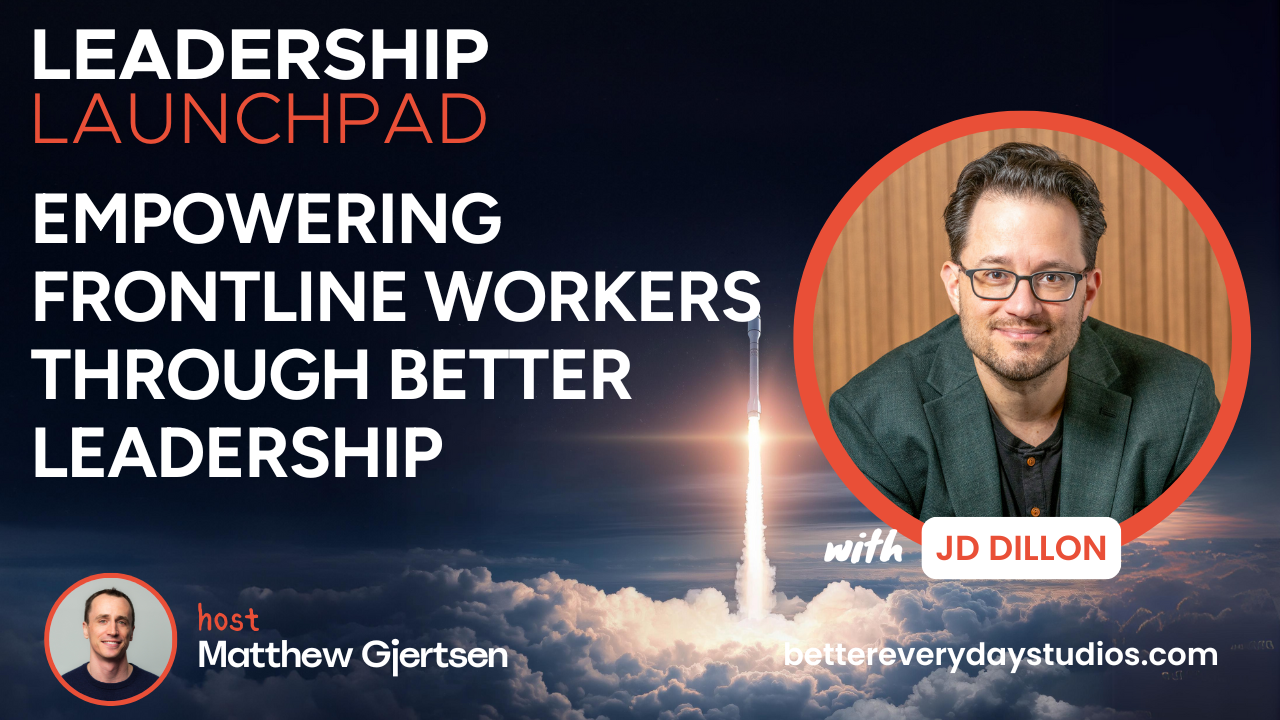
In this episode of Leadership Launchpad, host Matt Gjertsen sits down with JD Dillon, Chief Learning Architect at Axonify and renowned author, for an in-depth conversation about one of the most overlooked yet critical segments of the workforce: frontline employees. Drawing on years of experience and his soon-to-be-released book, JD breaks down what truly defines frontline workers, why supporting them is so uniquely challenging—especially in manufacturing and technical environments—and how organizations can better enable their success.
 Automated Transcription
JD DIllon [00:00:00]:
The biggest thing any organization can do to enable the frontline workforce, drive better performance, get better outcomes, and then, like I said, get those outcomes in service of organizational priorities. If you do anything, number one, invest in the management team.
Matt Gjertsen [00:00:33]:
Last week I was talking with a new potential client, and throughout the entire conversation I couldn't stop thinking, man, I love working with organizations like this. This was a custom stainless steel manufacturing company, which means they had that great mix of their office workers, plus a whole team of engineers and plus a lot of technicians, you know, And I love working with organizations who have that whole mix because they're the ones literally building our future, and yet they are also the ones that often get the least amount of support. It turns out I'm not the only one who feels this way.
Matt Gjertsen [00:01:08]:
J.D. Dillon is the chief Learning Architect at Axonify, an author and a talent development professional who has spent his entire career talking about the thing that most people don't want to talk about, frontline employees. Specifically enabling and developing frontline employees. He has seen firsthand the difficulties of leading and enabling the frontline workforce and spends all of his time trying to help organizations and managers to better support the people that make up 70 to 80% of our workforce. We start this conversation by defining what is the difference between a frontline worker and other types of workers, why it is so difficult to support them, and and with practical things organizations and managers can do to meet these challenges. Before we get into the conversation, I do want to remind you that if this is your first time listening to the show, please make sure you hit subscribe so you never miss a future episode. And if you happen to be someone who's responsible for developing leaders in your organization, I would love to talk to you. Please reach out to me@matttereverydaystudios.com to see if we can come up with a way to make your leaders better. With that, let's get into the discussion with J.D.
Matt Gjertsen [00:02:24]:
J.D. welcome to the leadership launchpad. How are you doing today?
JD DIllon [00:02:29]:
I'm doing all right, Matt. Thanks for having me.
Matt Gjertsen [00:02:32]:
Fantastic. I'm really excited for this discussion for a particular reason, because a lot of the people that this podcast is for is largely for engineers or people who have spent their education and most of their early career in a very technical field. And they're making a transition into people management for the first time. And in my world, in kind of like aerospace manufacturing world, a lot of those people become managers of very hybrid teams where they're managing out on the production floor. They're managing a test and evaluation team. And so they have some people like them that have a similar background to them, but they have a lot of people who are not similar to them. They have a lot of technicians, they have a lot of folks who have a very different background. And that's exactly where you've been focusing a ton of your time and energy.
Matt Gjertsen [00:03:25]:
Especially, you know, you're finishing up writing a book right now on frontline employees. And so I would love to start this discussion with, I mean, honestly, a little bit of what we just talked about. Of what when you, when we say frontline employees. And maybe we can narrow it a little bit to kind of a manufacturing world since I know that's a broad thing. What are some of the unique things about a frontline employee versus any other employee? Why make that as a classification?
JD DIllon [00:03:57]:
I would break down the frontline Persona because it's the question I get the most whenever I do anything related to frontline workers. Someone asked me the question, who do you mean? And it's not necessarily about the specific work that people do. It's more about how the work is done. The kind of context in which work is experienced that creates this common Persona that you would term frontline employee. So key considerations around that Persona begins with time. They're considerably time bound. And connected to time is autonomy. Frontline workers don't have the autonomy to make decisions in terms of how they use their time on the job.
JD DIllon [00:04:35]:
Because they are assigned a set of tasks and they complete those tasks and to do anything outside the box or beyond the task list, they often have to ask for permission to use their time. They might not be able to do any type of work related activities when they're not actively clocked in and on shift. And they tend to be focused directly on work that's associated to working with a company's customers or work that's associated working with a company products. So in a manufacturing context, the classic example would be people who are working on the manufacturing line who are responsible for ensuring the kind of safe and efficient execution of day to day tasks to keep the literal machine running. So it's, it's the significant group of people that represent 70 to 80% of the global workforce that organizations rely on to do the heavy lifting that makes strategies that are designed by their corporate counterparts successful. So yeah, when you think about frontline in the broader context, it's the people again that in a lot of cases you and I interact with in our day to day lives. So we go to the grocery store, you go to a restaurant, you go to a hotel, someone knocks on your door with a delivery. That's the team members that we're talking about who are part of pretty much every industry from first responders to healthcare to manufacturing to travel, transportation.
JD DIllon [00:05:51]:
So it's the biggest contingent of the workforce. At the same time, it's the most poorly supported part of the workforce. Not always. Not always. Because organizations value frontline workers. I believe most organizations do understand their importance. I often just say that supporting a frontline team effectively is a really hard math problem because if you're a learning and development team, you have a certain amount of resource, a certain amount of people, a certain amount of time, and you might be even a team of 50 to 100 people, but you're supporting 300,000 frontline workers who are distributed across a variety of countries. How do I do that? So it's a.
JD DIllon [00:06:31]:
It's a difficult math problem. At the same time a meaningful opportunity to provide value, improve the experience and by improving frontline experience, improving outcomes for the organization and value deliver to your customers.
Matt Gjertsen [00:06:45]:
Yeah, well then that makes a lot of sense. I especially love how you highlighted this idea of kind of how controlled the time is because in many ways.
JD DIllon [00:06:59]:
It'S.
Matt Gjertsen [00:06:59]:
The reverse of what we would say a good non frontline employee is. So much of what you hear when you're in corporate, when you're a salaried employee is. It's about going above and beyond. It's about having the interesting ideas and doing the side project that's interesting you and I think that's right is in a frontline context very often that is sometimes explicitly outlawed because they can get in trouble, the company can get in trouble. There's all kinds of things around it. And so I think that control piece is really important. I'd love to go a little bit deeper into. As you said, there's lots of reasons why they're often not supported that strongly.
Matt Gjertsen [00:07:45]:
What are some more of the. And maybe this can come lessen the framework of the organizational context of thinking about corporate L and D. But what are some of the things that make it challenging to support and enable frontline employees and especially enabling their development? What are some of the key challenges there?
JD DIllon [00:08:07]:
We've already checked the box of biggest challenge, which is time. Because oftentimes corp workers were measured in terms of quarterly outcomes and success in a lot of cases. Right?
Matt Gjertsen [00:08:19]:
Yeah.
JD DIllon [00:08:20]:
Frontline workers measured in terms of hours. So one person, if you make the decision that you're going to take an hour today and you're going to go work on an educational opportunity or stretch assignment or something for an hour today. Not a big deal. Your boss probably isn't sitting there saying where were you for that hour? Right? You're making productive use, doesn't even realize it, but you're deciding to do something different. Imagine someone walks away from the manufacturing line for an hour. The line stops, right? If a cashier leaves for an hour, the line doubles in size and maybe people walk away and don't make that purchase. So there's a considerable constraint, time, which then equates to how do I help you? Right? Where. Where do we find time to teach someone to do something new or to reinforce something that people have already been taught to communicate new information.
JD DIllon [00:09:11]:
So time is the biggest barrier. But then you complement that with reach. A lot of frontline workers don't work with technology on a consistent basis or. Or they work with a wide variety of different types of technologies. If you let's take a hotel as an example. Your front desk team is standing behind computers so I can reach them. They might even have email addresses. The housekeeping staff and the food and beverage staff probably don't have corporate email addresses.
JD DIllon [00:09:42]:
I can't even just send a message yet alone reach them with a timely update. So as a result, I rely on cascading information from a stakeholder decision maker down through layers of management towards a frontline worker. Question is often, does that information get there and does it get there in the shape and kind of level of actionable insight you originally wanted it to be? So it's even just difficult to reach frontline workers with basic information, basic support tools, because they live in a different environment when it comes to tools that they use every day. So a lot of the things we take for granted when it comes to enabling a corporate team, the fact that they're on Microsoft Teams and Slack and email and they have shared drives and they all of these different tools and it's still hard. I have yet to really meet the organization that says, you know what? We've nailed communication. In a lot of cases it's because you have stuff Everywhere like what SharePoint folder is it in which teams channel am I supposed to be a member of? We have an overabundance of resources and an inconsistent use of those resources and lack of consistent processes that makes corporate versions of sharing and access and collaboration and learning difficult. Take all of the tools away and try to overcome the same challenges with the frontline workforce. So it's kind of one of these silly, simple things that when you don't have a company email address.
JD DIllon [00:11:06]:
That cascades in terms of the challenges that you're going to face when it comes to accessing corporate systems, communicating across the organization. As a result, frontline work silos down into the location. So you may work in an organization with 400,000 other people who do similar work to what you do. You don't see those people. You don't know that that scale exists. You know, you work for this big organization, it might just be five other locations. You work with your team. Right? I always.
JD DIllon [00:11:38]:
Frontline workers don't work for the company. They work for their manager because that's the person who hired them, who trained them, who pays them, who schedules them. So the experience of frontline work is more about location based work than it is working for an organization. And it requires the organization to adapt our tools and our processes to accommodate the realities of frontline work. Rather than thinking, well, we have corporate tools, we can just give them to the frontline team. It doesn't work because the structure work is different and the day to day reality of work is meaningfully different for people who are doing these types of jobs.
Matt Gjertsen [00:12:15]:
Yeah, yeah, that's a really succinct way you put that. And I've seen it firsthand. Yeah, Even in companies where maybe every employee does have an email, they don't necessarily have a way to access it. And there's plenty of tools out there that they're trying to make it so that, hey, you know, everybody can have an app on their phone. Even if everybody has a phone now, if you want them doing work on that phone now, you gotta subsidize that phone. You need to pay them for their time of using, of using that app. And it just. The expenses multiply incredibly quickly, which, you know, so there can be a.
Matt Gjertsen [00:12:52]:
So you got the reach problem, you got the funding problem, you got the time problem. These all just like kind of snowball up, I'm guessing. It sounds like. So is the answer then does it kind of boil down? It sounds like there must be very local solutions. What are you seeing effective at getting past some of those barriers? What are some companies doing to get past all those barriers?
JD DIllon [00:13:18]:
The biggest thing any organization can do to enable the frontline workforce, drive better performance, get better outcomes, and then like I said, get those outcomes in service of organizational priorities. If you do anything, number one, invest in the management team. Because no matter what else I talk about, whether I talk about using technology, we could talk about AI, which has significant potential applications when it comes to enabling the frontline workforce in a variety of different ways. We could talk about investing in training programs and academies and upskilling and all of these different ideas. Rewards in recognition. If you talk about the entire frontline experience, it all comes down to the ability for the location management to execute. And if location management is constantly overwhelmed, 49% of frontline managers are burned out on a daily basis. You rely on them for everything.
JD DIllon [00:14:12]:
In these types of environments, the answer to the next problem from corporate is often let's get the managers to dot, dot, dot. If a customer is upset, the manager stepped in. There's a downtime in a piece of equipment, the manager steps in. If an order's late, the manager has to deal with it. Someone called in sick today, the manager has to figure out how to deal with it. So managers are often so busy dealing with operational realities, they have a hard time focusing on the experience of their team members. Making sure people have knowledge, skills and resources they need to be successful. Mitigating points of friction that are going to reduce turnover.
JD DIllon [00:14:51]:
So it really comes down to how well resourced and how well equipped are the managers. We have people in place who we have selected the right people, enable the right people, trained the right people, or do we have a lot of people in place because they were the next person up? Right. The manager quit, you took the next operator who was the most skilled performer and put them in role and now they're figuring it out. Is a lot of frontline managers experiences, including my own. I didn't go to a training class to become a frontline manager until I was in that uniform for several months and I was figuring it out as I was going. So it has to start with improving the way that we equip frontline managers. And then from there they need to be a critical part of the rest of the story. Cause let's say that you're going to implement new technology and for your frontline workforce, you can mitigate that reach problem.
JD DIllon [00:15:43]:
Right. We put devices in their hands with applications that are meant to help them solve problems, develop their skills. All of these really interesting tools that we can do, we're going to need the management team to support the implementation of that, especially because they control the frontline employees time. So if we're going to say, well, you know what we want to do, we want to do some daily training activities, you know, it takes three minutes every day, do some personal training with each employee, make sure they're continuing to develop. Again, three minutes to a corporate employee sounds like nothing. Three minutes to a frontline manager is an eternity because of what they have to get done and how they manage their labor hours and their workload. So we need the managers to not only be bought in and aligned, but we need them to be capable of supporting the type of experience we want to provide to the frontline team. Because if things break down at middle management, we can't help the frontline worker.
Matt Gjertsen [00:16:39]:
Yeah, you're reminding me about another, you know, a unique challenge for frontline managers because they get bugged because they have so many operational challenges to deal with. Cal Newport, the author. Cal Newport talks a lot about, you know, he's all about creating opportunities for deep work where you can really focus and get into a flow state where you can get a lot done. And so he talks about this, like, hyperactive hive mind that we've created in the knowledge worker environment where there's slack and there's emails and there's all these things, and the goal is to carve space out between those, shut off the email, shut off the slack. Maybe we don't need all of this stuff. And there is 100% a choice element to that in kind of the knowledge worker realm, where there's certain things that you can do, but that's just not often an option in the frontline world. And so for a frontline manager, even that, hey, here's a three minute or here's a five minute task. It takes them two hours because they keep getting pulled in all these different directions.
Matt Gjertsen [00:17:47]:
When we were just talking before we started recording, I mean, you were telling the story of writing the book inside of Panera Bread and watching the manager kind of try to do the schedule and how long it took her to do the schedule. It was a really, you know, like a very visceral example. I don't know if you, if you could tell that story or if you have another story because you brought up this idea that they're constantly getting pulled in different directions. What, what's an, what's an example of that?
JD DIllon [00:18:13]:
There's another anecdote I share in the book that's from a conversation, a research conversation with someone who is in the HR space in a retail environment. And they recently conducted a series of conversations with frontline managers to understand challenges that they were facing and how they could help them improve their experience. And one of the big findings from these conversations with their frontline management team was that frontline managers never eat lunch. And I'm sitting here listening to the conversation saying, oh, yeah, I didn't eat lunch for like seven years when I was a manager unless. Unless someone went out to go get food and brought it back to us. I survived on a steady diet of popcorn and nachos when I used to manage movie theaters because I could go into the day with a plan and say I'm going to accomplish the following things and then the lights go out and we have to deal with a Blackout on the 4th of July and a packed movie theater full of folks who are upset want a refund. And all of my point of sale systems are down, so I can't transact anything. Right.
JD DIllon [00:19:23]:
That's, that's extreme example, but that's just what the day to day reality is. So when I wrote the book, I was mentioning how I wrote the vast majority of it in collaboration with different contributors from around the world. But a lot of my writing was done in frontline spaces. So I went to restaurants and coffee shops and airport lounges and hotels, theme parks, grocery store cafe areas. So anywhere that I could sit and do my thing, focus on writing, but just be immersed in the experience that I was exploring as part of the book. And as part of that, I was able to just kind of look up and look around and watch people perform the job and watch the challenges that they faced and in some cases deal with upset customers or in some cases get consistently distracted from trying to accomplish what they were doing. And in one case, I watched a restaurant manager try to write the employee schedule for four and a half hours. And it wasn't that she was ineffective.
JD DIllon [00:20:17]:
A job is that literally every time she sat down, I mean, when I sat down at the table next to her, I thought someone had left their homework behind because it was just a table littered with papers and an iPad. And I realized, oh no, it's the manager. They're just doing stuff. And then I sat there and just wrote and watched as, you know, an off duty employee walked in and had questions about their schedule. And then a customer needed their help and they needed them in the kitchen. And just watched her bounce around for four and a half hours and never get the administrative work done because she was doing the job of managing the location. And I can relate to that experience. I tell a story in the book about one particular day.
JD DIllon [00:20:54]:
I didn't get to eat lunch. I was very excited. Day I was going to get a slice of pizza. It did not happen for me. It was just one day. But it's an example of the fact that a lot of frontline managers, even people are great at the job. They walk in with plan within minutes. That plan is gone because they're constantly dealing with the unpredictable.
JD DIllon [00:21:13]:
Because in an environment where frontline workers thrive on consistency and compliance and regulation, executing the operating procedure around that kind of framework of the job is a lot of unpredictable stuff that impacts their ability to not just get the job done to the best of their ability, but to dedicate any meaningful time to a manager, to the team, and then especially as a manager, to themself. Because yeah, I know that in a lot of cases I spent the first 50 plus hours of my week getting the job done. I was going to focus on the team or myself. That happened in hours 60 and 70. And that's why half of frontline managers burned out. Yeah.
Matt Gjertsen [00:21:58]:
So what have you found to be effective? So we already talked a little bit about what are the things that organizations are doing to help enable frontline employees or what they can do for frontline managers. And this is, you know, cause a lot if you're an individual manager, you don't necessarily have any say in what the company's doing for you. But I imagine there's some things or some common things that a individual manager can do to better manage, whether it's better managing their time or just having a different framework. What are the things that you've seen be successful for managers that find themselves in this position so that they don't get burnt out?
JD DIllon [00:22:40]:
I found a common theme both in my own experience, the conversations I had with people who are doing the job today, and some other research and other books that I read along the way. And I'll. I'll use an example from Monica Rothbury's book, Lessons from the Drive Thru. Monica was a former Chief Operations officer at KFC and she came up through the ranks being a restaurant manager and ascended into the corporate management space within the organization. In her book she shares examples of times where she was struggling in her location to figure out different parts of the job, especially when she was a new manager. How would she. Simple things from how do you put this display together effectively to the more complex pieces around how do you effectively read financial reporting then use that to make decisions to understand how to become more effective and drive better outcomes within the restaurant. The unlock for her was connecting with other managers, people who have seen it before, done it before.
Matt Gjertsen [00:23:38]:
Yeah.
JD DIllon [00:23:38]:
And maybe they. What they tell you and what they say is not necessarily in the training, but it's lived experience. It's the corner cases, it's the clever tips and tricks that maybe the corporate team doesn't know about or it's not in the formal teaching that really makes a difference. So before you talk about things like structured training programs, leadership development, emerging leader programs, the more kind of HR driven approach to enabling managers, for me, it begins with fostering community amongst managers so they can help one another. And I can't tell you how many times that when I managed a movie theater I had a question and I knew this wasn't the first time. Someone else has dealt with this, someone has seen this. But all I knew, especially when I was younger, was my team and I might have worked with a couple of other managers, but maybe I'm the only one on shift today. I don't know who to call.
JD DIllon [00:24:33]:
If you call your boss, that might mean admitting you don't know how to do your job right. So going up the chain is not always something that is advised or maybe comfortable for somebody. Yeah, maybe there's someone in Oregon who has experienced this problem before. I'm in Orlando, I don't know they exist. I'm not going to start cold calling other locations, say, hey, does anybody know how to, how to do this? So I think some managers have the benefit of. Later in my career, I worked on teams that had 12 different managers on them and I was really lucky to get to work with some people that I defined as epic frontline managers. And I learned more from them than I would regularly learn from more structured training. A lot of cases, managers may be on an island.
JD DIllon [00:25:18]:
They may be the only store manager in their location or their location may be the only location for the company in the state. So they don't know how to reach out without it having to be. Well, I have to ask my district manager and then are they going to look at me asking these types of questions. So how do you foster a community of managers? And it could be as simple as just give them a group chat, right? Help people connect the dots. Because there are people out there within most organizations who are willing to help, especially if you tap them on the shoulder and ask them and make it part of their job to say, can you help bring people along? Can you be a mentor to some new managers? Can you be there to answer questions? So I think there's a community and connection side of enabling managers and then I'll take it to the completely other side of the fence and talk about technology. Say there were so many instances where I as a manager just needed information and I didn't know where it was, if it existed, what sharepoint folder it was in these types of things. So I think it's a balancing act. Of giving me the ability to reach out to people so I could collaborate and problem solve with people who have the experience that I don't have and then give me the tools I need to find actionable information that I can apply to make a good decision.
JD DIllon [00:26:31]:
And that's where I think tools like AI digital assistants are going to transform. Yeah, the experience of frontline managers in so many ways. Because instead of guessing or relying on the person next to me or having reach out for questions that are foundational topics, I can just ask digital assistants, how do I do this? And as long as the corporate team has curated knowledge base of actionable insights that these folks can use to solve problems, that's going to take a lot off of people's plates because now they have a reliable source of truth that they can leverage in the way they need to. A lot of times have a more free flowing conversation with the information in that format thanks to AI and also have that conversation in their preferred language. Because maybe the newest member of your management team speaks French, all of their documentation is in English because maybe you have a large French speaking contingent within your workforce, but this individual would benefit from having information in their language so they don't have to just try to understand the information yet alone learn the information. Right. So again, AI is going to help overcome a lot of those obstacles and barriers that set the foundation that we can then build upon. Because once you've connected people with, with meaningful thought partners, collaborators, you've given them a solid knowledge base that they can really engage with.
JD DIllon [00:27:54]:
Well, now we can have a different conversation about what it takes to enable that person. Where do we focus more structured activity? Where do we focus training? When do we actually have to remove someone from the operation and disrupt the flow of work? Because it's the right thing to do to help them develop their skills and focus on certain types of activities versus it being the default, default way. Because again, you might think, oh, we do a 30 minute webinar once a month for our managers. That doesn't sound like a lot. That 30 minute webinar happened to fall on a Tuesday at 11:30 and that's when the truck was supposed to be here and it's late and I'm not going to be on the webinar and I'm going to miss out on that opportunity. So if you kind of start at that foundational level, it then helps you restructure the wrists of the enablement experience. And like I said, if you get this right and you have a capable, confident, frontline management team, then you can rethink, well, what's the best thing we can do for the frontline workforce? Because you have that first layer of support in place.
Matt Gjertsen [00:28:59]:
Yeah, that makes a lot of sense. And I love that you started with this idea of creating community because a few, maybe six months ago I went to a conference where we did what they called just kind of a mastermind exercise where we were sitting at tables of six and so they started a timer, okay, 10 minutes. And every 10 minutes we rotated where I'm the person, I'm the speaker now, so I just like tell a problem that I have and then everybody else, we spend 10 minutes trying to solve my problem. And then you know, ding, timer goes off. Next person, they say their problem, we all try to help solve their problem. I've since done that at a couple different conferences and every time people are like, this is the most amazing conversation I've ever had. Like, people love it. And so, and it's just such a, it's just such a low lift way to create community, solve problems.
Matt Gjertsen [00:29:47]:
But it's not, it's almost so low lift that it's not something that we think would be valuable, but people find it incredibly valuable. This has been a fantastic discussion. I know there's a lot more that we could talk about and a lot more that people could learn from you because you're just finishing up writing a book. If people want to keep following you to learn more, where should they go?
JD DIllon [00:30:10]:
So many places. So start on LinkedIn. Always happy to have a conversation or help out however I can. So if you find me jdville on LinkedIn, pretty easy to find. Not an energy executive, I'm the other one because there's two of us.
Matt Gjertsen [00:30:24]:
Okay, good.
JD DIllon [00:30:24]:
LinkedIn, my personal website. Learngeek co. You can find my first book, the Online Learning Ecosystem there. You can also go to gwroteabook.com a very real website where you can pick up the first book. The second book is also at Lengeek Co or@frontlineplaybook.com this is called the Frontline Enablement Playbook. And yes, jdrote, another book.com is also a viable website for that book. So I'll be updating the website with resources right now. Just kind of gives you a high level overview of what the book is about, the different parts of the story, some of the research that I use that goes into the book.
JD DIllon [00:30:59]:
And once I'm finished with the draft, I'll start updating and providing more resources. As the great thing about working with a team of collaborators from around the world is we have a lot of different voices that can help elevate the story. And that's really the goal.
Matt Gjertsen [00:31:11]:
Yeah.
JD DIllon [00:31:12]:
Beyond selling a book is to create permission to have more conversations about frontline workers across the employee experience, HR and learning and development space. So I'm excited to do that in the second half of this year, leading towards publication at the beginning of 2026. So that is there. And then if you want to hang out with my team at Axonify, where we're building technology that enables frontline workers around the world, you can check us out@axonify.com awesome.
Matt Gjertsen [00:31:42]:
Well, this has been fantastic, so thank you so much for your time and I look forward to the next time we get to chat.
JD DIllon [00:31:48]:
My pleasure. Thanks everybody.
Matt Gjertsen [00:31:50]:
Thank you so much for listening to today's show. If you are looking for help turning your organization's goal great engineers into great managers, me and my team at Better Everyday Studios would love to help. We deliver targeted and interactive training workshops that are designed to help build the three fundamental skills of any new manager. Building trust, giving feedback and setting goals. Reach out to me through matt better everydaystudios.com so we can start making your organization better every day.