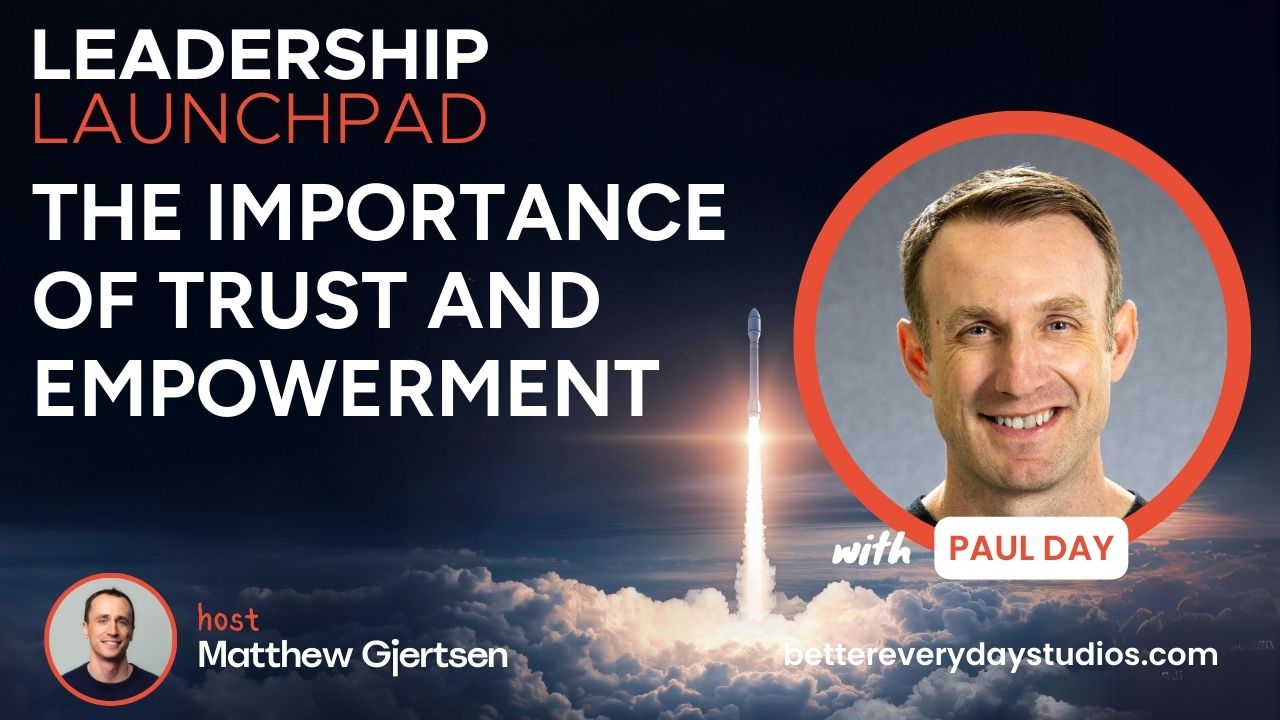
In this episode of Leadership Launchpad, guest Paul Day, co-founder and VP of Engineering at Muon Space, discusses the transition from top-level individual contributors to people managers. He emphasizes the importance of trust, empowerment, and a concept he terms "organizational EQ" in managing technical teams. Paul shares insights into the challenges engineers face when moving into management roles, such as overcoming the need for perfection and shifting from hands-on problem-solving to decision-making and team empowerment. Furthermore, he delves into Muon Space's approach to tackling the complexities of satellite production through vertical integration and modular design, aiming to reduce time and costs associated with traditional satellite manufacturing. The episode underscores leadership strategies for fostering a productive and empowered team environment.
 Automated Transcription
Paul Day [00:00:00]:
Because there's a bunch of things that are critical to have that team function at a high level. Right. You need people to feel empowered. You need people to feel heard. You want people to identify problems and not feel like they'll be punished for identifying problems. Yeah.
Matt Gjertsen [00:00:29]:
When I first started started training new people managers, one of the first things I had to do is figure out what to train them on when an engineer becomes a people manager. What are the critical skills that they need in order to be successful? And honestly, the first thing that popped into my mind was the ability to build trust. Now I will admit I was a little uncertain how this would go over, especially working with technical organizations. I'm not sure they would fully buy into the idea that trusting another person is the key thing you need in order to be successful. But luckily that idea has actually gone over really well and today's guest is a perfect example of that. Paul Day is the co founder and VP of Engineering at Muon Space, an end to end space systems provider that designs, builds and operates LEO satellite constellations for Earth observation. Previously, Paul led satellite programs at Loft Orbital, Apple's Satellite Connectivity Group and Skybox Imaging. This is a really amazing discussion in which we dive into why top level individual contributors so often struggle making the transition to becoming a people manager, the importance of a concept that Paul calls organizational EQ and of course, why building trust is one of the most essential skills for being a people manager.
Matt Gjertsen [00:01:57]:
Before we get into the discussion, I do want to remind you that if this is your first time listening to the show, make sure you hit subscribe so you never miss a future episode. And if you are someone who's responsible for developing leaders in your organization and find today's conversation industry, I would love to talk to you. Please reach out to me directly matteterradystudios.com so we can see if there's a way that we can help you, your organization, build better managers. With that, let's get into the discussion with Paul Day. Paul, thank you so much for being on the leadership launchpad. How are you doing today?
Paul Day [00:02:33]:
I'm doing well, looking forward to speaking with you.
Matt Gjertsen [00:02:36]:
Yeah, I am really excited to chat with you and the place where I'd like to start. Since you have been in kind of the satellite game for a while, I think space satellites in particular have been known to be really expensive and take a long time to build with. With all your experience, I would kind of love to know, you know, what are some of the traditional drivers that make satellites expensive and take a long time and Then what is Muon doing differently to fix that?
Paul Day [00:03:07]:
Yeah, yeah, no, I mean, it's a good question. I think it's one I get, I get asked a lot when we, when we try to define, you know, what we, or what the new space industry is doing, doing differently. And I think if you look historically, you know, a lot of, you know, and it was, it was fundamentally driven by launch costs for a while. That's true, yeah. Where everything was, you needed to eke out every iota of performance that you could get out of the solution that you were going to put in space. It was going to cost, you know, a lot of money to put it up there. You need a lot of capability. And so it drove you towards these very custom, very optimized designs around that specific task.
Paul Day [00:03:45]:
Right. To get every last bit of performance. And I think, you know, in short, where that tends to drive you is kind of where you would expect, right? It tends your custom engineering solutions, your custom building sensing systems, your custom building power systems to give you every bit that you can get and that, that, that basically that custom and typically a higher level complexity drives you down this, this road both on the production side where, where you're highly custom. So you have to produce very small, if not one off production runs of these very highly custom solutions. All this infrastructure and test is set up ad hoc. All that takes time. And then there's the typical complexity that's in there too, which even when you get through your production, your build, you get into the test and the verification and validation of this system and, and it becomes again, a complex system requires complex validation and verification to make sure what you actually need to do. You're going to be able to meet that complex mission on orbit.
Paul Day [00:04:51]:
And that just, it complicates and extends every aspect of the spacecraft production, build and test program. And that leads to those very, very long lead times.
Matt Gjertsen [00:05:02]:
Yeah. So how are you trying to tackle that? Cause I know at Muon, I think that's part of what you're trying to do, right, is make that a lot simpler and easier.
Paul Day [00:05:12]:
It is, it is. And there's, you know, there's a number of ways to try to tackle this. And you know, I think that the easiest one that you'd probably hear the most is sort of modularization, Right. Using off the shelf components. And I think I generally agree with that. I think there's multiple ways you can attack that problem as well. And I think one of the ones that we've tried to do is really sort of a focus on, you Know, vertical integration wherever we can, because fundamentally one of our theses is that the integration of these systems is the hardest part. Right.
Paul Day [00:05:46]:
And you know, it's where it's not just, you know, to be flippant. You know, you buy a camera, you stick it on a bus, you put in a USB cable, tighten some bolts and send it to space. Right. The integration, especially on more and higher performance earth observation systems, which is the area that we've, we've focused in, can be insidiously complex and problematic when you try to bring these complex systems together. And that drove us in the direction of vertical integration because what we wanted is to really have total control over the architecture that we were building to meet the customer's needs. And in some cases we have customers bring instruments to us, that's their IP or something they procured. And in other cases we actually do the design in house to create that, that like a higher performance end to end system because we have control over, over all these aspects of, of the chain, whether it's, you know, the bus, the instrument or otherwise. So I mean, there's myriad advantages to vertical integration.
Paul Day [00:06:52]:
It is a higher NRE investment for sure. So that's something that is a downside. But what you get, you get to choose your own architecture, right? And to us that's critical to achieve that, a higher degree of ease of integration. And you know what I mean by that is when you are in control of all your, the architecture of your hardware and the architecture of your software, it allows you to take advantage of, of a lot of different sort of more modern components, modern techniques, modern software approaches that give you tremendous advantages when you need to do that end to end integration and the validation. And I think it requires a lot of effort, right. I think the other advantage is when you put in that effort, what you get is an ability to go sort of increase the level of performance that you can achieve with that system. You're not beholden to, hey, whatever you get is as good as the vendor offers, right? Yeah. You're not beholden to the choices or architectural choices they've made, either hardware or software.
Paul Day [00:08:05]:
Maybe five years ago, God forbid, 10 years ago, you can, you can build an in house system that's higher performance. So the fact that it's modular, right. The downside of modularity, right, is that you build one, you know, it's a jack of all trades, a master of none, right. You do sacrifice some amount of performance by, by backing off from that hyper optimized solution, but we can make up for that. By designing our own system with, you know, cutting edge parts that we've, and screened ourselves from a radiation perspective, thermal perspective, etc. We could get closer to that sort of optimized point, but not, not having to sacrifice the modularity that allows it to more easily integrate with customer A, customer B, customer C. So we found that that's given us like a solid advantage in terms of how we, we approach the problem.
Matt Gjertsen [00:09:01]:
That makes sense. So you're kind of trying to take advantage, take the advantages of both worlds, you know, where to, to kind of cancel out some, at least some of the trade offs that you have. Those two approaches. Interesting.
Paul Day [00:09:12]:
Yeah, yeah. And the only other plug I'll say is like I'm a hardware guy, don't get me wrong. But I think one of the advantages you get when you control that hardware architecture is it allows you to implement a software architecture of your choosing. And in my experience software is always the long pole. You know, good hardware engineer can keep many good, you know, software engineers busy for a long time. They tend to be the long pole. And so allowing you to make software architecture choices that allow you to accelerate your development process and your test process can be mostly advantageous and is something again, you may not be able to achieve, you're likely not going to be able to achieve if again you're beholden to the choices that have been made by your vendors or suppliers.
Matt Gjertsen [00:10:02]:
Yeah, it's interesting even, it's interesting in my experience, looking around and talking to different companies, just how much hardware companies rely on good software. And even, even at the point of view of just like, you know, like the manufacturing process software, you know, I mean, I think like Stoke Space, they made their own, well Obviously, you know, SpaceX made their own kind of internal system for managing everything. Stoke Space loved theirs so much that they actually sell it as a SaaS product to the kind of like on the side of building a rocket company.
Paul Day [00:10:33]:
Which is actually, I didn't actually know that I should, I should reach out and see what they're, what they're pitching down there because I, I couldn't agree more. You know that that infrastructure software that goes alongside what you're building is, is also critical, can be critically enabling. I mean man, we could do a whole, a whole additional show on just that and, and the state of the industry there and how to do it because that's, you know, one of the things I'm, I, I care a lot about and I like to nerd out a lot in terms of how we're going to Scale our production here at Mueller.
Matt Gjertsen [00:11:02]:
Yeah, yeah. I mean, Laura Crabtree, she's a friend of mine and former guest. Her company, Epsilon 3, that's what they do. She left SpaceX and started just kind of like that software management company.
Paul Day [00:11:14]:
We're a customer.
Matt Gjertsen [00:11:15]:
Oh, excellent. Fantastic. So, so you're doing a lot of this custom stuff. You're making the. But you're making it modular. There's a lot of technical challenges to that, both on the hardware side and, as we just said, on the software side. So you have a lot of engineering talent, you know, shifting to a little bit more of. Kind of like the subject of what we talked about and what you and I talked about earlier is that means you, you have a lot of this really high engineering talent.
Matt Gjertsen [00:11:44]:
And then as you build a company, you ideally want to be shifting some of that talent up the ranks into leading that engineering talent. And I've seen that that traditionally can be a hard shift to make. What are some of the challenges that you've seen in your experience leading these highly technical teams? What are some of the challenges that engineers face when they're making that initial shift into being a people manager?
Paul Day [00:12:08]:
Yeah, no, that's a, that's a great question because it, it is a really challenging transition for a lot of engineers. And I think we, as we, we discussed before, there's a couple books that I think get it, get it pretty right. And I'm not paid by this no, no, no plug here. One of them says a lot in the title. It's called what gets you what got you here won't get you there. And it kind of lists that a lot, like typical pitfalls, bad habits. There's another one called the next level when it talks about, you know, habits to pick up, habits to put down. And I think what, what I see in a lot of engineers is they're pretty good with the pickup, right? Most engineers are analytical.
Paul Day [00:12:46]:
They're aware of their, their shortcomings or they're aware of what they don't know, right? So they're, you know, they know that, hey, okay, I'm going to need some new skills. Maybe, maybe I'll get a book. Maybe I'll go, you know, think about, you know, management techniques and how to do these. But oftentimes, what I feel like the critical part is that's not as clear is, you know, what, what to put down, right? What to stop doing. And, you know, many, many engineers, right, they're in this position of getting promoted into management. They're typically the top ic, right that's, that's the usual process. Okay, who's the top performer in Group X? All right. We need a manager of Group X.
Paul Day [00:13:23]:
It should be that, that top performer. And, you know, I think a lot of what ends up happening is those tendencies that make them exceptional individual contributors can complicate that transition into management. Yes. You know, one is sort of this. They typically have a very high standard for their individual contributor work. Right. That's most engineers. Right.
Paul Day [00:13:50]:
You know, we tend to be perfectionists.
Matt Gjertsen [00:13:53]:
Engineers like to engineer.
Paul Day [00:13:55]:
Exactly. Right. And they strive for that level of perfection. And I think what's difficult is to understand a little bit more about, you know, from an organizational perspective, for a team perspective, you know, the practical reality is perfection is not required across all fronts. Right. And knowing how to identify how to determine when something is good enough. Right. When something that may not be up to their individual contributor standards, I, you know, I would have done this better.
Paul Day [00:14:25]:
This is, this isn't how I would have done it. When, when that is. Is still good enough for what the team needs or what the company needs, you know, that, that, that can be challenging. Right, because that's a, that's a recall often a judgment call they're not accustomed to having made. Right. They, they're responsible for their own output. You know, they, they kept it at their high standard. They kept, got them this position to begin with.
Paul Day [00:14:48]:
And I think that can be challenging because, you know, what it leads to can be a very prescriptive approach with implementation strategy, you know, like, like how, like, you know, dictating to, to their, their how things should be done and that, and, you know, it comes across as, you know, it's my way is the only way. This is, this is the way that something should be done. And that doesn't, that doesn't tend to build an environment of empowerment, ownership in those reports. And you know, the one other thing that I feel like I've seen fairly commonly is it is, you know, one has typically exceptional visibility over their individual contributor work. Right. You know, everything that's going on. Right. You've got, you've got it pegged.
Paul Day [00:15:39]:
You know, you're controlling the variables, you're working with it, you're pulling things together. And what happens when you go from being on Team X to leading Team X is that that visibility starts to fade a little bit. Right. It's not quite as clear. A little bit of the fog of war creeps in. Everyone's busy. You don't have that, that visibility across everything anymore. And what it leads many high performing ICs to do is to sort of develop this, develop sort of innate anxiety.
Paul Day [00:16:05]:
Right. Like I used to know everything that was going on and now, now I don't.
Matt Gjertsen [00:16:09]:
Yeah.
Paul Day [00:16:09]:
Makes me nervous. What if something goes wrong on my watch? You know, so leads, you know, that and the previous thing I mentioned kind of lead towards this like over statusing, being, being sort of invasive with updates and visibility. You know, I need to see everything that you're doing. And I think both of those contribute, you know, to a sort of tendency towards micromanagement which you know, will, will brush. If you have exceptional team members that you're now managing, they'll bristle at that.
Matt Gjertsen [00:16:42]:
Yep.
Paul Day [00:16:43]:
And it can also reach, lead to the kind of overextension where okay, hey, you did, you know, you know, team member, you did your job. It's great, it's probably good enough. But you know, I'm just going to polish this up a little bit or I'm going to fix this a bit. And so there's this tendency to overextend because now they're doing, you know, five individual, you know, semi partial individual contributor jobs as well as their management job. And, and that you know, can lead to burnout, overextension and things like that. So this is some of, some of the common things that, that I've seen or witnessed that I think are driven by those common engineer tendencies which I think is at an IC level are great, are great kind of habits to have.
Matt Gjertsen [00:17:26]:
Yeah, yeah, yeah, you put that so well. I never really thought about that before because I've always had this kind of sense that almost the higher you go in an organization or really like kind of the farther you go in your life in some, in some sense is dictated by kind of like how much uncertainty you're willing to live with. You know, that like how much, how much you are you're comfortable with in a sense because as you said, like that the more layers there are between you and the actual work, kind of the, the more opaque that becomes, the more the fog of war is there. And it's just, I do think there's a tendency to think it's a problem to be solved when really it's just kind of a reality that has to be accepted at least, at least at a certain level there's, there's some amount of like you need to know information, but you have to find that right level so that you're not constantly in the weeds and getting overwhelmed. I did want to ask kind of a follow up to that idea of you Know my way is the right way or like always want it to be better. Do you also see that sometimes it's not just that you have this really high standard of work and people maybe aren't meeting that and you want to raise it, but you're used to like it's my way. And you, and do you see people struggle adjusting? Like somebody just doing it different, Maybe it's even better than what you have done, but it's just, they do it, they're doing it differently than would have been your first thing. Is that, is that a challenge you see? Or do engineers tend to like be so focused on kind of like the results that they're able to get past that?
Paul Day [00:18:57]:
Yeah, you know, it's a good question. And you know, I'm hesitant to be too abroad in my, in my assessment, but I do think, you know, many engineers often become creatures of habit, right? So you know, whether it's the programming language they use, I mean, boy, how many engineer to engineer programming language arguments have you seen in your day about, you know, use Python? No, you use this. No use Julia. Do you use that Rust or it's. That's funny. But I do think they, that that is an inhibitor, one inhibitor to, I think, you know, accepting these alternative approaches is that tendency over time and many engineers have been through a long series of education to get where they are and then their professional experience, they do become creatures of, of habit. I think that's, that's one of the big contributors to it. Trying to think there's, there's others as well.
Paul Day [00:19:55]:
It's kind of eluding me at the moment, but that's okay. I think that's, that's, that that tendency is, is a big one and it's time to, to, to really adjust and for them to be, you know what? I think the one thing else that I, I'll, I'll volunteer is, you know, many engineers, especially the ones, again those, those top individual contributors when presented with a problem, I mean, I'm guilty of it. I'm sure many, you and many, many of your listeners may be, you know, you get presented with a problem and there's this sort of like 30 second crank turning and then like snap judgment, like, huh, you know, I bet we could do it this way, right? There's almost this like recency bias towards those initial snap assessments. And of course, you know, different experiences, different backgrounds, you know, exposure to different engineering disciplines could lead one to take very different, you know, approaches in those initial snap adjustments or snap assessments. And I think that Just common psychological bias towards, you know, one's, one's, one's guess, I think can create a barrier almost instantaneously on presentation with a problem like that that, you know, be difficult for folks to get over without sort of forcing them to take, you know, a more open mind, you know, and listen to, you know, what others, their subordinates, their peers or otherwise might propose.
Matt Gjertsen [00:21:23]:
Yeah, yeah, I think that's 100% right. So, yeah, so you've done an amazing job of kind of highlighting some of the major challenges, especially for those really high end individual contributors when they make that shift and the implications that it can have. You know, maybe starting with that one. Since you said like sometimes you cause that snap judgment, you know, I think a big thing then as you make the shift is figuring out ways to stop yourself from doing all that stuff. So like, I mean, I guess starting with that one, since you say sometimes you, you have that snap judgment, how have you kind of trained yourself to, I don't know, do you, do you stop that, do you suspend judgment? Like, like what do you do to kind of overcome that challenge?
Paul Day [00:22:04]:
Yeah, it's, I mean, that's a great question. And I imagine, you know, everyone's going to have to sort of develop their own, their own approaches to this themselves. But I think part of it starts with humility, to be honest. I think, you know, I did 10 years of engineering education, you know, I did my graduate work at Stanford. And I think one of the things, you know, when I got there was this sort of exposure to, you know, some really, really brilliant, absolutely brilliant people. And going through, you know, my experience there, it was, it was humbling, right? Like you're, you know, everyone, everyone there is high performing. And then you get there and you look around and you find some folks, you're like, oh my God, you know, these folks are next level, right? I have the, I've had the fortune of working with many of those folks over my career. But I think, you know, for me one things that, one of the things it did is instill a little bit about, of the, of the.
Paul Day [00:23:08]:
Knowing what you don't know, right. And recognizing that, hey, you know, expertise exists outside of me that is greater than mine, and I think that's key. And even for people who really are those top tiers, you know, achievers, I think this one has to be introspective and kind of force themselves to say like, hey, you know, even if it's, you know, reading a bit of a psychology and things like that and understanding the way that Human tendencies in those brains, I guess, things like recency bias and other things. Being aware of that, I think that's. To me, that's like the engineer's solution. Right. Is let me understand the. That's operating between years and let me understand these natural biases.
Paul Day [00:23:50]:
So. So I can kind of spot them and feel them and, And I think what that leads to, I mean, a little, a little dose of humble pie never hurt anyone. Never heard any engineer, but, you know, just. And I think also appreciating the fact that if you've done your job right, or at least if your previous job boss has done your job right, hopefully you have some pretty. Pretty solid folks around you. Right. Yeah. And that, and, and that diversity of experiences, again, exposure to different disciplines, exposure to different programming languages and trades, I think can be really key to the realization that there's always multiple ways to attack a problem and that other ways can often be as good, if not better, if you open your mind to it and force yourself into a very engineer, like, rational assessment of these approaches.
Matt Gjertsen [00:24:44]:
Yeah, yeah, I know exactly the experience you're talking about of. You know, I always kind of joke with my wife of that. Like, I know smart people and I'm not one of them. Like, I just, I always think back to. I mean, and I think. I think pretty highly of myself, but I think back to when I was at the Air Force Academy getting a physics degree and it was like the top member of the physics department, so he's got a 4.0 in physics. And oh, by the way, he's like, building his own car on the weekend. You know, you're like, yeah, okay, man, that's go you.
Paul Day [00:25:15]:
Yeah, exactly. Yeah, I know the type.
Matt Gjertsen [00:25:18]:
Yeah. And it. But it is, it's tough, especially I think, for new managers, because there is that humility piece. But I think the other thing that I often see is a challenge is there's a little bit of imposter syndrome that can be there as well. And so people are. Even though a part of them knows and believes that, like, I. Other people have great ideas that I need to, you know, pull from. There's also this belief that I'm the leader now and I'm here because I'm supposed to have the answers.
Matt Gjertsen [00:25:51]:
So I'm going to, like, overemphasize the fact that, like, I'm the one making the decisions or I have to come in and make the final say or have the good ideas, because, like, that's my definition of what a leader is, you know, from your Perspective, especially focusing in on, you know, you know, frontline leaders. What do you think is the role of, the primary role of a frontline manager, especially in a company like Muon?
Paul Day [00:26:20]:
Yeah, you know, I like that question. I do want to key in for a second though on something you just said, sort of that tendency, you know, I'm the leader now, let me establish myself as a leader. I do think that's important. Right. However, to me there's this, this balance. There's obviously the iq, right. And most engineers generally tend to be pretty high iq. There's also the eq.
Paul Day [00:26:43]:
Right. And you know, I might get bad comments or shot for saying this, but like I've known a lot of engineers, I was in engineering school for 10 years. You know, we generally engineers have a tendency a little bit more towards the IQ than the eq. Not a statement across the board, but, but I think that there's the EQ which is important to the people manager role. And I also think there's this counterpart to that which is almost like an operational or organizational eq. And I think to me those two things are critical. I'm going to assume for the sake now you're the top ic, you're a smart person, you got the high iq, lockdown, the EQ side. Right.
Paul Day [00:27:24]:
You do need to know and have a feel for how to deal with people even when you're managing other engineers. Humans are inherently irrational. I mean, we see that in every, in every way, shape and form in our daily lives. And I think engineers are more rational than most, but can still succumb to human tendencies towards a rationality when it comes to, you know, their perception, their title, their role, their pay, everything like that. And I think inability to engage with, with them and engage in a discussion there that isn't simply explaining to one that they are being irrational doesn't tend to go over terribly well, kind of state that. But the ability to engage in there is critical for one to be able to work with the spectrum of people they have. They may have engineers that are just like them, highly rational and not overly emotional per se, or, or you know, prone to outburst. But they will inherently have a spectrum and they must be able to impedance match to each of those and enable to adjust their approach and style for those interpersonal reactions.
Paul Day [00:28:32]:
Yeah, I think is key. But to, but to address a little bit more of what you said, there's this counterpart, it's like an again operational eq which is how one goes about establishing themselves as that leader. Right. Because there's A bunch of things that are critical to have that team function at a high level. Right. You need people to feel empowered, you need people to feel heard. You need, you want people to identify problems and not feel like they'll be, you know, punished for identifying problems. And there's a very delicate balance to establishing that.
Paul Day [00:29:10]:
And that to me, that's the operational eq which is, hey, how do I make people feel hurt but avoid analysis paralysis. Right. Avoid opening every decision up to the council of elders or the full team or when is enough debate enough and we need to make a decision. And that is not, I don't think it comes naturally, certainly not to everyone. But I think it's also a skill and an awareness that is honed over time. And I think you can, you can be successful as an individual contributor engineer without building that muscle up very much. Yes. Because if you're not aware of it.
Paul Day [00:29:49]:
Right. It's easy to overlook when you're in a fairly well run meeting. Like you know what it takes when to know to draw that line, where to, you know, where to stop asking questions and make a decision. Easy to overlook. And that takes practice to get good at it. And again, you can be very successful as an IC without building that muscle and then it leaves you wanting. And you can go in very different directions when one tries to go do exactly what you said, establish themself as a leader. And without that balance in practice, you can end up again the analysis paralysis end of the spectrum where you know, everything's a constant debate and decisions are never made.
Paul Day [00:30:34]:
Or you end up in the dictatorial end where it's just like, nope, I slam my fist on the table. This is the way we're doing it. And both of which are going to be problematic in very different ways when, when you, yeah. When you go to try to, you know, actually lead the team and continue keeping the team at a, at a productive operational cadence.
Matt Gjertsen [00:30:54]:
Yeah, yeah, I love that because normally when we, when you think of eq, we primarily think of it on a personal basis like a one to one bas. And so it's transitioning that of like what's the overall feel of the, whether it's your team or the organization and just kind of like how those, how those dynamics play out that you're saying like that's like that's a wholly other like kind of key skill to kind of develop.
Paul Day [00:31:16]:
Yeah, yeah, it is. And I, I honestly think, I mean the, the pure EQ tends to feels a little bit more personality based and naturally. But not to say that one can't improve their. Their ability intentionally. But I feel like the operational EQ in some extent, to some extent has to be. Has to be learned, has to be experienced, and you have to be aware of it to try to pick up on the good habits and the bad habits. Right. Like, we've all been in a.
Paul Day [00:31:42]:
A really bad meeting that went nowhere and accomplished nothing. Yeah. But looking at those good meetings, you know, what, what, what sort of intentional approaches were taken to result in the, you know, the outcome that you want, and also the sort of the feeling among the participants that, hey, this is a good decision. Whether I agree with or not, I'm going to commit to it. I was heard, you know, I feel good about this. I feel good about this. This company that I work for.
Matt Gjertsen [00:32:07]:
Yeah. So it sounds like, you know, kind of went around to a couple of different things, but with that idea of, like, the primary role of a frontline leader especially is that kind of a big part of how you see it is, is being that person who can manage and balance and understand that kind of organizational EQ to make the best outcome. So there's. For the, for the whole team.
Paul Day [00:32:32]:
It is, it is. And I'm trying to think of, you know, if these kind of things are nuanced, it's a bit, A bit difficult to kind of boil down to certain things. But, you know, using myself as an example, and to be clear, not to claim that my way is the only way to do this effectively, but one of the ways that I have found to be successful is like the old motto that you've heard a million times. It probably feels a bit trite, but lead by example. Never ask anyone to do something that you wouldn't be willing to do yourself if push came to shove. Right. Sometimes people ask me what we look for at Muon, what kind of people we want. And I mean, that's a difficult question to answer.
Paul Day [00:33:16]:
Right. But I kind of jokingly will respond. Sometimes, like, we're looking for people that are willing to take out the trash. And I kind of get these, like, puzzled looks. And I was like, yeah, I was like, we got a facility back in 2021. You know, recology wasn't showing up on time. Like, I was, I was set up everything. Trash was piling up.
Paul Day [00:33:36]:
We had a dumpster, right. And I was like, I was the co. Founder, chief operating officer at the time. Like, I took out the trash, I broke down boxes. I ended up dumpster diving when contractors filled the recycling up with Styrofoam because I Knew ecology would yell at us. And, you know, it's just like, we want people that, you know, will do whatever it takes to. To be. To be successful and are willing to do it themselves.
Paul Day [00:33:58]:
Because I think when people see that, you know, they see that that big starts to become the culture, right? There's like, no, no, not my job culture.
Matt Gjertsen [00:34:10]:
Yes.
Paul Day [00:34:11]:
And I think the other, you know, this is a bit further afield from, I think, that sort of organizational eq. But I, hopefully that concept, you know, was at least a little bit clear. I think, also holding oneself to your own standards, right. If you're going to, you know, I think about this the other day. We're, you know, we're in the process of scaling up a lot of our production. And it's more important, for example, that more of our engineers understand inventory and kitting processes, right? Why it's important that you can't just go take apart off the inventory shell. And, and why we're structured about kits that go into assemblies that go onto flight, spacecraft that get consumed into a, you know, as built, you know, bill of materials. And so we've had trainings and things like that.
Paul Day [00:35:00]:
And, you know, I showed up to the training and, you know, like, sat through the training and understood it and everything like that. And, you know, afterwards some. Some folks came by, was like, hey, like, I appreciate that you actually showed up, like, to the training. And I was like, hey, you know, this is important to me. I'm the one preaching this. Like, what would it look like if I didn't show up to the training? Right? Generally, yeah, I knew most of the material, but it's about, like, again, living it. Like, if you're going to say it's important, show it's important. Important.
Paul Day [00:35:29]:
And I think that's what will get people to feel like it's. It's less of, you know, lip service and more like, okay, hey, this is actually how we're. We're going to operate, you know, you know, we're all gonna. We're all gonna live by the rules. We're all gonna operate in this, you know, in this style because it's important to our success as the. As the company. You know, the other one I think. I think, I think would be like, trust and empowerment.
Paul Day [00:35:58]:
You know, you. You will not be able to be successful as a leader if you do not trust your team and that, you know, if you don't trust your team, you have the wrong team. Right? And so if you have good people, you need to trust them all, right? To speak to that, you know, I don't know what's going on everywhere, all the time. The fog of war is the fog of war. Right. This, it doesn't magically lift through, through, through special, through special skills or different techniques or, you know, you know, or an IT system like a JIRA or whatever else.
Matt Gjertsen [00:36:35]:
Like the tool won't do it.
Paul Day [00:36:37]:
Yeah, right. There will be the fog of war. And I think if you, you have to become comfortable with that and you have to say, you know what? I trust this person. Right. I trust that they're going to handle their job and if they need help, they're going to ask for it. And I am going to, you know, create an environment where they feel that they have the ability to go do that job. They have the ability to make localized decisions as long as they understand sort of when the impacts of those decisions may require more, you know, escalation or moving them up to. That's a nuanced thing.
Paul Day [00:37:17]:
Heck, we could probably spend a whole additional episode on just that right there. Yes. But also, you know, having them know that you have their back. Right?
Matt Gjertsen [00:37:28]:
Yeah.
Paul Day [00:37:28]:
Yes. I'm the manager of this team. The buck will stop with me. Right. I'm giving you this trust because based on a relationship, based on your capabilities, based on what I know you can do, you know, I'm going to let you operate. Things will go wrong. Things will go wrong and when they go wrong, I will have your back. Right.
Paul Day [00:37:49]:
The only thing I will ask of you is to be able to provide me with like, why you thought this was the right idea at the right time, why you thought this was the right call, why you thought you had the authority to make a decision. And if that makes sense. Right. That's that trust. Right. I trust you to make rational, informed, responsible, professional decisions. Then I have your back. Right.
Paul Day [00:38:11]:
And it stops with me. And, and we will, we will fix this together. This is not something where I'm going to throw you under the bus or blame. And when you can, it's not easy. Right. Because it really does require a willingness to put oneself at risk based on that trust of that team. Yeah. And, and one's.
Paul Day [00:38:31]:
One's own reputation. But again, hire the right people makes you, makes it a little easier to. Easier to do that. But once you establish that relationship, that's when things start happening by themselves. The production increases. And to me, yeah, that's when you've, you've start to become successful at, you know, and your impact will grow well beyond the, you know, maybe 1.2x your IC 1.5x. If you're, you know, kind of micromanaging and overextending yourself, your impact grows significantly. And all of a sudden your, your day to day impact can be, you know, integer multiples of what you, you could do as an IC because you're enabling and empowering those, those folks to go execute independently.
Matt Gjertsen [00:39:17]:
Yeah. I mean, I obviously agree that trust is essential. Trust is the, it's the first kind of like foundational skill that we teach at better studios when we're working with, with new leaders. And probably one of the things that come. Probably one of the reasons that I kind of like focus on that so much is, you know, you mentioned hiring well, and I come from a military background and I, whenever I'm talking to people in the business, I'm always like, what would you do if you had no say of who was on your team? If people just showed up one day, you know, and that's who you had to work with? Because that's every leader in the military. Yeah, that's right.
Paul Day [00:39:53]:
Great perspective. Yeah.
Matt Gjertsen [00:39:55]:
And so it's, and so it's all about building connection, building trust. How do we work with these people? Because you, you don't have any say in who's coming in. And so you just have to have to develop techniques to build it.
Paul Day [00:40:06]:
Yeah, yeah. And. And I have to imagine that that requires, you know, different strokes for different folks. Right. You, you can't manage that, that very diverse team in the same way every time. I mean, I'm sure there has to be consistent structure. It's the military, but. But yeah, it requires, I would imagine, just a very different, you know, to again, to go back to the nerdy.
Paul Day [00:40:30]:
Nerdy term like impedance matching. Right. You have to know how to adjust to connect with and empower different people. And you know, to me it's a, it's maybe a smaller, a more limited subset of that problem on the engineering side.
Matt Gjertsen [00:40:45]:
Right.
Paul Day [00:40:45]:
Because you do get a little bit of pick and choose and they all have a similar background and maybe a foundational understanding of things. But. But yeah, no, it's a great point.
Matt Gjertsen [00:40:53]:
Yeah. Well, this has been awesome. Baldik, kind of close out. Are there any big. What's the next big milestone for Muon? What are you all looking forward to right now?
Paul Day [00:41:01]:
Yeah, no, it's a great question. I would say you probably haven't seen it. Right. But I've got our cool T shirt fire set zero. We have a launch coming up on the next transporter. It is an internal mission beyond owned but it is the procedure prototype, the first of, of its kind of what will be a really transformational wildfire detection and tracking satellite constellation. So we're really excited about getting the first light data from that, understanding the instrument performance. Our partners at the the Earth Fire alliance are really excited about that and there's a lot of additional potential for use of this data in many different verticals.
Paul Day [00:41:43]:
So. And it's the first of our new sort of second generation satellite design with deployable solar and lots of other cool bells and whistles. So it's on the rocket now and our ops team is busy prepping. We're really, really excited about that. I can't say the specific date because I don't know when it will be. It's moved a little bit recently, but it's in the very near future and we're excited about that. So definitely check out our website, our socials and stuff. Stuff if, if you're at all interested in the program, either the prototype or the broader production program.
Matt Gjertsen [00:42:17]:
Awesome. Well, that's definitely exciting. So definitely look forward to that. This has been a great conversation, Paul, so thank you so much for your time. I hope you have a great rest of your week.
Paul Day [00:42:26]:
Yeah, no, it was an absolute pleasure. Thanks so much for inviting me on.
Matt Gjertsen [00:42:30]:
Thank you so much for listening to today's show. If you are looking for help turning your organization's great engineers into great, great managers, me and my team at Better Everyday Studios would love to help. We deliver targeted and interactive training workshops that are designed to help build the three fundamental skills of any new manager. Building trust, giving feedback and setting goals. Reach out to me through Matt better everyday studios.com so we can start making your organization better every day.