
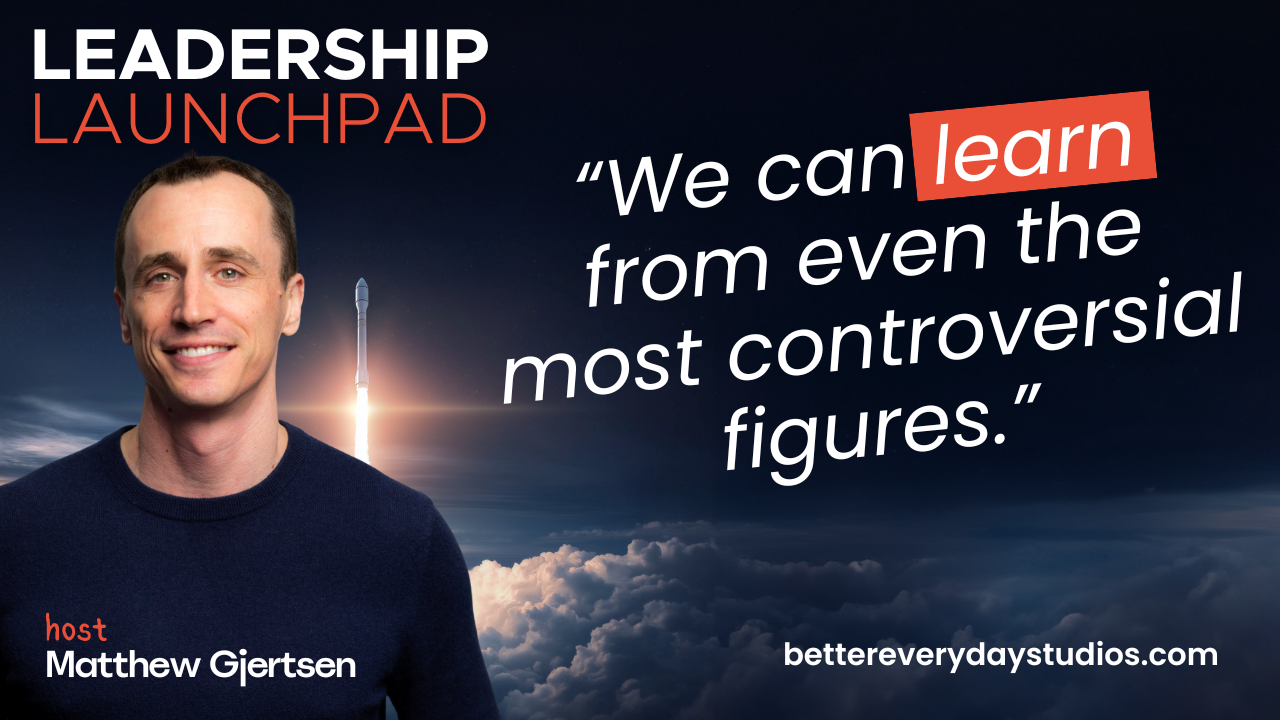
Episode Description
Today, I’ll be sharing three powerful leadership lessons I learned directly from working with Elon Musk at SpaceX. While Elon Musk may be controversial, his innovative approach and remarkable results are undeniable. In this episode, I’ll dive into the principles that have inspired me and can be useful across various leadership contexts. Whether you’re an emerging leader, a seasoned manager, or just looking to improve organizational efficiency, these insights can transform your leadership journey. Don’t miss out on practical advice on simplification, challenging requirements, and optimizing timelines!
---
Want more tips on effective training? Sign-up for our weekly newsletter: https://www.bettereverydaystudios.com/newsletter
Visit us at https://www.bettereverydaystudios.com
Matt Gjertsen [00:00:00]:
There's no doubt that Elon Musk is an incredibly controversial figure. I get it. Like he says some crazy things, but I think if you at least are looking from the point of view of innovation and results, it's hard to argue that he's not one of the most successful leaders in the world today. Again, from that very specific lens, I'm really lucky in that I worked at SpaceX for four and a half years, and I caught kind of a front row seat into how Elon Musk runs his companies. And so I wanted to take a minute today to share with you the three main things that I learned from Elon Musk, from working for him, and that I try to apply every single day as a leader in organizations. Welcome to the leadership launchpad. My name is Matt Church and the founder of Better Everyday Studios. As I said just a minute ago, I am a former head of training development at SpaceX.
Matt Gjertsen [00:00:53]:
Before that, I was an instructor pilot in the US Air Force, and now I work with organizations all around the world to help them make better managers. Like I said at the beginning, Elon Musk is a controversial figure. But there's a lot we can learn if we look at even the most controversial of figures. And there are three specific lessons that I want to cover today, because I think they can be useful in almost any, any context. The first lesson that I learned from Elon Musk is this phrase. What I absolutely love that he says a lot. The best part is no part. The story of this goes back to the beginnings of Starlink, the Internet satellite constellation that now is, you know, massive, and, you know, has over 7000 satellites orbiting the earth.
Matt Gjertsen [00:01:41]:
But when it first started, the satellites were a whole lot different. The very first prototypes of the Starlink satellites, which were called Tintin A and Bdez, were almost the size of a car. They were really big, bulky things, and it looked like, if I remember correctly, SpaceX was going to be able to launch about eight of them in any given launch. Those two were launched. They learned a lot. And then the whole Starlink program went through a massive refresh. And the satellites that ended up getting launched looked completely different. Instead of being the size of a car, they were about the size of a small table.
Matt Gjertsen [00:02:16]:
And instead of launching 80 of them, they were launching 40 of them at a time. Like, they were launching just tons and tons of these satellites every single launch. And it was because of this one phrase that Elon kept repeating again and again. The best part is no part, because every part has the chance to fail. Every part has weight associated with it. We're not here to just put stuff up into orbit. We're here to bring Internet to the world. And so we should be always trying to do that in the simplest way possible.
Matt Gjertsen [00:02:50]:
So you're probably telling me, or saying to me, hey, Matt, that's great. That's a neat phrase. I'm not an engineer, you know, I'm not a technician building things. What does this mean to me? The way I always like to think about this is I just replace the word part with something else. One of my favorites is always the best document is no document, because if you've been in any organizations like me or companies produce documents out of their ears. Like, there's just always another company document, company policy, they seem to just, like, they seem to just be all over the place. And yet, unless you work at a publishing company, your goal should never be to make a document, right. You should always be trying to only make documents if it's absolutely necessary for the conclusion of whatever project you're working on.
Matt Gjertsen [00:03:36]:
Right? The. The document is never the ends. It's a means to an end. And the same thing, too. In my world of learning and development, the best course is no course. I know learning and development leaders out there who joke that they spend the majority of their time trying to convince managers and leaders out in the company that whatever problem they're bringing to them as a learning problem isn't actually a learning problem. And that's true. Anybody in our industry will know the majority of the time a course isn't what you need.
Matt Gjertsen [00:04:08]:
There's some other intervention that is going to be much more effective. And so we should always be trying to say, no, no, no, the best course is no course. Let's find some other thing. Let's have a manager intervention. Do some. Do some performance management on this. Let's introduce a new, a new policy, or, I'm sorry, a new process. We should only make courses when we know for sure that that is the root of the problem.
Matt Gjertsen [00:04:32]:
So this idea, this lens through which you're viewing the world, the best part is no part, is just always reminding me, try to remove, try to simplify, try to create as little as possible to get the job done. Related to this, the second major thing that I learned from Elon, and this is kind of what I think of as the root of his first principles, engineering philosophy. The first step of that philosophy is to question every requirement, because what would happen is they're building these rockets, and rockets are very complicated, and there's all these things and there'd be some part that would have a certain tolerance that it needed, or a certain requirement of, it needs to be able to stand 4000 psi or something. And people would just be, you know, it'd make it really hard to be sourcing these, like, really complex parts in order to do this. And so then Elon would come in and be like, well, why does it need to withstand 4000 psi? And they'd say, oh, I don't know. The document, whatever document, whatever spec we have says that's what it's required. It's like, well, where did that come from? And you peel back the onions, and it was, you know, an intern that wrote it six years ago or something. And there was a reason for it at the time not saying interns don't do good jobs.
Matt Gjertsen [00:05:41]:
Every requirement out there, every law out there was probably created for a reason at the time. But the question is, are we in new times? Has the situation changed? And is that requirement valid anymore? So anytime you're going into some kind of project, you're going into any endeavor where you're saying, oh, well, we need to do x, y, and z. If you look closely enough, chances are, you know, x doesn't apply anymore. Y isn't really a thing that, like, technology has moved beyond it or something. And then z, oh, now that we need to do, you know, this especially happens a lot, or this can be notorious when there's lots of leadership turnover inside of an organization, and a requirement just becomes known as a requirement. A great story of this actually came up in a podcast I was listening to just two days ago where they were talking about this simple example of cooking a ham. And this husband was. He was cooking a ham, and every time he cooked the ham, he sliced the ends off the ham.
Matt Gjertsen [00:06:42]:
And his wife was asking him, well, why do you do that? It seems like that's good meat. Why are we slicing the ends off the ham? And he's like, I don't know. It's just how you cook a ham. That's how we always did it. Well, let's call your mom and find out why you slice off the hand, the ends of the ham. And she says, I don't know. That's how my mom did it, so I just kept doing it. And then they call grandma, and grandma says, oh, well, when we had Thanksgiving dinner, the pan that I had wasn't big enough to put a whole ham in, and so I had to cut the ends off in order to fit the ham in there, you know? And so this two generations of this family had been throwing away meat for some requirement that clearly didn't exist.
Matt Gjertsen [00:07:17]:
There was a good reason for it in the beginning, but it just snuck in there as something that people didn't think about anymore. And so that's what you always want to be doing. Question every assumption, question every requirement. And then the third thing that I love, because Elon does a lot of this management by rhyme. And so the third thing that I really learned from him is this idea that if the schedule is long, the design is wrong. And I think, especially in human resources, we fall into this trap of thinking that everything needs to take forever. We're introducing a new HR system, a new learning management system, and the timelines will be like 18 months to implement these things. And you're just like, why is this taking so long? What are we doing here? Because chances are the longer any project is, the more likely change is going to happen during that project, which means you need to make updates, and that's going to extend the timeline longer.
Matt Gjertsen [00:08:16]:
And so then more changes happen and you need to make updates, and you extend the timeline a little bit longer. If the timeline is long, the design is wrong. Instead of just letting things take as long as we think they're going to take, let's figure, let's put caps on this. You know, some of the most successful companies in the world do this by what they, what they do is they say we have to ship something every six weeks or every four weeks or whatever their cycle is, and everything needs to fit within those buckets. That doesn't mean every project can be done in one go. Maybe you have to break it up, but if you're just letting something, assuming that something's going to take six months, twelve months, whatever it is, you're just not going to be moving at the pace of the business anymore. And so when you start to have a project just starts to look like it's getting longer and longer and longer. You should always be thinking, okay, how can I break this up? What requirement can I get rid of? How can we reframe this thing? How can we break this into chunks where we're blocking out, you know, the development of the project, always trying to think through, how can we make this shorter? Because the world's changing.
Matt Gjertsen [00:09:21]:
The world is obviously changing faster than ever. And so these long projects just mean that chances are you're honestly never going to finish if we're really honest with ourselves. And there's been plenty of projects that I've been involved with, big change management, projects that ended up, just never really getting done. And the project just kind of got canceled because the timelines just kind of ended up being infinite. And that's what you want to avoid. So, yeah, I get it. Elon says a lot of crazy things, especially on X Twitter. You know, there's all kinds of crazy memes that he's always sharing.
Matt Gjertsen [00:09:54]:
It's kind of, you know, he, he doesn't have much of a filter between his brain and his fingers typing on his phone, but he, or at least his companies, have been incredibly successful in some very difficult situations. And so I think anytime there's somebody like that out in the world, there's things that we can learn from them. And since I had the privilege of working for them, working at them and for him, there's some really interesting things that you can learn. The first one, just this idea that the best part is no part. We should only be making things that are absolutely necessary. Question any requirement. And then if the design, if the timeline is long, the design is wrong. I'll never forget those three phrases.
Matt Gjertsen [00:10:36]:
They're always kind of in the back of my mind as I think about building better everyday studios, implementing a project with an organization, working with any new company. So I find it really helpful day to day as a leader. I hope you will, too, and I hope to see you next time on the leadership launchpad. Thank you so much for listening to today's show. If you are looking for help turning your organization's great engineers into great managers, me and my team at better everyday studios would love to help. We deliver targeted and interactive training workshops that are designed to help build the three, three fundamental skills of any new manager, building trust, giving feedback, and setting goals. Reach out to me through matt@bettereverydaystudios.com so we can start making your organization better every day.


