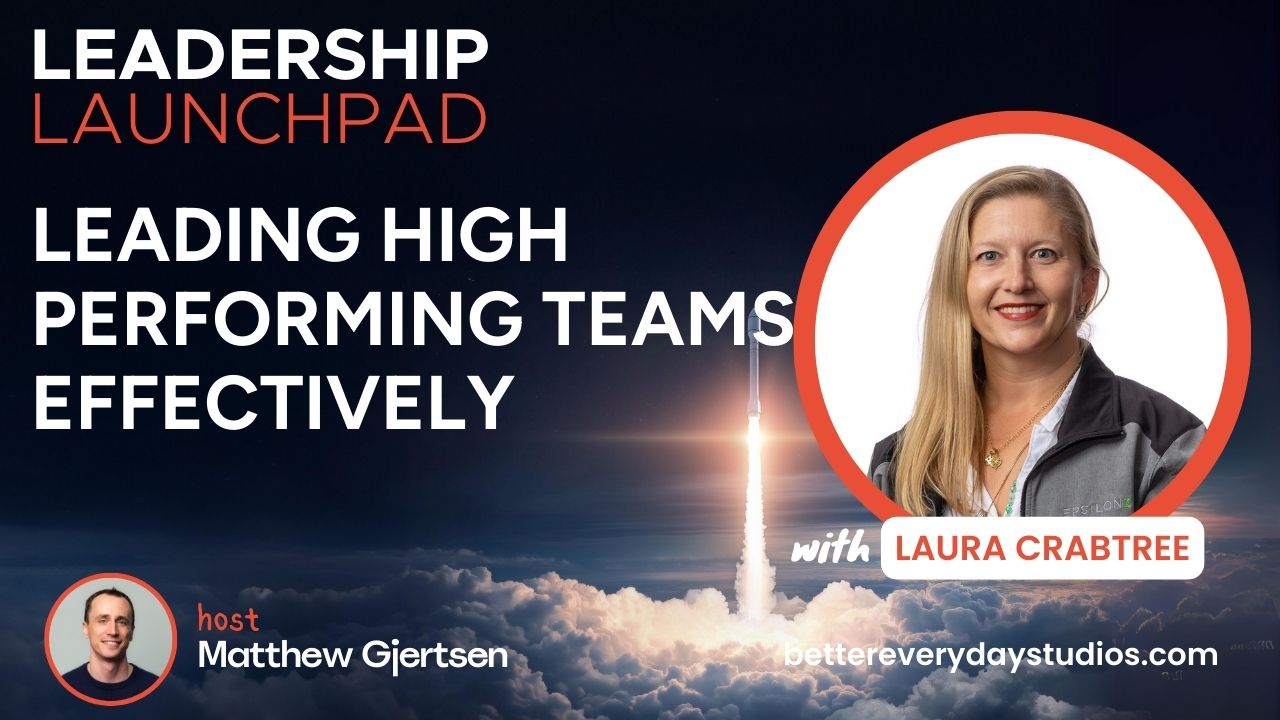
In this episode of Leadership Launchpad, our guest is Laura Crabtree, co-founder and CEO of Epsilon 3. Laura shares her journey from being a critical member of SpaceX's Dragon program to starting her own company. She discusses the transition from individual contributor to people manager, emphasizing the importance of communication, setting boundaries, and maintaining productivity. Laura also highlights the value of training and preparation, drawing from her experiences in high-pressure environments like SpaceX. The conversation delves into leadership styles, balancing managerial duties with individual contributions, and fostering growth within teams. This episode provides practical insights for engineers and aspiring managers looking to develop their leadership skills.
 Automated Transcription
Laura Crabtree [00:00:00]:
I think in order to build a trusting relationship between all of the leadership and engineers, it's better if those people have seen their leaders be productive. You know, this is a person that I look up to, a person that can teach me something and a person that can guide me.
Matt Gjertsen [00:00:32]:
One of the most common questions I get from organizations, in fact, kind of the reason why I started Better Everyday Studios was to figure out how to transition from being a successful individual contributor into being a people manager. And today's guest has some unique insight into answering that question. Laura Crabtree is the co founder and CEO of Epsilon 3. She was previously one of the key members of SpaceX's Dragon program, being there from the initial design phases of the spacecraft all the way through the successful launch of people in 2020. In today's conversation, we're going to learn about the things that Laura found out about leadership in those high pressure situations. We're going to talk a little bit about how important communication is for all phases of leadership, and then finally look at what she thinks it takes to successfully move from being an individual contributor into a people manager. If this is your first time listening to the Leadership launchpad, I want to make sure you take a minute to subscribe so you never miss a future episode. And if you're already subscribed, then I ask that you take just one moment to share this show with at least one other person.
Matt Gjertsen [00:01:45]:
That, after all, is how we grow. I can't tell you how much it means to me. So with that, let's get into the discussion with Laura Crabtree. Laura, it has been a long time. It's been five years, I think it's at least five years, at least. So yeah, so we work together, are kind of, you know, adjacent to one another at SpaceX for a long time. You catch me up what have been doing. You're, you started your own company after leaving SpaceX Epsilon 3.
Laura Crabtree [00:02:10]:
So I, so I was at SpaceX until 2020.
Matt Gjertsen [00:02:12]:
Yeah.
Laura Crabtree [00:02:13]:
And I try to, to play down what happened in 2020, but we all know what happened in 2020, so we'll get there. Yeah. So I left, I left in August of 2020 with kind of a plan to reinvent some other place in the industry. And the, the thing that, you know, spoke to me the most was software.
Matt Gjertsen [00:02:31]:
Okay.
Laura Crabtree [00:02:32]:
And I had built a bunch of software tools, sort of driving requirements and things at my previous companies. So I had done it multiple times. And when I left, a lot of startups, people that I talked to around the industry in aerospace, environment, particular space and Aviation had wanted software tools, better software tools for just mission operations and testing.
Matt Gjertsen [00:02:57]:
Yeah.
Laura Crabtree [00:02:58]:
And so that's where we started.
Matt Gjertsen [00:03:00]:
What. This isn't really what we're going to focus on today, but, like, what drives Adam and you know, because, I mean, you saw the Dragon program.
Laura Crabtree [00:03:07]:
Yeah.
Matt Gjertsen [00:03:08]:
Through, through the whole, the whole life cycle, you know, from the very beginning, all the way to launching humans. There's so many different aspects of that. What led you to the software thing? Like, what is it that operations software needs solved?
Laura Crabtree [00:03:22]:
It's funny, when, when I started at SpaceX, there was. There, There were no Con Ops concept of operations documents, there was no training, there was not even flight software. And the first thing I had to do was figure out what are the operators in Mission Control going to do.
Matt Gjertsen [00:03:39]:
Yeah.
Laura Crabtree [00:03:39]:
And how do we compartmentalize each person's job and then how do we train them to do those jobs?
Matt Gjertsen [00:03:45]:
Okay.
Laura Crabtree [00:03:46]:
And without a design on the software and, or a design of the vehicle, to be honest, we had to sort of start with what are the things that we need to accomplish. And when we got into Mission Control after having no software, we discovered that we, we had a lot of people doing a small number of jobs. And so the directive from on high was no paper and Mission Control.
Matt Gjertsen [00:04:13]:
Yeah.
Laura Crabtree [00:04:14]:
And so we had to start with how do we get to that eventuality of no paper and Mission Control? Because we started printing out PDF documents and we started creating word templates, and that proved to be a fruitless effort, which. Everybody breaks word templates, everybody breaks PDF documents, and there's no traceability of any action that's been taken. And so how are we eventually going to get to pilot copilot, which was the directive. And the only way to do that was to have better training, which you were a part of, and helping with some of the training. And then how do we have better software tools? And so one of the main things that was sort of my secondary or tertiary job was figuring out what tools we needed to get the operators what they needed, the information they needed when they needed it on console.
Matt Gjertsen [00:05:03]:
Yeah, that's. That's incredible. Just, you know, I love the way, you know, you mentioned pilot, co pilot. And so essentially what you mean is you want two people to control Dragon.
Laura Crabtree [00:05:12]:
Yeah. That's all you need, or no people, really.
Matt Gjertsen [00:05:14]:
Yeah, yeah. And it's just interesting, you know, because I, I'm a reservist in the, in the Space Force, and so, and I have some friends that work at Planet as well. And just the difference in kind of the culture of In, I think in, I think in the Space Force right now there's something like 3,500 people controlling a few hundred satellites versus there are a lot, you know, the reverse.
Laura Crabtree [00:05:39]:
Right.
Matt Gjertsen [00:05:39]:
You know, and so much of that comes down to just kind of that top end design and just decisions that are made that obviously took a lot of. I'm sure there was a lot of pressure. You know what?
Laura Crabtree [00:05:51]:
Understatement of the century.
Matt Gjertsen [00:05:53]:
Yeah. What did, I'm just curious, like, what did you learn being in the midst of, you know, this is probably the highest profile, most can't fail mission that SpaceX had?
Laura Crabtree [00:06:04]:
Yeah.
Matt Gjertsen [00:06:05]:
What are some of just like the lessons you learned about how to be successful in that kind of environment?
Laura Crabtree [00:06:10]:
Well, if you, if you look at the first mission, so Dragon 1, which was two orbits and come home, you're looking at we in Mission Control, some of us, many of us gave it a 50, 50 chance.
Matt Gjertsen [00:06:22]:
Yeah.
Laura Crabtree [00:06:23]:
You plan for every eventuality, everything you can think of that could go wrong and you train for it. So there were instances where we were planning to train for two failures deep. So if you think of thruster failures, you have one on one thruster fail, one on the other side. Can you still get home if you go three failures deep? There are things you can do, but you're not planning for that. So what is your threshold for how many failures you can actually take?
Matt Gjertsen [00:06:56]:
Interesting.
Laura Crabtree [00:06:56]:
To successfully complete the mission.
Matt Gjertsen [00:06:58]:
Interesting.
Laura Crabtree [00:06:58]:
And so you basically train the operators for every worst case scenario you can think of. And if you find a worst case scenario that software team can then mitigate for in flight, they go write software code to fix those problems before you fly. And so what we did was we tested the software past where people thought it was necessary to do so with people.
Matt Gjertsen [00:07:23]:
Interesting.
Laura Crabtree [00:07:23]:
Because testing software in automated setting is different than if the people controlling the vehicle are actually looking at it and evaluating data in real time.
Matt Gjertsen [00:07:33]:
Yeah.
Laura Crabtree [00:07:33]:
And so I think what we learned was, you know, here, here's your design criteria. You want to go past your design criteria to really make sure that you have got all of the things under control that you can.
Matt Gjertsen [00:07:47]:
Yeah.
Laura Crabtree [00:07:47]:
And then you basically check everything and check it again. Yeah. And making sure that also you are putting, putting all of your operations team into the most stressful scenarios possible.
Matt Gjertsen [00:08:00]:
Yeah.
Laura Crabtree [00:08:01]:
So the most lifelike, the most stressful. So that when they get into the real time operations and things happen, which.
Matt Gjertsen [00:08:07]:
Yeah.
Laura Crabtree [00:08:08]:
Inevitably they will.
Matt Gjertsen [00:08:09]:
Yeah.
Laura Crabtree [00:08:09]:
Nobody freaks out.
Matt Gjertsen [00:08:10]:
Yeah.
Laura Crabtree [00:08:11]:
And that was. Those were hard, hard days.
Matt Gjertsen [00:08:13]:
That was the favorite, my favorite part of pilot training was there's very high fidelity simulators I've seen.
Laura Crabtree [00:08:22]:
I want to fly them, but I've seen them.
Matt Gjertsen [00:08:23]:
Yeah, they're incredible. And I remember very clearly, uh, when I was flying the T6, the first plane you fly when you're in pilot training in the Air Force, uh, you'd kind of go in and there would be whole sim sessions where you're there for about 90 minutes. And it was just kind of like the instructors over there, it's just like, can they kill you?
Laura Crabtree [00:08:40]:
Yes.
Matt Gjertsen [00:08:40]:
So it'd just be like, let's do an engine failure here.
Laura Crabtree [00:08:42]:
Yes.
Matt Gjertsen [00:08:43]:
Okay, let's you survive that. Okay, let's back it up a mile and give you an engine failure there. Can you make it now? Uh, and it was a great way to kind of, kind of pressure test and push and push the envelope. But, but one thing that I heard in your answer is it sounded like you, you were putting the operators in a stressful position. Possible, but you still drew some line of what makes sense to test so you're not just there forever. And I feel like that's kind of a really one lesson that can be applied in a lot of places, but certainly to managers is how do you figure out where to draw the line of what you need to plan for so that you're not just always there. I know in engineering fields they always say like engineers like to engineer, you just want to like keep going.
Laura Crabtree [00:09:26]:
Yeah, you do.
Matt Gjertsen [00:09:27]:
How do you. From an operational perspective, how, how did you draw that line of knowing to stop?
Laura Crabtree [00:09:31]:
Well, at some point you don't. You always have a Kobayashi Maru scenario that you give everybody. You always, you always give everybody at least one place where they are going to fail.
Matt Gjertsen [00:09:41]:
Yes.
Laura Crabtree [00:09:41]:
And they have to like internalize it and recover from it because there's always unexpected things that can happen.
Matt Gjertsen [00:09:49]:
Yeah.
Laura Crabtree [00:09:49]:
And you may have a scenario like that. I haven't seen one.
Matt Gjertsen [00:09:53]:
Yeah.
Laura Crabtree [00:09:53]:
But. Well, actually I did see one. Sierra 7 was one.
Matt Gjertsen [00:09:57]:
Sure.
Laura Crabtree [00:09:58]:
But for, for managers, you have to like set the boundaries to past what is easy, but not so far as to this is unattainable and the person is never going to complete this. So you know, generally what I do with our engineering team is I say, okay, here's the goal. And if you meet this goal, you were at 100, completion of month, a quarter, whatever. Let's set the goal to be 90% so that if you hit 90% you feel really, really good. But there's always that extra little bit that you could do beyond that so that you could say, Well, I hit 100 of what was planned for sure. This quarter. This, this month. Yeah, but it's, it's really hard line.
Laura Crabtree [00:10:46]:
Like it's. Where do you draw that line is hard.
Matt Gjertsen [00:10:50]:
Yeah.
Matt Gjertsen [00:10:50]:
And it's, it's different for everybody too. It's different for each employee of how much they can take, what they're ready for, for the situation. You know, if your company is in a really risky spot, maybe you can't take, you know, maybe you need to push farther or you can't push as much. It's, it's sounds very situational.
Laura Crabtree [00:11:04]:
Yeah. It's also hard in Q4, which is, that's true. Which is really hard. We were talking about it earlier this week, which is, you know, Q4 is hard to plan for because you can't plan as much as you planned in Q3, knowing that there's three, four weeks that people might be in and out.
Matt Gjertsen [00:11:21]:
Yeah.
Laura Crabtree [00:11:22]:
That is a hard thing for leadership and managers to.
Matt Gjertsen [00:11:24]:
Yeah.
Matt Gjertsen [00:11:25]:
If only just everybody just worked all the time and it was just easy.
Laura Crabtree [00:11:28]:
No, everybody needs time off. And that's the other thing is how do you encourage people to be productive and still take time off?
Matt Gjertsen [00:11:36]:
Yeah. Yeah.
Matt Gjertsen [00:11:38]:
We were having this discussion. Right. Right before we sat down. I, it sounds like we went through similar phases. So when I, I was, I think, lucky in the sense that I started at space x 3 months after my daughter was born.
Laura Crabtree [00:11:50]:
Oh. Yeah.
Matt Gjertsen [00:11:51]:
So I came in with like, no, there's lines that I'm not going to cross. Uh, but even then I still didn't realize until much later where I would actually get to points where I would say, okay, I am only going to work 40 hours this week. I'm not going to tell anybody else. I'm not going to ask to reduce my workload.
Laura Crabtree [00:12:11]:
Yeah.
Matt Gjertsen [00:12:11]:
But I am only going to work 40 hours a week. I have to figure out how to get the important stuff done in those 40 hours. And it just really unlocked a lot because I had to think differently.
Laura Crabtree [00:12:21]:
Well then you don't have 45 minute conversations over coffee.
Matt Gjertsen [00:12:24]:
Right.
Laura Crabtree [00:12:26]:
And which happens a lot there. There are a lot of people who are there more time and yet complete the same amount of work that are for us people who are there less.
Matt Gjertsen [00:12:37]:
Yeah.
Laura Crabtree [00:12:38]:
And that, that was hard for me because I was there, you know, 7:00am to 7:00pm for much of my career. And then after my kids were born, I had to leave to go pick them up at school. And that was, that was a hard transition because I, I wasn't less productive. I was just there less time. And as one of my old managers said, perception is reality. And I hated that he said that to me. But the perception was that I was not physically there.
Matt Gjertsen [00:13:07]:
Yeah.
Laura Crabtree [00:13:08]:
So in other words, that was everybody's reality, was that I was not physically there. Even though after my kids went to bed, I would go back to work.
Matt Gjertsen [00:13:15]:
Yeah.
Laura Crabtree [00:13:16]:
So it's hard.
Matt Gjertsen [00:13:17]:
It is hard. I was, I was very lucky. After I left SpaceX, the company that I went to was a very similar kind of grind culture. Lots of young people, they incentivized. You know, you get free dinner if you stay past 6:00. And so everybody and I going into it was very clear. I'm like, look, I'm going to leave at 5, like, I'm going to show up early, so I'm going to be here before everybody else, but I need to be home for dinner and it's important. Yeah.
Matt Gjertsen [00:13:41]:
And. And I was really lucky that I had a manager who was totally fine just kind of clearing the way for that. Like when I, when I'm standing up at 5 and saying bye, she had no problem with.
Laura Crabtree [00:13:52]:
And you're not having to like, like sneak out.
Matt Gjertsen [00:13:55]:
Yeah, yeah, yeah. Other people might have looked at me a little weird because they were getting ready to stay until 9:00 even though they hadn't shown up until 10:00. Yeah. But she gave me that permission and that kind of, that freedom how. Shifting kind of to Epsilon 3.
Laura Crabtree [00:14:11]:
Yeah.
Matt Gjertsen [00:14:12]:
When we talk. A couple months ago, there was, you know, we talked a little bit about the, the challenge of kind of growing managers from individual contributors. Sticking on this point of, you know, looking at the productivity over the time is. Is that one of the difficult things to get managers to value because it's so easy to just look at the. Look at the time.
Laura Crabtree [00:14:33]:
Well, you know, we're a remote company, so nobody actually looks at the time. So now the only thing that we look at is productivity.
Matt Gjertsen [00:14:41]:
Yeah.
Laura Crabtree [00:14:42]:
We only look at how much you're doing, how happy your customers are, etc. And I don't look at how much time people spend because nobody clocks in and clocks out, which is different than when I was at Northrop. When I was at Northrop Grumman, you are bookkeeping every six minutes. So every tenth of an hour is book kept. So I would have to imagine, you know, 0.3 hours on this job number and 1.5 hours and it would have to total up to eight every day or. And I had to put in. And I don't know how that's how it still works now.
Matt Gjertsen [00:15:16]:
Yeah.
Laura Crabtree [00:15:17]:
2009. So this was a while ago.
Matt Gjertsen [00:15:19]:
Now they just have tracking software. They're watching your eyes.
Laura Crabtree [00:15:21]:
Maybe. Maybe they're like. Well, she was looking at this document for 25 minutes. So we're going to round up.
Matt Gjertsen [00:15:28]:
Yeah.
Laura Crabtree [00:15:29]:
To 30 and call this a half an hour. But you know what, what ends up happening is the leaders, you know, at, at Epsilon 3 in particular, those are people that have grown into the leadership role. They are not people that we hired into those roles. Because I think in order to build a trusting relationship between all of the leadership and engineers in particular, it's better if those people have seen their leaders be productive and be sort of one of them.
Matt Gjertsen [00:16:02]:
Yeah.
Laura Crabtree [00:16:02]:
For them to fully understand and appreciate. You know, this is a person that I look up to, a person that can teach me something and a person that can guide me.
Matt Gjertsen [00:16:11]:
Yeah.
Laura Crabtree [00:16:12]:
And that's. I would prefer that.
Matt Gjertsen [00:16:13]:
Yeah.
Matt Gjertsen [00:16:14]:
That makes a lot of sense. So let's kind of go through that lifecycle then. You know, when you're looking at the individual contributors.
Laura Crabtree [00:16:21]:
Yeah.
Matt Gjertsen [00:16:22]:
What are the things that are kind of cues to you of this person might be a good people manager versus they're just a really good individual contributor. How are you judging that?
Laura Crabtree [00:16:32]:
So I think it, it stems from how other people react to them.
Matt Gjertsen [00:16:35]:
Okay.
Laura Crabtree [00:16:36]:
And you look at a bunch of younger engineers, will look to a more senior engineer that wants to mentor them, that wants to help them, and they gravitate towards that person or those people. And those are people who are growing into a more leadership style position.
Matt Gjertsen [00:16:58]:
Yeah.
Laura Crabtree [00:16:59]:
You can't necessarily just pick somebody who wants it.
Matt Gjertsen [00:17:02]:
Yeah.
Laura Crabtree [00:17:03]:
Because that's how you break an organization. And unfortunately, people who really want it aren't always the best choice. It's usually the people who don't want it that are the best choice. And then you have to try to convince them to lead.
Matt Gjertsen [00:17:18]:
Yeah.
Matt Gjertsen [00:17:19]:
I think years ago I remember hearing, like, nobody should want to win a medal of honor.
Laura Crabtree [00:17:24]:
No.
Matt Gjertsen [00:17:24]:
Because the things you need to go.
Laura Crabtree [00:17:25]:
Through to win, the things you have to do.
Matt Gjertsen [00:17:27]:
Yeah. Yeah.
Matt Gjertsen [00:17:28]:
And it's.
Matt Gjertsen [00:17:28]:
Yeah.
Matt Gjertsen [00:17:29]:
I, I think that that makes a lot of sense of like, if you know what it takes. Because especially for like really hard, charging, successful individual contributors. I think it's really important to be honest that when you become a people manager almost by default, you have to get less good at whatever skill that.
Laura Crabtree [00:17:46]:
Got you there or you take less time to do it. So, you know, when you are an individual contributor and not a people manager, you are doing 100% work on your own and maybe on your Free time mentoring and helping other people. You know, in our case, looking at their code, reviewing, teaching them best practices, et cetera. But when you become a people manager, you likely have to do as much individual contributor work plus. Plus manage people. Yeah, which, which is, you know, one on ones goal setting, helping them kind of grow into what they would like to be in the future.
Matt Gjertsen [00:18:23]:
I'd like to go a little bit deeper on that point for a second because I have talked to other people who think the problem with management today is that we don't let managers be just managers managers. And I've talked with other people who say, no, no, no. The key is that you have managers who also have individual contributor duties. And if you don't, then, then that's gonna, gonna break it. And certainly it's probably different in different organizations. Yeah, but it sounds like you come down a little bit more on. Or is it. Is the IC duties just a reality of the fact that you're a growing business and you need people to do it, or is it kind of a deliberate choice if you want them to kind of stay?
Laura Crabtree [00:18:59]:
It's both. It's both. So when I was at Northrop Grumman, we were a matrix organization, which is you have a functional manager and then you have a project or a program manager. And so your functional manager, you'd have the systems engineering group and all the systems engineers get farmed out to all the different programs and then you have a program manager. So you have two managers that you report to. One where you're being graded against all the other systems engineers, and then one where you're being graded against the people in your program. And the person that writes your review is your lead on the systems engineering side. So like the functional, your functional leader.
Laura Crabtree [00:19:36]:
So I had two managers I was reporting to and two people driving what I needed to do. Yeah, that's really confusing.
Matt Gjertsen [00:19:44]:
Yeah.
Laura Crabtree [00:19:45]:
So that was my first foray into what does my manager need me to do. And it was very hard for me to handle that. So when I went to SpaceX, I had one manager and one direction to go in. And that manager was as productive as I was and yet still managed all the people. Now, I think SpaceX maybe does like the complete opposite, whereas they don't actually. Well, at the time they didn't really teach people how to manage. And so you ended up with managers that didn't need to be managers because they were leaders in the technical aspect. And sometimes that's really good thing and sometimes it's not.
Matt Gjertsen [00:20:28]:
Yeah.
Laura Crabtree [00:20:29]:
And so I think I land somewhere in the middle, which is you need to spend, I don't know, 25% of your time managing, and then the other 75% of your time, you need to be showing all the people that work for you how much you can accomplish so that you're all working together towards the same goal.
Matt Gjertsen [00:20:49]:
Okay.
Laura Crabtree [00:20:49]:
And so I think the most successful teams that I've worked on are where the manager spends time and thinks about how they want to manage the people that work for them and contributes individually. But it's not 50, 50. It's somewhat skewed towards individual contributors towards the work. Yeah.
Matt Gjertsen [00:21:09]:
Okay, that makes sense. Since you're growing leaders, what are some of the common pitfalls you've seen people fall into as they try to. I really like to focus on this, this transition point of going from IC into first time manager. What are the kind of common challenges that you see there?
Laura Crabtree [00:21:28]:
Well, one, it's, you know, you, you have to spend time managing.
Matt Gjertsen [00:21:31]:
Sure. Yeah.
Laura Crabtree [00:21:32]:
You have to actually be mindful.
Matt Gjertsen [00:21:34]:
Yeah.
Matt Gjertsen [00:21:34]:
Realizing that you've made a change.
Laura Crabtree [00:21:36]:
Right. And, and realizing that all of these people look to you for guidance and leadership. And then the other, which we just kind of touched on, which is, you know, you forget sometimes if you go all the way towards managing that, you still have that individual contributor piece. And it could be one of the same kind of one way or the other.
Matt Gjertsen [00:21:58]:
Yeah.
Laura Crabtree [00:21:58]:
And then kind of the other thing is, you know, what, how do you organize yourself? How do you organize one on ones? How do you keep track when somebody asks you, you know, hey, in the next year or two, I want to get a promotion. What are the steps that I need to do? What are the things I need to show you to get there and really like laying those things out and communicating that either to your leadership above you, or to the person, what they need to do to be able to see and realize that goal.
Matt Gjertsen [00:22:27]:
Yeah.
Laura Crabtree [00:22:28]:
And the goals for the people should always be part of the growing business.
Matt Gjertsen [00:22:33]:
Yeah.
Laura Crabtree [00:22:35]:
And that's the thing that I have a hard time with, which is like, if your goal is, I want to get a promotion, but it doesn't entail, I want to do these things to show you that I deserve a promotion. It's just, I want a promotion. It's really guiding people towards what are the things that sort of drive your growth and the business growth that you can do to prove to us that you need to get to the next level.
Matt Gjertsen [00:23:01]:
Yeah.
Matt Gjertsen [00:23:02]:
It sounds like the biggest pitfall you've seen is just people not realizing that management is a Skill.
Laura Crabtree [00:23:09]:
It's an organizational.
Matt Gjertsen [00:23:10]:
Yeah. That they need to now develop.
Laura Crabtree [00:23:12]:
I think that's across the, the board of every place I've worked.
Matt Gjertsen [00:23:16]:
Oh, interesting.
Laura Crabtree [00:23:17]:
People don't think of management as a skill. They feel it's a placement. And I think we, as a, an industry, maybe in aerospace, could think more diligently about how we teach people to manage and speak to one another.
Matt Gjertsen [00:23:35]:
Well, it's tough because, I mean, obviously we're in the middle of, you know, Boeing is in the middle of a pretty bad spot.
Laura Crabtree [00:23:42]:
Yes.
Matt Gjertsen [00:23:42]:
The thing that a lot of people say, I, you know, I grew up in Seattle, so I know a lot of people from there and they even point to, you know, it was when like the business types came in. And, and there's, I think we have lots of examples within the industry where too much of a focus on business is bad. So it kind of leads to, oh, well, we're going to pretend it's not there. We need to focus on the technical side of things. And so. But it sounds like that's where that balance comes in of kind of the time that you're spending on it. Always staying grounded in the technicals.
Laura Crabtree [00:24:14]:
Yeah. What, what I tell my kids is, you know, you have to balance and everything in moderation.
Matt Gjertsen [00:24:20]:
Sure.
Laura Crabtree [00:24:21]:
So I always tell my kids, you know, you've got to eat your vegetables, but you can't only eat vegetables. You have to eat the meat also. So it's, you know, you have to look at it as a piece of the moderation schema.
Matt Gjertsen [00:24:32]:
Yeah.
Laura Crabtree [00:24:33]:
So you can't just hire finance people and expect them to run the business. And you can't have just engineers and expect them to run the business. You have to have them working together. And it's the same as management versus IC work or hiring and teaching people to be managers and then expecting them to just manage. They're not going to know all of the technical things that people are doing, all the nitty gritty technical decisions that are being made. And I think that's the important thing is having engineers that understand the technical decisions that are being made, the risks that are being weighed, and then balancing that with, what's your schedule? How do you guys make money? How do you continue to show growth in the business? Through kind of a partnership between the business aspect and, and the engineering aspect.
Matt Gjertsen [00:25:18]:
Yeah. How did you develop those skills? Was it trial by error? Did you have any, any kind of, you know, specific things you did to try to develop that in yourself?
Laura Crabtree [00:25:31]:
So I, when I was in high school, I worked at a Bagel shop, which is okay. Like going way, way back.
Matt Gjertsen [00:25:39]:
Everybody needs a service job at some point. Point.
Laura Crabtree [00:25:41]:
Everyone needs a service job. This is how you learn to speak to people and how you learn to deal with adversity.
Matt Gjertsen [00:25:48]:
Yes.
Laura Crabtree [00:25:49]:
And I got yelled at quite a lot actually, because I was in high school.
Matt Gjertsen [00:25:54]:
Yeah.
Laura Crabtree [00:25:54]:
And there was a time when a customer yelled at me and I looked at my manager at the time and he was, I don't know, 25 or something. And he said, laura, it's okay, go to the back. Because he could see in my face that I did not want to be there.
Matt Gjertsen [00:26:07]:
Yeah.
Laura Crabtree [00:26:08]:
So. So I walked to the back and I just sat down and I thought to myself, I need to learn how to like, not let things like that affect me. And so over the course of the next couple of years and through the rest of, through the, through college and through my first couple of years working, I developed a thicker skin with respect to what people would say to me.
Matt Gjertsen [00:26:29]:
Yeah.
Laura Crabtree [00:26:29]:
And I, when I was working at Northrop Grumman, I lived in England and I was working operations there. So I was working 12 hour rotating shifts with a bunch of ex military people. And the way they speak to one another is completely different than the way that just engineers in college speak to one another just by default. And so I had to learn to adapt. And I went back to the skills that I sort of honed in my service professions. Cause that was only one of the service jobs that I worked. Yeah, I had four, which they all have like a special place in my heart because I learned so many good skills through that. But I went back to that and I just thought, you know, these people, they mean well.
Laura Crabtree [00:27:17]:
I have to default to. Everybody means well. And so I, you know, they don't mean to make me feel the way that they're making me feel. So I have to think about it from like, what is the intent of what they said? And so I learned how to speak to different people. And that's sort of the start, in my opinion of management.
Matt Gjertsen [00:27:37]:
Yeah.
Laura Crabtree [00:27:38]:
And leadership is learning how to adapt the way that you respond in different situations and not letting people sort of ruffle your feathers.
Matt Gjertsen [00:27:46]:
Yeah.
Laura Crabtree [00:27:47]:
And because of what they say or how they act or what they look like. Or whatever.
Matt Gjertsen [00:27:52]:
Yeah.
Laura Crabtree [00:27:52]:
And so that was when I knew that, you know, I could speak to anyone and I could sort of internalize and talk about it later and laugh about it. That was when I knew it was okay to work in any situation. And when I started at SpaceX, it was more of the same because People from all walks of life. I worked a little bit out on the production floor doing some welding. I worked with the structures team and the, you know, GNC team and they all have a different way of speaking to one another.
Matt Gjertsen [00:28:27]:
Yeah.
Laura Crabtree [00:28:27]:
And being in operations, you work with everybody from the top all the way down to the technicians.
Matt Gjertsen [00:28:35]:
Yeah.
Laura Crabtree [00:28:35]:
And it's the same way in management and leadership.
Matt Gjertsen [00:28:39]:
Yeah.
Laura Crabtree [00:28:39]:
Because every team is made up of a smattering of different personalities.
Matt Gjertsen [00:28:43]:
Yeah.
Matt Gjertsen [00:28:43]:
Different people.
Laura Crabtree [00:28:44]:
So that was how I Learned. But also SpaceX at the time had a course that you went through when you became a lead. And I went through this training course which basically was like goal setting, how to speak to different people. And I thought back to my times at all those different jobs and I thought, well, I've learned those skills now, here's how to apply them.
Matt Gjertsen [00:29:06]:
Yeah.
Laura Crabtree [00:29:07]:
Which was great.
Matt Gjertsen [00:29:07]:
Yeah.
Matt Gjertsen [00:29:08]:
I think you're totally right in that Adaptability is one of the. You know, I think if there was one lesson that I would want every new manager to get is that when you become a manager, it's not about you.
Laura Crabtree [00:29:19]:
No. Like, that's everybody else.
Matt Gjertsen [00:29:20]:
That's the switch. Yeah. And so it's about. I do think there's a lot of. There's a tendency to still have this feeling of, oh, but I'm a leader, people need to adapt to me. This is how I communicate. So you need to fall in line. And we maybe kind of exacerbate that problem because it's sometimes true at the highest of levels, you know, like at a CEO, like maybe you, you're coached on, like how to talk to the CEO.
Matt Gjertsen [00:29:45]:
And so, you know, maybe in certain situations, but it's pretty rare. And certainly anything below that, it's just, it shouldn't be there for sure. Even at the highest levels, it really shouldn't be there. Probably they should be adjusting to the people that they are now serving.
Laura Crabtree [00:30:01]:
Right. Well, if you are a servant leader, which I think I have defaulted to based on my experiences, that's what I've been told, at least. I didn't know that there were certain types of leaders, but here I am and, you know, I, I hired someone and he said, you know, you're very servant leader oriented. And I thought, I don't know what that means. Let me go look it up. So. So I learned what that meant, which is, you know, I adapt and I listen to all of the people that work at Epsilon 3 and that work for the company to try to unblock them from whatever is in their way, whether it be Personal, professional, different people within the organization, etc, I try to just like, make their work life as simple and easy as possible. Here.
Laura Crabtree [00:30:49]:
Here are the goals. And then we set goals together. It's not, you know, Laura says you have to do this, and therefore, you know, everybody falls in line because who would want to work for that person?
Matt Gjertsen [00:30:57]:
Yeah.
Matt Gjertsen [00:30:59]:
Yeah, I. I totally agree with you on that one.
Matt Gjertsen [00:31:02]:
Yeah.
Matt Gjertsen [00:31:02]:
Well, this is. This has been great. I'm glad we got to reconnect. I think it's been a really, really great discussion. It's. I'm. We found similar lessons, I think, through the. The at least the certain.
Matt Gjertsen [00:31:13]:
Similar experiences that we've had, which is really great.
Laura Crabtree [00:31:15]:
So what was your favorite plane to fly?
Matt Gjertsen [00:31:18]:
My favorite. Honestly, my favorite job I've probably ever had was as a T1 instructor pilot. So T1 is a little business jet. It's based off of Beach 400. And so it was basically like, I got my own private jet that I just flew around the country. Usually I had somebody else and I'm, like, teaching them, but I just. That was. That was a great time.
Laura Crabtree [00:31:38]:
That's awesome. How long did you do that for?
Matt Gjertsen [00:31:40]:
Three years.
Laura Crabtree [00:31:41]:
Okay.
Matt Gjertsen [00:31:41]:
And so I think there's something special about, you know, the operations side of things, you know that it's just. I think pilot training was really, really cool because you were in this really compact environment where, you know, you're at an airfield where there's maybe 30 airplanes all buzzing around, where half the people in them don't know what they're doing.
Laura Crabtree [00:32:04]:
Scary, but also cool.
Matt Gjertsen [00:32:06]:
You got to be on the ball. You gotta.
Laura Crabtree [00:32:07]:
You gotta be like, okay, paying attention at all times.
Matt Gjertsen [00:32:09]:
Yeah, yeah. It was a lot of fun. It was a lot of fun.
Laura Crabtree [00:32:12]:
So you still fly?
Matt Gjertsen [00:32:13]:
Unfortunately, it's expensive to fly when the military is not paying for it, so. So I haven't been flying for a while. Okay. With. I recently moved out of la up to Northern California.
Laura Crabtree [00:32:25]:
Okay.
Matt Gjertsen [00:32:26]:
And so, yeah, I'm hoping to get back into it. Yeah. Because it was a lot of fun.
Laura Crabtree [00:32:30]:
I gotta learn. I don't actually know how to fly a plane, but I can fly a spacecraft.
Matt Gjertsen [00:32:34]:
I bet. It's funny. One of the hardest things to teach people about flying a plane is how to talk on the radios. Oh, so you would have a leg up.
Laura Crabtree [00:32:44]:
I can do that.
Matt Gjertsen [00:32:45]:
Because really, what flying a plane is, is. It's a lesson in how to deal with too much information.
Laura Crabtree [00:32:53]:
I can do that.
Matt Gjertsen [00:32:53]:
Exactly. You've. You're used to looking at lots of instruments, listening to multiple people talk into your Head at the same time figuring out what's important for you and making. Making the decision. That's really the hardest part about flying.
Laura Crabtree [00:33:05]:
Okay.
Matt Gjertsen [00:33:05]:
The like push, pull, like stuff that this is.
Matt Gjertsen [00:33:08]:
Yeah.
Matt Gjertsen [00:33:09]:
You'd pick it up pretty fast.
Laura Crabtree [00:33:10]:
It's funny, I. I was flying with a friend of mine a couple years ago and he said the same thing and he said, I think you've got that down because every time I'm into mission control with you, there's 10 people talking and I see you have 10 different loops on. And I say, laura blah, or whatever your call sign is and you respond right away. I said, well, I can take 10 inputs and figure out which one is important at any given time.
Matt Gjertsen [00:33:36]:
Yeah.
Laura Crabtree [00:33:36]:
And that's the special skill that he said.
Matt Gjertsen [00:33:39]:
It is.
Laura Crabtree [00:33:39]:
It's interesting that you said the same thing.
Matt Gjertsen [00:33:41]:
Yeah.
Matt Gjertsen [00:33:41]:
In Afghanistan, very often we're, you know, flying overhead and. Yeah. We'd be talking on three radios at once and. And flying plane and stuff. It's a friend of mine. I remember when I first joined the Air Force, I was with an F16 unit.
Laura Crabtree [00:33:54]:
Okay.
Matt Gjertsen [00:33:55]:
And the. One of the more experienced pilots said, if you are flying the plane, you're behind because your job isn't to fly the plane. Your job is to employ the plane. Plane.
Laura Crabtree [00:34:06]:
Tell the plane what needs to be done and let the plane do it.
Matt Gjertsen [00:34:08]:
Exactly. And so the flying of it needs to be second nature. And so I think that's why it's interesting kind of to loop back to the beginning of the conversation about kind of the strategic direction with Dragon early on to like, make it simpler and simpler. It's because, like, we don't care about. It's not that we care about flying Dragon. We care about doing something with this spacecraft. You know, it's not. It's not.
Matt Gjertsen [00:34:32]:
We're not holding on tightly to this particular position. It's just we want to go do stuff.
Laura Crabtree [00:34:37]:
Right. So you want to rendezvous with the space station.
Matt Gjertsen [00:34:40]:
Yeah.
Laura Crabtree [00:34:40]:
And that was actually most of the training was talking, was teaching people how to communicate with one another, teaching people how to listen to NASA or any other inputs, faa, etc, and process the information that they gave to make decisions on what was coming next.
Matt Gjertsen [00:34:59]:
Yeah.
Laura Crabtree [00:35:00]:
Rather than, you know, I mean, there were a lot of things happening in the background, figuring out rendezvous profiles, etc. But as that became more and more automated, more of the job was communication, coordination, data input, data output, rather than actually physically flying.
Matt Gjertsen [00:35:18]:
Exactly.
Matt Gjertsen [00:35:18]:
Yeah.
Matt Gjertsen [00:35:19]:
That's what really unlocks potential.
Laura Crabtree [00:35:21]:
It's all about communication.
Matt Gjertsen [00:35:22]:
Yeah.
Matt Gjertsen [00:35:34]:
Absolutely awesome. Well, that is a perfect way to put a cap on episode. Thank you so much for being here. We definitely got to keep in touch.
Laura Crabtree [00:35:41]:
Absolutely. Thanks.
Matt Gjertsen [00:35:43]:
Thank you so much for listening to today's show. If you are looking for help turning your organization's great engineers into great managers, me and my team at Better Everyday Studios would love to help. We deliver targeted and interactive training workshops that are designed to help build the three fundamental skills of any new manager building trust, giving feedback, and setting goals. Reach out to me through Matt better everyday studios.com so we can start making your organization better every day.