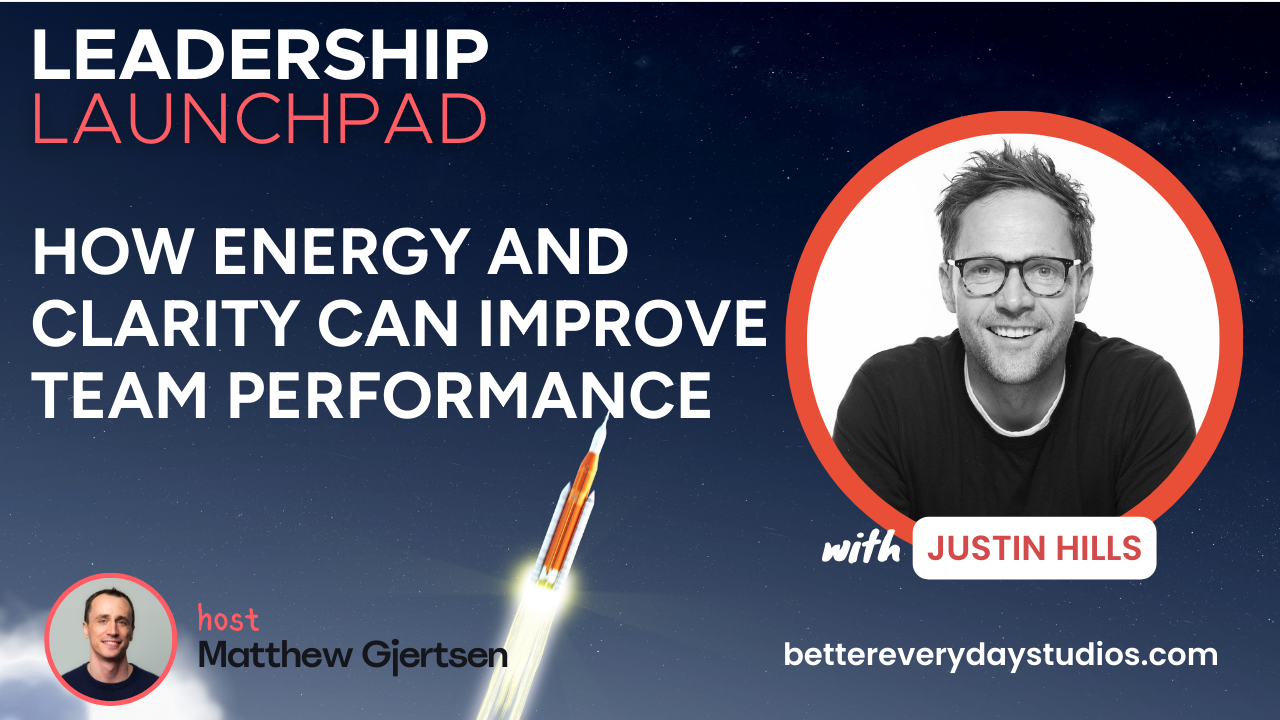
Episode Description
This week’s episode features an enlightening conversation with Justin Hills, leadership performance coach and strategic advisor. Justin talks about the direct link between workforce health and productivity, highlighting the need for energy and clarity in leadership. He introduces his business, Courageous and Co., and emphasizes creating a psychologically safe work environment. Matt Gjertsen, our host, delves into the shift in career advancement and the importance of focusing on strengths. Together, they discuss practical techniques for maintaining a positive mindset and the evolving challenges in leadership styles. Join us to explore how to foster a more human-focused and respectful workplace.
Connect with Justin on LinkedIn: https://www.linkedin.com/in/justinhills/
Visit Justin’s website: https://www.courageousand.co/
Justin Hills [00:00:00]:
If you walk into a room, or if you're in a room and someone walks into that room and they're in a bad mood and say they're in a senior executive role, the room shuts down. That's energy. No one said a single thing. And the opposite is also true. If someone, if you go into a room and there's sort of chaos in there, or confusion in there, or sort of uncertainty or unhappiness, and you go in there with clear sort of calm confidence, you can change the room just by the presence.
Matt Gjertsen [00:00:36]:
Hello and welcome to the leadership launchpad, where we help technical managers improve themselves, their teams, and their organizations. Over the course of 20 years of working at aerospace and technology, I have gotten to work with some of the smartest people on the planet, and I have witnessed firsthand how many of them struggle making that first jump to being a people leader. On this show, we talk with industry experts, coaches, and authors to help give you actionable insights to help improve your own performance and the performance of those around you. Our guest today is Justin Hills. Justin is a leadership performance coach and strategic advisor to executives and organizations, helping them maximize how they lead. We met at a networking event where he took a small group of learning practitioners through some great exercises to discover more about ourselves and the things we all have in common. He started his career working on world leading brands such as the Grand Theft Auto series, video games, and a few years ago he decided to shift out of marketing and into leadership coaching. In this conversation, you can expect to learn how to identify your values as a leader, why you should be focusing on your strengths instead of your weaknesses, and how leaders can transform the performance of their teams by focusing on the energy and clarity they bring to every conversation.
Matt Gjertsen [00:02:05]:
Before we get into that discussion, I do want to remind everyone that if you aren't subscribed already, make sure to hit subscribe. Like the podcast, it really helps us. And if you are already subscribed, then I would ask that you share this show with at least one other person. Because that, after all, is how we grow. I can't tell you how much it means to me. And with that, let's get into the conversation with Justin Hills. Justin, thank you so much for joining us today. Welcome to the making Better podcast.
Matt Gjertsen [00:02:36]:
How are you doing?
Justin Hills [00:02:38]:
I'm doing great, Matt, thank you for inviting me.
Matt Gjertsen [00:02:41]:
Awesome. I'm really excited to have you today and have this discussion. We met over dinner recently, a dinner where you kind of facilitated a conversation between a bunch of learning leaders from the LA area, and it was such a great conversation. And then as we got to know each other, I really wanted to have you on because you have such a different background than the majority of people that I've met in the leadership development, in the coaching space. You spent the majority of your career kind of in branding and building some like major brands. How do you see, you know, since you've just semi recently made that switch, how do you see that connection between the branding that you're used to of a company's brand and now like a leader's brand as you start working with individual leaders?
Justin Hills [00:03:26]:
Yeah, it's funny you ask that. I love brands, honestly, the weird thing is I love how they operate and how they communicate. And all the research shows is that we trust brands, brands significantly. We trust them sometimes more than people in our lives. And that's because brands put a lot of emphasis on who are we? Why do we exist, what are our values, who are we talking to, why are we communicating with them, what's the purpose of our relationship, what do we represent in culture and actually over recent times? So say in the last five or ten years, brands have much more of a powerful voice in society than politicians or other leaders that we see often. So they represent us and we can cancel them at any single time if they do not represent us and we cancel with not using our money, essentially. So the relationship with brands is really interesting. And then also if you think about how we operate on the Internet these days, a lot of say, you know, content creators and or influencers, they work with brands, they align themselves with people with like minded value systems and, you know, there's, there's an inherent relationship there.
Justin Hills [00:04:51]:
I've always thought about, you know, brands and people as sort of having a lot of crossover. So if you think about a human being, your brand is how you walk, how you talk, how you show up on your bad days, which is something I love to ask. It's like, you know, if you, you having a really shitty day, you know, how can we rely on you to lead us, to engage with us, right? So that's part of your brand architecture, your system, as it were. So bringing it into, I'm a brand strategist by nature, I'm just curious like that. So then bringing it into as an executive coach and as a team performance coach, it's just, it's, I use the same system, who are you? Why are you? How do you show up? How do you add value? What are all the components of those pieces? And how do we rely on you? Because it's about authenticity and trust. At the end of the day, it really is.
Matt Gjertsen [00:05:49]:
And, I mean, I don't think it was our conversation, but I was just recently in a conversation with somebody who was really talking about trust from a way that I hadn't thought of before in that really what trust is about is it's about expectations and, like, knowing what to expect from another person. And, like, kind of like, when you're talking about brand, that's really the core of it, is like, you know what it is? Like, there's brands that you may like or dislike, but a strong brand just means you. You know what to expect, you know what it stands for. And ultimately, that's really what it comes down to from a leader, is your people want to know what to expect. They know who's gonna show up. They know that you do what you say you're gonna do. So that, that makes a lot of, that makes a lot of sense that there would be that connection.
Justin Hills [00:06:43]:
You remind me of. What's that book? Is it called the four agreements or something?
Matt Gjertsen [00:06:48]:
Okay. Yeah, yeah, yeah.
Justin Hills [00:06:50]:
It's about your work. One of them is about your word, which is integrity, which is accountability, which is about responsibility, which is do what you say you're gonna do. That's trust. Like, I, it takes, I forget who said this to me, but it always stuck with me is it takes years to build trust and seconds to lose it.
Matt Gjertsen [00:07:11]:
Yeah.
Justin Hills [00:07:12]:
Yeah. So it's, it's that idea, that, that consistency. It's okay if you make mistakes as long as you own up. And that's how humans relate to human beings. You know, when you, when you've been, when your trust has been, when you're trusting someone has been shooken, shall we say, it takes a while to rebuild that relationship. And that's just an inherent way we operate. So, of course, and brands track brand love or whatever their measurement is. So it makes, we put all of our humanity into these things that are not human because that's how we relate, that's how we communicate, that's how we rely on each other and how we build community.
Justin Hills [00:07:57]:
It's how we build all relationships, honestly.
Matt Gjertsen [00:08:02]:
Yeah. You mentioned that you use basically many of the same skills or same tools that you use used in working with brands now working with leaders. Let's go. I'd love to go into that a little bit deeper. You mentioned some of the questions of kind of, how do you show up on a bad day and that kind of stuff. What are some other examples of ways that you kind of help a leader when you first start working with them, like, understand their brand and create their brand.
Justin Hills [00:08:29]:
Yeah, always start with values, honestly. So the question for your audience that we met discussing was, what are qualities of great leaders that you most admire? And that is a way for us to learn about the people that are in that room, or whether it's in your company or your team or your friend group or what have you. When you share what qualities it is you admire most in other people that you genuinely admire, we can learn from that, how it informs who you are and within that is your value system. And your values are how you communicate. So you may not know your value system, but you definitely know when someone treads on your values. You know when your values are not aligned, but you may not have articulated your values in a clear way that you can remember them. So the first job is always to go to the core. At our core, we make decisions based on a value system.
Justin Hills [00:09:30]:
Everyone does it. So bring some more definition around that, and we do it through the lens of leadership versus management. Because I'm working with executives, professionals, teams. So who are you in this situation? And who are you in this situation? And why is it important? When you're in this situation, say a leadership, it's about being a human being, communicating with human beings, going somewhere. And in this situation, it's more about management per se. It's like operationalizing things and stuff to achieve whatever we're looking to achieve. So you might need to have different values to help you manage through that. So it's all about bringing awareness.
Justin Hills [00:10:15]:
The statement that I use a lot, which I really love, this statement, it's a big driver for me in my own life, which is great. Leadership starts with self leadership, which starts with self awareness. So self leadership is how you command yourself. It's how you make decisions, it's how you show up, it's how you're consistent, it's how you're reliable. But self awareness is, why do I make those decisions? What is it that's triggering all of these things? So it's, you know, values is the first, the second is strengths. What are your.
Matt Gjertsen [00:10:45]:
Got it. Got it. So on that values piece, I guess when you're first and, you know, you're typically working with, you know, more senior folks, but how often, you know, when you ask a question, kind of like, you know, what, what are the leadership qualities that you admire? How many people have not taken a lot of time to reflect on that stuff or see that there's a difference? Cause I think leadership is one of those things. Very often where we're kind of thrust into it and we just kind of start doing. And it's easy to just, you get rolling and very often, you know, you're, it's, it's like the age old thing of, you know, you grow up and you become your father or something like that, you know, and you hated everything your father did and you just become it because you just start doing stuff. How often do you find that when you ask the question in that way of like what are the qualities that you most admire? Maybe they've never really reflected on that and seen that they're not living up to those things.
Justin Hills [00:11:38]:
Yeah, it's. I love that you're referencing that. Cause it's that you're talking about conditioned behavior. Yeah, we turn into our fathers because that's what we grew up learning. We don't know any different. So it's about conditioning and this, this is about, it's adjacent to that. It's, it's really about recognizing that there's more information here. And maybe you're operating like your father and only you're picking up things that you don't like.
Justin Hills [00:12:05]:
Like, dammit, I'm doing what my father did. I promised. I said I'd never do that. But you also might be doing 90% of what your father did that you admire. You just haven't thought about it. Because by nature, in our heads and in our bodies, we isolate what we're not doing very well. We focus on what we're not achieving during the day, what we haven't achieved during the week. Or I'm a bad this, I'm bad at that, I'm not good at this.
Justin Hills [00:12:30]:
It's just sort of an inherent human condition. My job is to help you also recognize what you are doing well and what it is that you do really enjoy. Because that's actually where fulfillment is and happiness is and joy is and all of these other things. And we want you to be making decisions based on things that motivate you and encourage you and grow you. And also then recognize the things that you don't like doing and either correct them, edit them, delete them, do whatever we need to do but move through them.
Matt Gjertsen [00:13:02]:
You know, that kind of links to what you were just saying. If you said you start with values and then it's all about strengths, I, based on what you've been saying, I'm guessing I can kind of pick up where you're going with this question. But there's kind of that question of like, do I work on my strength? You know, do I maximize my strengths or minimize my weaknesses? Strengths. You know, where do I put my focus? I don't know. When you're. You said we naturally tend to focus on our weaknesses and you're kind of trying to get people to also focus on their strengths. How do you think about that in terms of coaching other people? Where does that balance sit in terms of, yeah. Strengths versus weaknesses?
Justin Hills [00:13:44]:
It's an easy question for me to answer because I'm always going to focus on strengths.
Matt Gjertsen [00:13:49]:
Great. Yeah.
Justin Hills [00:13:49]:
And bring awareness to weaknesses. But strengths. We have inherent strength. We have natural abilities that we're either very acutely aware of or maybe we're not even aware of. And sometimes we don't even know what our strengths are, are. So sometimes we look at our strengths as well. I'm good at spreadsheets and I'm good at this and I'm good at that. And yet what you also might find is actually you're a very personable person and people are very approachable, but you don't think of that as a strength.
Justin Hills [00:14:22]:
And yet bringing up the idea that you're an approachable person means that maybe that you're a very calm in chaos. Maybe that actually means that you have a skill set that you're not taking advantage of. Maybe when you have those conversations, you're bringing a lot of empathy. So maybe your strength is actually empathy and listening. So there's just, all I'm saying, really is that there's so much more to uncover. No one who comes to me can just say, yeah, I know my strengths. Don't bother. It's like, sure, we know some of your strengths, but actually, do we know all of your strengths and actually where do they show up and how are they reliable and how do you feel when you're in that place of operating from a place of strength? The other thing I wanted to just share because it just popped into my brain is coaching is nerve wracking.
Justin Hills [00:15:17]:
For some people, it's, oh, my God, I'm going to get psychoanalyzed. People are going to tell me all the things that I'm wrong and it's like, no, that's not the job at all. The difference between therapy and coaching is quite clear for coaches. The simplest way I can describe it is therapy is to really look back to get you to where you are here. Coaching is to take you from where you are here to where you want to go. So it is naturally an encouraging place, but we have to do corrective behavior along the way. I focus on strengths because why wouldn't you want to focus on identifying what you're great at? You're constantly beating yourself up, you're constantly getting feedback saying, maybe you're not good at this, maybe you're not good at that. And in your brain you're thinking about, I'm an imposter.
Justin Hills [00:16:02]:
I can't do this. I'm not sure why I'm doing this. Someone's going to find me out that I'm a fraud. And in actual fact, you've got a thousand, thousand things that have proven to you that you're great at a lot of things. You just don't pay any attention to it. So bring attention to it. Lift people up, energize them, motivate them, make them feel powerful in their own way. And then it's going to be much easier to look at the things that maybe do need to be corrected through a lens of I'm a good person and I have to do this work.
Matt Gjertsen [00:16:35]:
Yeah. And it makes sense too that, you know, in many ways our greatest strengths are probably the things that we discount because they're the things that were easy for us. Like that just, that just started happening. It's like the, the fish not knowing they're swimming in water. It was just, it seemed like a natural state to their life. So it was never something that they had to develop and so you don't really realize it. That makes, that makes a lot of sense. Do you have many people? I don't know.
Matt Gjertsen [00:17:05]:
I'm sure you deal with a lot of type a people. They're trying to be great. Like, how often do people push back on that, focus on, on strengths? Do people want to keep, keep pressing on their weaknesses ever, or. I don't know. What do you see?
Justin Hills [00:17:20]:
The short answer is not really. No. The reason why is that I'm a type a person and I think you're a type a person. Did we have this conversation?
Matt Gjertsen [00:17:35]:
We haven't. We haven't probably, but we haven't.
Justin Hills [00:17:39]:
I love working with type a people. The reason is that I think I know them really, really well. And type a people are incredibly self critical because we're constantly, we love to move things forwards, to achieve things, to have goals, to be, to be achievement oriented. And it's, it can get harsh up in here when you're a type a because you're constantly pushing, moving things forwards and you're leveling up, leveling up and then you, you, you hit walls constantly. Am I any good at this? I'm not sure if I'm doing a good job. So in your head you can really trip yourself up. And a lot of type as have these moments, this is when I meet type as actually is that they give themselves over to the people that they're working with, their team, their clients, their companies, their priorities as a group and all this sort of stuff. And they give a lot of their energy away and they're phenomenal at it.
Justin Hills [00:18:40]:
They're very natural leaders by most of them, honestly. And yet they hit this wall. What's next? And then they don't have a plan for themselves. They're not really excited about their personal goals and stuff like that. So then they start to become a little less enthusiastic and then they make different decisions and then they start questioning and then they start researching. I'm not really content anymore. I'm not happy anymore because the achievement, I'm not saying addiction, addiction's the wrong word, but that sort of, you know, I want to. The hunger and desire to achieve needs to be satiated in some way.
Justin Hills [00:19:14]:
So they, when they work with someone like me, I fill them up. You're great at this. No, I'm not. Yeah, you are. You've proven yourself a thousand times. Why don't you see it? Oh, I am really good at it. I feel phenomenal. I feel like a superhero.
Justin Hills [00:19:31]:
So then, you know, from that place, type as are absolutely gangbusters. But when they're on the downside, they can be quite detrimental to themselves.
Matt Gjertsen [00:19:43]:
Yeah, I'm sure. I'm sure. And that, that makes sense. When I was kind of getting ready for this discussion and looking at your website and looking at your LinkedIn page, one of the two, two words that popped out a lot were energy and clarity. That was kind of, you know, through what we've already been discussing. Those two ideas, I feel like, are kind of in the background of a lot of what you're helping people with. How did you, where did that come from? Where did those ideas of energy and clarity come from for you?
Justin Hills [00:20:14]:
Yeah. The simplest, the simplest way to describe it is that I've always known that energy is how people communicate. An example of that. Yeah. An example of that is, and I think science has proven this over and over and over again, and I'm going to hatch it, anything if I put spout numbers out there. But this is how I believe. If you walk into a room, or if you're in a room and someone walks into that room and they're in a bad mood and say they're in a senior executive role. Yeah, the room shuts down, everyone reorganizes.
Justin Hills [00:20:54]:
Their posture gets organized. They just. They don't feel like they can share. That's energy. No one said a single thing. That's purely. You're communicating with whatever this is. The opposite is also true.
Justin Hills [00:21:08]:
If someone. If you go into a room and there's sort of chaos in there or confusion in there or sort of uncertainty or unhappiness, and you go in there with clear, sort of calm confidence, you can change the room just by the presence. And again, that's energy. So communication is energy. Words have meaning. They add value. So I can say something, for example, like, when you're observing someone communicate, I could say to you, I'm really happy. Right.
Justin Hills [00:21:44]:
You know, you know, energetically, that that's not true.
Matt Gjertsen [00:21:48]:
Yeah.
Justin Hills [00:21:49]:
My body language. Yes. You're observing me and all sorts of stuff, but there's also an energy to that also. So I've always known these things for myself, and I'm a very sort of a believer in that type of approach. And then clarity, I think, is just under talked about, really. Here's how I communicate it. The simplest way, because I'm all about team performance and leadership performance. If there is any confusion around where we're going, why we're going there, or what my role is, that uncertainty equates to lower confidence in how do I apply myself, which automatically goes to a lower performance.
Justin Hills [00:22:36]:
So then clarity is the point of the root there. So if you take clarity, high levels of clarity create high levels of confidence, because I know what to do. Like, high levels of certainty, I know what to do, when to do it, how to do it, how to apply myself equals high performance. So clarity is the differentiator. The more clear you are, the higher performance. Less clear performance.
Matt Gjertsen [00:23:03]:
Yep. No, absolutely. There's. Man, there's so many different. It's interesting. So, because I love how you just explained that, because I don't know if I would have arrived at that from my initial thought of what you meant by energy and clarity, but really, the way you just described it means, like, these are the two things that, as a leader, you need to manage. You need to lead to. You need to figure out what you know, you need to drive to bringing energy to the room, to the conversation, and bringing clarity to the room and the conversation, which makes so much sense.
Matt Gjertsen [00:23:39]:
Have you ever read anything by Lisa Feldman Barrett? One of her books is. So, one of her books is called how emotions are made. And I would highly recommend you read it because everything that you just said really laces in. She's a neuroscience researcher, and how emotions are made. Talks about how all of our emotions are really coming from this system inside us. That is all about energy management. Right. What your body is always trying to do, ultimately, is decide, do I have enough energy to survive? You know, today, tomorrow, next week? And both energy, you know, the energy that you're bringing and the clarity you're bringing feed into that.
Matt Gjertsen [00:24:23]:
Where if the boss brings low energy into a room, that means my body starts to assume something's wrong with the company, something's wrong with the revenue. My job is at risk, my family is at risk. And even if it's all subconscious, that's what's happening inside our brains. And so that's why. That's why low energy brings low energy, because we become scared, and it just becomes like a. You know, you can't bring your. Yourself and your productivity to the project in the same way. I.
Matt Gjertsen [00:24:56]:
Yeah, I've never.
Justin Hills [00:24:58]:
I'm gonna read this book because, you know, there's something that you were saying that I wanna build off of is, you know, we're talking about very simple terms here, energy and clarity. Yeah. But what you're also bringing up is that a leader, and a leader can be anyone. It doesn't have to be sort of hierarchical. You can be a parent or a friend group or in any sort of situation where you're influencing and motivating people to go somewhere to do something. Right. There's a natural. And leadership is energetic.
Justin Hills [00:25:35]:
You're having to motivate, influence. These are human things. We are humans. We are energy fields, as it were. But the thing that really resonated with me is that when you dig into it, we are communicators. And you go back to the leadership analogy of someone walking into a room. You can be in a. You can have a bad day.
Justin Hills [00:25:56]:
That's fair. You could have had something really frustrating happen to you, and you're not in a good place yet. Your responsibility as you walk into that room is to be in a good place, because that's how you're reliable. That's what we need, because your job is to help us go there. Our job is to do these things so you can have a conversation with yourself, like, and shake it off. For the next 30 minutes, I'm going to be in this level of energy, and then you will walk in with that level of energy. And that's how powerful it is. It's that simple.
Justin Hills [00:26:27]:
It's also a conscious decision to do those things. And, you know, a lot of the training that I went through, which I've been through many different programs, but one I really appreciated a lot was the conscious leadership. And that was really sort of working on the idea that we have three centers of intelligence that are constantly communicating to us. We have our head, our traditional sort of intelligence, as it were, our iq. We have our heart, which is our emotional intelligence. We have our gut, which has our body intelligence or our intuition. And they are constantly talking to you. And it's very rare that your body lies to you.
Justin Hills [00:27:06]:
Your head lies to you all the time.
Matt Gjertsen [00:27:08]:
Yeah.
Justin Hills [00:27:08]:
And your heart, your emotions are generally feeding off of your thoughts, which inform your behaviors. But your gut is an underutilized. My body talks to me all the time now I'm aware of it. I used to be very sort of closed to that, but I get goosebumps all the time, and my goosebumps are signs that, oh, I've hit onto something that really, my body really reacted to. What is that? So, if you're actually looking at this, look at it as a Venn diagram. Something comes in and you feel agitated. Why do I feel agitated? What is my intuition telling me? Then you start to be. Then you start to understand from an energetic perspective, and you have more perspective by nature.
Justin Hills [00:27:59]:
So you can actually look at things non reactive in a non reactive fashion. So you're not so impulsive. You're not actually responding to your emotions, which maybe you were just triggered by something because, I don't know, two weeks ago, someone else said the same word to you, and the result was this. You may be just managing off a historical fact, not what's in the room. So this is all about energy, leadership?
Matt Gjertsen [00:28:27]:
Yeah. No, yeah. It's an amazing. It all goes back to that, you know, kind of that self leadership and self understanding and introspection of understanding where these. These feelings are coming from, you know? And I do think it's. It's something that we often forget about, especially when people are new leaders. We forget that we do have that role of, you know, kind of putting. We're protecting.
Matt Gjertsen [00:28:56]:
Protecting is maybe the wrong word, but we're putting some kind of barrier between or around our team in a couple different ways. You know, one from, you know, our own emotions, and then maybe from top level leadership or things like that, but especially when it comes to when you're working with somebody and trying to help them understand. Okay, I had a bad day, but now I still need to show up for my team. Other than, you know, we can say, shake it off. We can say, think about it, move on. How do you help people do that? What are some, like, practical things that somebody can do? If I just got off a call with my boss or with my spouse or my partner and, oh, man, I had this argument, and now I'm going into a big meeting where I need to show up. How can people make that transition? What are some techniques that people can use?
Justin Hills [00:29:40]:
Yeah, that's a great question. I'll talk about it from my perspective first because it's good to come through your own lens. What works for you doesn't necessarily work for me. For me, I just need to do. I need to either talk about it or I need to go for a walk. I need to. I need some space. I need some nature.
Justin Hills [00:30:02]:
I need some sunshine. I need to hug a tree, whatever it is. My feet, grass, but grounding. And, you know, we talk about energy. Everything out here is energy. The trees. I mean, I love watching those documentaries where they show you how, like, trees and plants communicate with each other.
Matt Gjertsen [00:30:23]:
Yeah.
Justin Hills [00:30:23]:
And it's like, we can't deny these things, so let's embrace them as part of our healing, as it were. I think meditation really helps, whether it's five minutes or, you know, ten minutes or 20 minutes. I studied positive intelligence, which is around mental fitness, and part of that is actually using the body to sort of regulate your nervous system. Then you've also got breathing. Box breathing. So I'll utilize whatever comes up in the moment. My favorite is if I have 30 minutes, I'm walking. I'm immediately out of my computer, off my phone, and I'm walking because that's what my body prefers for me to deregulate with.
Justin Hills [00:31:05]:
Breathing is fine and good, and sometimes I'll do it. Meditation. I actually love meditation, but I find it really difficult to do in reactive situations without someone guiding me through it.
Matt Gjertsen [00:31:18]:
Yeah, that makes a lot of sense, and that's such a great point, though, of it really is. Everybody's going to be a little bit different in what they need to do. And so trying out some of these different things to see what works for you is really what people have got to do. I don't know. I mean, we've covered a lot of ground. Any other kind of. What are the. Are there any particular, more common challenges that you're helping folks through right now that crop up with leaders that we haven't touched on yet?
Justin Hills [00:31:52]:
Yeah, I think there's a few core ones which are universal at the moment, which is. It's hard being a leader. Leadership is going through a transition. I'd say it's an era defining moment in time where there's still a lot of people in the workforce that are in senior roles that say they're leaders, but they don't operate in a way that the younger generations, the newer generations who are coming into management soon to be into executive roles, communicate. They do not communicate the same. They're like different from different planets, honestly. So you've got this command and control, do it, as I say, type of like eighties, nineties, early two thousands energy, which is a little, you know, macho in some ways, or competitive or aggressive, and that's just not cutting it. It's simply not cutting it and no one wants it.
Justin Hills [00:32:51]:
And yet we're still working through that. And not everyone from that generation is like that. But that was how they were conditioned. That's what they, that's what success was looked like. So it's no judgment, it's just not working. And then you've got these new generations, I'd say, myself included, is part of that, is that we want to be, we want to feel respected, we want to feel a part of the solution. We want to be around people. We don't go to work to be bullied.
Justin Hills [00:33:19]:
We go to work to show up, to do the work, to collaborate, to communicate, to achieve. We go there because we want to, not because we're being sort of, you know, controlled to, if you know what I mean. And there's just a massive shift in the world happening. And I think we're a relatively early part of this big, big shift, but it's very consistent. It's all about being more of a human being in the workplace. And yet the challenge is that people are being, they feel really burnt out. They don't feel like they have permission to say no to things. They feel like they have to, you know, so mental health is, I'd say, a big challenge for most organizations right now.
Justin Hills [00:34:04]:
Productivity is directly related to how healthy your workforce is. And also then there's the economy of everything. It costs more to do things, so everything's sort of, you know, working and breaking and being rebuilt. How do we get our workers to do more for less? How do we, you know, there's a lot of sort of big losses of workforces in big companies at the moment. So it's pressure filled. Like we are going through pressure. So there's a lot of people that need a lot of support and they're questioning whether this is going to work on an individual level or on a team level. But, you know, I believe, and this is because I'm an optimist, but I believe you can have your cake and eat it.
Justin Hills [00:34:50]:
I think there's a way. If you use clarity, if you use prioritization, if you use, like, really understanding who you are and what you want out of your own career, who you are as a leader, and how you're prepared to bring people together to solve things, we can solve these things. If you're going to come in with a hard stick and beat people around, they're just going to bail, because no one, it's unacceptable and no one's going to tolerate it. And that's the place we live right now.
Matt Gjertsen [00:35:19]:
I mean, but what a tremendous opportunity that creates for leaders of, you know, we live in a world that is where every news story is about how things are gonna end. Social media is all just, like, filled with negative comments. Like, so much of the just world is focused on this negativity and negative energy. And if you can create a bubble of positive energy, and then similarly, we live in a world of all this uncertainty, of is AI going to take all of our jobs? Is nuclear war about to break out? Like, is, is the economy about to crash? If you can create a bubble of clarity, you know, so if you can create a work, if you as a leader can create a space where on your team, people come to work and they know there's going to be positive energy, where they are clear about what is expected of them and what needs to happen. Like, you'd create a world where people would just flock to you, you know, because you'd be such a break from the rest of the world. And it's just such a flip of how we normally, we think about work as the place we don't want to go and we want to go on vacation. But you have the opportunity in the world today to make work kind of the vacation from the rest of the world, which would, I mean, be pretty incredible.
Justin Hills [00:36:31]:
That's a really nice way of putting it. I haven't heard it that way for really pivot the table. So it's like, I don't want to go home from work. Not, I don't want to go to work. Yeah, I believe in what you're saying is creating that bubble. But what I really, truly hear you saying is creating that psychological safety, which is what people talk about, which is I'm allowed to be myself here. I feel that I'm allowed to show up fully, to engage fully towards what we're all working towards in an environment where I feel respected and challenged and motivated and all of these things, and that is what we all want. I was actually having this discussion today because I'm actually getting coaching right now because my ADHD is flaring up.
Justin Hills [00:37:23]:
I'm actually, I hired a specific coach, an ADHD coach, and I was sharing with her that, you know, part of the challenge that I have is that I don't like being told what to do. I love to be asked what we want to do or how to do it together and all these sorts of things, but I do not like being told what to do. And I'm not being like a, you know, an irritating teenager here. I'm just saying that it's not the best way to motivate me. And yet I am telling myself, this was the insight today. I am telling myself what to do and I'm actually pushing back against myself. So this is what my ADHD is like, flaring up because it's saying, no, Justin, don't tell me what to do. And I'm like, but you have to do this, else you're not going to be able to achieve what you want to achieve.
Justin Hills [00:38:19]:
And I'm like, no. So I'm being rebellious. I associate that with the workplace. If you tell me what to do and you tell me how to live and you tell me how to operate, I'm gonna rebel against you. So that is not an inclusive environment. That is not a place that I feel safe. I need to know that you know who I am, how to motivate me, why it's important to me in the way you communicate, in the way you give feedback. I want my leader to represent all of those things.
Justin Hills [00:38:51]:
That is hard. That's hard work, because, say you've got a team of six people, six individuals, all motivated differently, all different needs, psychological needs, emotional needs, all of that. And you have to do the work and you have to reach the goals and you have to serve the company and the clients. It comes back to the pressure, man. It's a. It's a. You sign up to be a leader. It's a.
Justin Hills [00:39:14]:
It's. I would say it's a choice.
Matt Gjertsen [00:39:17]:
Yeah. Yeah. It's one of those things where. I love that so many companies now are adopting these dual track career ladders where it's not just the only way forward is to become a manager. You can move forward as an individual contributor because you're 100% right. Like, it needs to be a thing that you choose to do, not something that you feel like you have to do, because it's. It's hard.
Justin Hills [00:39:41]:
Yeah, there's no shame in being a subject matter expert. What you're actually, the only reason you're going in that other track is you want the pay or the recognition. So if we take these away and say you can actually achieve pay this way, then they're going to choose, actually, yeah. I don't want to manage people. It's really challenging.
Matt Gjertsen [00:40:01]:
Yeah, exactly. Exactly. It is challenging. But it can come down to, you can still boil it down to some discrete skills. And that's why I think I've loved this conversation so much. I've never heard it quite talked about in terms of something like energy and clarity, of thinking about how do I manage those things and think about those things. So I think even just that framing is going to give people a lot to think about, which I really like. What's the best way for people to follow you? I think you're getting more active on LinkedIn.
Matt Gjertsen [00:40:37]:
Yeah.
Justin Hills [00:40:37]:
Which is where my ADHD is flaring up. Yeah, I'm active on there. I'm building community on there and I'm really, really enjoying it. Meeting a lot of really interesting people on there. So you can find me at Justin Hills on LinkedIn. It's a yellow circle with my face planted on it. So, yeah, reach out. I'd love to talk to people.
Justin Hills [00:40:57]:
I really enjoy being on that channel. You can go to my website. My website currently of this date is very much out of date. But you can also find me, you can sort of see who I am and what I believe in. I'll update it soon. That's pretty much it. It's the best way to get me. My business is called courageous and co.
Justin Hills [00:41:18]:
The reason why it's called that is because I think it takes courage. I think it takes a lot of courage to lead and it takes Co, it takes collaboration, it takes a company, it takes people.
Matt Gjertsen [00:41:31]:
Nice.
Justin Hills [00:41:32]:
So, yeah, reach out. Love to speak to you.
Matt Gjertsen [00:41:35]:
Perfect. Well, thank you so much for taking the time today. This was, this was honestly a really. I really love this discussion. I thought this was. I personally got a lot out of it. So I hope, hope other people did as well. Thank you so much, everybody, for listening today.
Matt Gjertsen [00:41:48]:
And Justin, you have a great rest of your day.
Justin Hills [00:41:51]:
Thank you. See you.
Matt Gjertsen [00:41:52]:
Thank you so much for listening today. If you are a fan of this podcast and have ideas for future episodes, I would really love to hear from you. Send an email to podcastettereverydaystudios.com. And we would love to incorporate your ideas into the show. While you're at it, make sure to like this episode and subscribe so you never miss a future episode. I hope you have a great rest of the week and we will see you next time on the making better podcast.