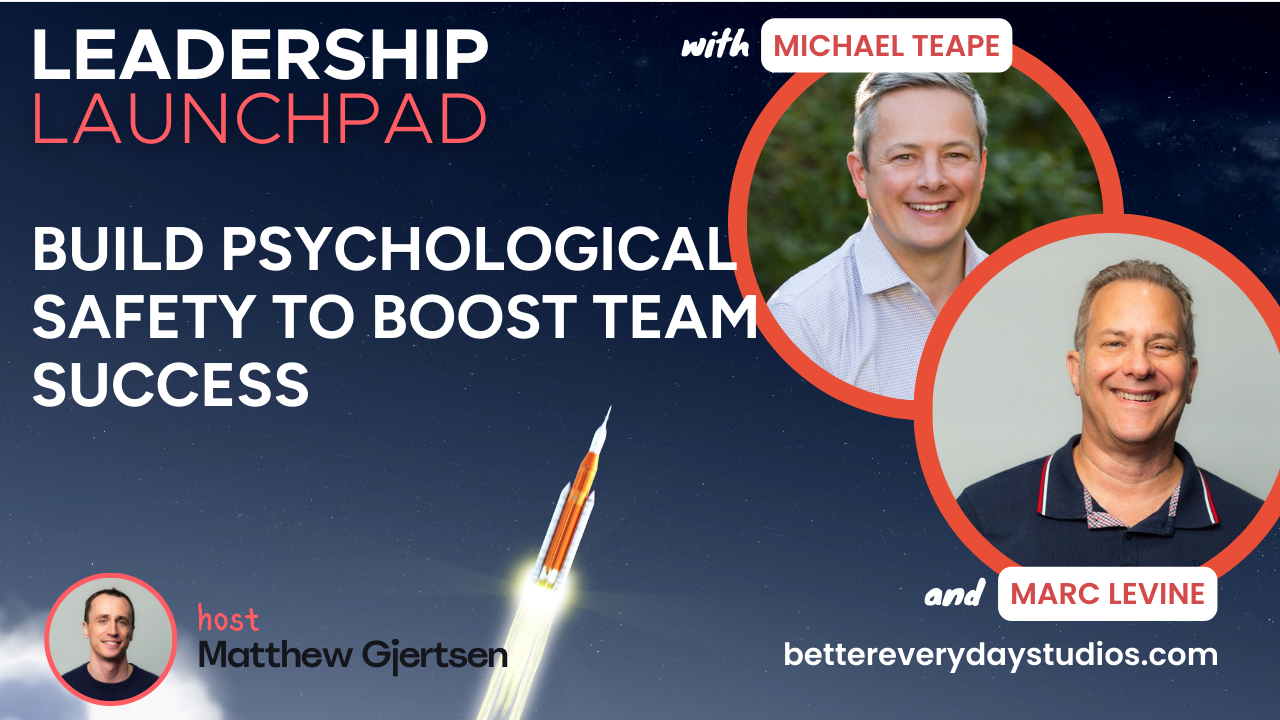
Episode Description
In this episode, Michael Teape and Marc Levine join host Matt Gjertsen to delve into the critical importance of fostering psychological safety within teams. They discuss how creating an environment where team members feel comfortable expressing ideas and providing feedback is key to enhancing creativity, team performance, and employee satisfaction. The episode emphasizes the need for leaders to adopt a growth mindset, encourage open communication, and actively work towards building trust and support within their teams. Tune in to gain valuable insights on the impact of psychological safety on team dynamics and ways to cultivate a workplace culture that promotes collaboration and innovation.
Want practice developing your skills as a leader? Check out our Leadership Skill Accelerator sessions at www.bettereverydaystudios.com/accelerator.
Marc Levine [00:00:00]:
The best people always have the choices of where they want to work.
Michael Teape [00:00:03]:
Exactly.
Marc Levine [00:00:04]:
Exactly. As Mike said, human capital walks out the door. The best people always have choices.
Matt Gjertsen [00:00:09]:
Yes.
Marc Levine [00:00:10]:
And if they don't feel heard or supported or valued or validated, then it's easy to walk out the door. But if you feel that. I feel that Matt's my manager. He listens to me. He doesn't use every idea. No one wants every idea used. And Matt listens to me. He values me.
Marc Levine [00:00:31]:
I'm going to think a lot harder before I walk. I'm going to talk to Matt. I feel this loyalty that every manager wants and every employee wants.
Matt Gjertsen [00:00:40]:
Hello and welcome to the leadership launchpad, where we help technical managers improve themselves, their teams, and their organizations. On this show, I talk with industry leaders, coaches, authors, and experts to give you actionable insights to help improve your own performance and the performance of those around you. Today's show is another one of a series that I recorded while at the recent association for Talent development International conference. If the video looks a little weird or the audio isn't as clean as normal, I do apologize. This is my first time recording out in the wild and I've learned a lot. So I promise next time it'll be better. Our guests today are Michael Tepe and Mark Levine. Michael is the owner of Teap Training International where he works with clients in technology, marketing, finance and more to build structured learning strategies for their teams.
Matt Gjertsen [00:01:31]:
Mark is the founder of Improv my Sales, where he uses principles from improvisational comedy to help sales teams. Recently, both of them have been focusing on the development of psychological safety in organizations and so that is what we are going to focus on today. Expect to learn a practical definition for psychological safety that anyone can understand, why it is so hard to identify, a lack of safety, what leaders can do to create psychological safety, and so much more. Before we get into the discussion, I do want to make sure that you subscribe to the channel. If this is your first time listening and if you are already subscribed, then I ask that you share this show with at least one other person. Because that, after all, is how we grow. I can't tell you how much it means to me with that, let's get into the discussion.
Matt Gjertsen [00:02:18]:
Gentlemen, thank you so much for the first ever in person session of the leadership launchpad. I'm used to doing this in Zoom, so I'm really excited to be chatting with you both.
Michael Teape [00:02:27]:
You're welcome. It's absolute pleasure. Thanks, Matt. Thanks for doing its first one, right?
Matt Gjertsen [00:02:31]:
Yeah, exactly. Yeah. So we met yesterday and you mentioned a very specific term of psychological safety. Sounds like you both do a lot in that space. I work with a lot of engineers, technical people who maybe don't, that word might almost be triggering for some people. So when you say psychological safety, what do you mean?
Michael Teape [00:02:53]:
Well, that's a great question. You want to go first? Yeah.
Marc Levine [00:02:56]:
Well, if you work with a lot of engineers, one of the things they probably care about is physical safety.
Matt Gjertsen [00:03:02]:
Yeah.
Marc Levine [00:03:03]:
Right. Structural safety.
Matt Gjertsen [00:03:05]:
Yeah.
Marc Levine [00:03:06]:
If they build something that's not safe, what's going to happen?
Matt Gjertsen [00:03:09]:
Yeah.
Marc Levine [00:03:10]:
What's going to happen?
Matt Gjertsen [00:03:11]:
It's going to break. It's going to fall down. It's going to hurt people.
Marc Levine [00:03:13]:
It's going to hurt people.
Matt Gjertsen [00:03:14]:
Right.
Marc Levine [00:03:15]:
So they understand physical safety and who would want to go into a building if I'm consistently worried about whether it's going to fall on my head? So imagine, now, let's talk about psychological safety in those terms. If I'm in a workplace where I'm consistently concerned that my words are going to cause someone, something to fall on my head.
Matt Gjertsen [00:03:37]:
Yes.
Marc Levine [00:03:37]:
It might hurt my career, it might hurt my stability, my credibility, my standing on my team, my performance review. What kind of quality work will I do?
Matt Gjertsen [00:03:51]:
It's going to be not as great as it could be.
Marc Levine [00:03:53]:
That's psychological safety.
Matt Gjertsen [00:03:55]:
Okay, that makes sense.
Marc Levine [00:03:57]:
We have to. We don't have to feel safe.
Matt Gjertsen [00:04:00]:
Yeah.
Marc Levine [00:04:00]:
And when we do feel safe, I don't.
Michael Teape [00:04:03]:
I'm.
Marc Levine [00:04:03]:
No, I'm not sitting here. We're not sitting here worried. We trust that this building is safe.
Matt Gjertsen [00:04:08]:
Yeah.
Marc Levine [00:04:09]:
In a team meeting, though, if I want to challenge the process of my manager.
Matt Gjertsen [00:04:14]:
Yeah.
Marc Levine [00:04:14]:
And I'm wondering, how do I say this? What will he or she or they think? I'm not going to bring my. I'm going to be stressed and I'm going to hold back my ideas. And that's why psychological safety is so important. So people can bring their ideas forward, so they can challenge the norms, so they can bring their best to the team and know that it's safe to risk, it's safe to be vulnerable. That will be encouraged even to ask for help.
Matt Gjertsen [00:04:47]:
Yeah. Yeah.
Marc Levine [00:04:49]:
I need help. I don't understand this. I'm great at this, but I'm not as good at that.
Matt Gjertsen [00:04:53]:
Yeah.
Marc Levine [00:04:54]:
That's why psychological safety is so important.
Matt Gjertsen [00:04:56]:
I love that analogy so much. Because you're right. I mean, think of what would happen if you had to worry about every day. Is the food I'm buying. Safe is the building I'm walking into. Safe is the airplane that I'm getting on safe. We just have this assumption that it's going to be there, and it got there the only reason. And to your point, it's not a natural state.
Matt Gjertsen [00:05:19]:
It took work to get there in the physical world, so it makes sense that it would take work to get there in the emotional world, the mental world as well.
Michael Teape [00:05:29]:
I mean, what we find fascinating is that the people we work with don't even realize, they don't even name it until we start talking about psychologists. Well, what is that? Oh, that's what I want to achieve. Oh, the pit in my stomach is because I'm not being treated with psychological safety, but it's subconscious that you should have to put up with it at work. And not all managers are equal, are they? Unfortunately. So they are not equipped with this at all. Right. So it's a concept that needs to be pushed out there by your podcast and the work that people do in this space and we do in this space. But their benefit, the benefits are huge.
Michael Teape [00:06:10]:
But if you don't have it, you don't realize you don't have it until you're super stressed. You're not performing. Why is the team not performing? Why is no one sharing any ideas?
Matt Gjertsen [00:06:19]:
Yeah, it is one of those things like the water you swim in, you can't see the water that you swim in. So it is thing. Do you find that when you're working with teams, how often do you find that there is a. Do you often go to places where there's skepticism and you kind of have an unlock moment or an aha moment?
Michael Teape [00:06:35]:
Well, yeah, yeah. I mean, mostly it's. There is usually there's two types of engagements. One is people know they want to create this psychologically safe environment. They know it. They may not be the key decision maker. There may be an influencer, they may be learning and development. They may be a business head, but they're like, yeah, this is, I want this.
Michael Teape [00:06:58]:
And I'm struggling because people aren't doing that. They're bringing forward challenges or ideas and they're getting shut down. Like, no, we already know how to do that. You know, we tried that before and it didn't work. Yeah, exactly. Yeah. And we're like, you want to change that, right. And then that's the yes for them.
Michael Teape [00:07:16]:
Yes. That somebody can help identify that for them. So that's the one type. And the other type is they're not aware of it, and then they're very functional with their training around skills specific. This is how you give feedback. It's a feedback model, but overarching is psychological safety. Without psychological safety, I can't give you feedback in a way that you're going to receive it and you're not going to be honest with me when I say, is there anything you want to add? I could be giving you feedback on your work performance, but it's not actually your issue, it's Mark's issue. He's not doing his bit, but you don't feel safe enough to have that discussion.
Michael Teape [00:07:56]:
Psychological safety.
Matt Gjertsen [00:07:57]:
Yeah.
Matt Gjertsen [00:07:57]:
I mean, it goes back to what, what you were saying earlier of, I think, especially as managers, you forget that, you know, especially if you're a new manager who you were just an individual contributor, and you become a manager, you forget that you've kind of taken on this mantle of I control your pay now. And so even if you don't really, but to an employee, maybe you do. And so anything you say that's critical, anything you say that feels like it's pushing you out, pushing that other person out of the organization can really quickly trigger those fight or flight responses of I need to protect myself. And once we get into that mode, there's, you can't receive the feedback anymore.
Michael Teape [00:08:38]:
Yeah, yeah.
Marc Levine [00:08:39]:
You just, you just hit it. When we talk about, it's easy to say, bring your challenges, bring your ideas. The idea of a challenge, though. And every leader theoretically wants their people to bring their challenges because the world is getting more complex. It's getting harder, interdependent. It's getting harder. The marketplace is changing. So everyone says it in theory.
Marc Levine [00:09:02]:
And then I'm in the meeting and I say, hey, Matt, can I bring a challenge of this? I know the process is you want to lock it in. And I was talking to so and so over who's affected by the process. Can I bring that idea? And you go, well, Mark, you know, we got ten minutes left. Or you feel Mark's challenging my authority in front of other people.
Matt Gjertsen [00:09:20]:
Yeah.
Marc Levine [00:09:21]:
Or challenging time, or I gotta get this done. Cause I'm getting the pressure from my manager.
Matt Gjertsen [00:09:25]:
Yeah.
Marc Levine [00:09:25]:
And you shut me down. And then what message do you send to everyone else?
Matt Gjertsen [00:09:30]:
You don't want that.
Marc Levine [00:09:32]:
Exactly. And as Mike said, why is it so quiet in the meetings? And then the manager feels the pressure to solve everything themselves.
Matt Gjertsen [00:09:39]:
It's a reinforcing.
Michael Teape [00:09:40]:
It's like ever decreasing circle.
Matt Gjertsen [00:09:42]:
Yes.
Michael Teape [00:09:44]:
What's the point? And people will often say on employee service, well, we don't feel heard. Yeah. And that's where we get a lot of our work from more from the HR areas. It's like, look, they're not heard. They don't feel motivated, they don't feel connected. And then the real value is that human capital walks out the door and it comes right down.
Marc Levine [00:10:04]:
The best people always have the choices of where they want to work.
Matt Gjertsen [00:10:08]:
Exactly.
Marc Levine [00:10:09]:
As Mike said, human capital walks out the door. The best people always have choices.
Matt Gjertsen [00:10:14]:
Yes.
Marc Levine [00:10:15]:
And if they don't feel heard or supported or valued or validated, then it's easy to walk out the door. But if you feel that, can I feel that? Matt's my manager. He listens to me. He doesn't use every idea. No one wants every idea used. But Matt listens to me. He values me. I'm going to think a lot harder before I.
Marc Levine [00:10:38]:
I'm going to talk to Matt. I feel his loyalty that every manager wants and every employee wants. Everyone wants to feel this connection, that they're supported. You have my back. I have your back.
Matt Gjertsen [00:10:51]:
Exactly.
Marc Levine [00:10:52]:
Psychological safety. Creating that fertile soil is the place for it.
Matt Gjertsen [00:10:57]:
Yeah, that's great. So we've defined what it is, why it's important. I know you also have, the tricky part, I think, with a lot of these conversations is they stay very high level. And the key is, okay, practically, what are the actions, what are the behaviors day to day that a manager can do to help create that space, that psychological safety on their team?
Michael Teape [00:11:17]:
Well, it's funny because people are going to a non psychologist, they get it. There's an aha moment, I need to do this. And then they ask us and others, right, they go, how do I do it? And they're like writing down every step, like, well, you need to take a step before that. Yes, we give the tools. Yes, there are some great ways of doing that, and we'll probably share one of them with you if that's what you're looking for. But you've got to start here, the mindset. And the mindset is, why am I reacting in a way that's defensive, that's not creating psychological safety, number one thing.
Matt Gjertsen [00:11:53]:
So by that, do you mean if I'm having kind of a reaction to what you're saying?
Michael Teape [00:11:58]:
Yeah, you've been the manager or the project or something.
Matt Gjertsen [00:12:02]:
So it's asking, why am I trying to push you away?
Michael Teape [00:12:04]:
Understanding that in the moment, you'll be very hard to do. But you've heard of growth and fixed mindset, right? So when you think of growth, open to idea, open to learning, curious. That's actually kind of the mindset we're looking for. And a fixed mindset is this is how we've always done it. This is how we have to do this. By the end of the day, we're done. I'm done. I'm under pressure.
Michael Teape [00:12:27]:
Closes you down. So a way to open that up is one of the techniques that we talk about is if you think of something as a challenge, bringing forward. Oh, hey, Mark. I want to, you know, I just want to go back. I know we said we're going to do this, but I just wanted to circle back with someone we've not heard of. That's challenge. You could feel like that's challenging you. It's challenging.
Michael Teape [00:12:53]:
Well, have I missed something? Have I not done my job properly? It challenges your time and you can feel as though you're defensive. Someone's attacking you personally.
Marc Levine [00:13:02]:
And what do we know about leaders? As you rise up, you often get there because you have taken things on.
Matt Gjertsen [00:13:10]:
Yes.
Marc Levine [00:13:11]:
You're the person who can fix it, who can problem solve it. So that becomes your identity.
Matt Gjertsen [00:13:16]:
Yes.
Marc Levine [00:13:17]:
So you may feel, as Mike said, an attack of your identity through a challenge. And that's why the self awareness is so important.
Michael Teape [00:13:25]:
It is. That's not going to help have us create a psychologically safe environment. Before we give you a tick list, you have to think, well, this person's giving me a contribution. We're in a meeting. They're the only one that stood up, and there are books written about this. Ford happened to Ford and the CEO. They're there. It was one person stood up and said, I need some help.
Michael Teape [00:13:45]:
It's not working. And the CEO gave him a round of applause. I said, thank you. At last, someone wants to fix something, rather than telling me everything's fine, and it's not. So it's thinking of it as a leader, not as being challenged, but it's a gift that someone actually cares enough, has thought enough, wants to contribute an idea, but hold it in that space first. As a gift, it's something to be explored. We're not trying to solve it. And everyone jumps into, well, I've been challenged.
Michael Teape [00:14:18]:
So I now have to make a decision whether your idea is going to work or not. No, it's. You've got to stay in the. My mindset is a contribution. Somebody wants to share. Let's just give it a minute, 30 seconds, say the right thing, and now we can look at the tools. Now we can be, okay, you're ready now, because you have to have that mindset shift.
Matt Gjertsen [00:14:36]:
When we teach at better verdict studios and we talk about feedback and giving feedback, that's one of our pillars. It's always, we don't. Similar to what you're saying. We don't teach giving feedback first. It's really receiving feedback. How do you as a leader receive feedback? Then you're ready to start giving feedback. So I feel like that's part of what you're saying is like, first you need to take that in before you can hope to create that safety in other people.
Michael Teape [00:15:01]:
Yeah. Psychological safety, Mark, isn't it? It's the umbrella for good coaching conversations. Good feedback, good delegation. Where is someone at the level? How do I need to be speaking to them? And all those are tools underneath.
Marc Levine [00:15:15]:
Yeah. And because, as you said, if I want to have a feedback conversation with you up or you want to have it with me down, and hopefully when you give me feedback, you want an honest response.
Matt Gjertsen [00:15:28]:
Yeah.
Marc Levine [00:15:29]:
I'm only going to give that back to you, Matt, if I feel psychologically safe. Otherwise, I'll just take it in and I'll either think, nod my head and you'll think, oh, Mark. Got it. And Mark's thinking, yeah, I'm going to start looking for something else. I can't really tell Matt that there's some other systemic problems or something he's doing that's interfering with that feedback and my success. And if we can get to the heart of it, we can get to the heart of so many things that we can just get people to talk to each other. Yeah, but we've stopped doing that. Yeah.
Marc Levine [00:16:03]:
We've stopped doing that.
Matt Gjertsen [00:16:04]:
Yeah.
Marc Levine [00:16:05]:
And every survey says people have more to give.
Matt Gjertsen [00:16:09]:
Yep.
Marc Levine [00:16:10]:
And every. If you surveyed, every manager say, I want more, I want more from my team.
Matt Gjertsen [00:16:15]:
Yep.
Marc Levine [00:16:16]:
And so we're all saying the same things. We got the same.
Matt Gjertsen [00:16:19]:
What's the problem here? Why are we. Why are we at odds?
Marc Levine [00:16:21]:
This is a place to bridge that gap.
Michael Teape [00:16:24]:
I mean, you live in your own world, you live in your own mind.
Matt Gjertsen [00:16:27]:
Yes.
Matt Gjertsen [00:16:27]:
Yeah.
Michael Teape [00:16:28]:
The world, the world is in here. And everyone's triggered by something. They need to apply different mind shifts, start exploring what's in front of them and helping, helping employees, anyone that works with you or for you, helping them to formulate their idea, they're not going to know. So a manager goes, oh, yeah, of course. I'd love to have some feedback. Can you give me some feedback? How difficult is that for an employee? First you've got to figure out, what do you want feedback on? So true, so true. So you'll work on receiving feedback.
Matt Gjertsen [00:17:00]:
That's exactly it.
Michael Teape [00:17:01]:
You need to help someone, you need to channel them. Right? Yes. And that's the same with creating a psychologically safe environment. You don't just say, I've created it. You have to work with them.
Matt Gjertsen [00:17:10]:
Okay.
Michael Teape [00:17:10]:
Work with them. You have to help them bring them into that space. Right. And that's how we're doing. Yeah.
Matt Gjertsen [00:17:17]:
Yeah.
Marc Levine [00:17:17]:
People aren't going to be. They're still going to be protecting themselves.
Matt Gjertsen [00:17:20]:
Yeah.
Marc Levine [00:17:21]:
They'll still have that emotional hard hat on.
Matt Gjertsen [00:17:23]:
Yeah.
Marc Levine [00:17:24]:
It's like, I want to give, but let me check in about how much I can give, Matt, before something May. A beam may fall on me. God forbid, an emotional beam, where next time a performance review comes around and Matt, for some reason, just feels. I don't quite feel as good about Mark anymore. And it's that conversation on May 12 where Mark said this and didn't take it quite the right way, of course. And this work was pioneered by Amy Edmondson, of course, who studied medical teams and started talking about this. And then Google with their project oxygen. Project Oxygen.
Marc Levine [00:18:02]:
Exactly. Gave us data that said this was the number one attribute of high performing teams. So even if you don't care about wanting people to speak, even if that's not important to you as a leader, this is the way to more productivity.
Matt Gjertsen [00:18:16]:
I'm so glad you brought up Project oxygen, because I do feel like it's a thing that's missed all the time, because it's one of the greatest data sets that's ever been put together on what makes high performing teams, what makes good leaders. Project Aristotle is just such a large organization. They have so much good insight. And I feel like, because it's been a few years now since they did.
Michael Teape [00:18:39]:
It, it's been a while. Right. And what I find most fascinating. You were with me when this happened. We were talking about. We were running a course, psychological safety and how to receive effective challenge. And it was for a technology. It was a technology group, wasn't there.
Michael Teape [00:18:54]:
And we asked, well, what was the feedback? And you know what they said? Some of them said, oh, well, Google's not the place it used to be. Right. Where is that person? They are not in a technology, psychologically safe place. They're in a blame that we need to help that person realize that. Well, actually, it's phenomenal.
Matt Gjertsen [00:19:15]:
Yeah.
Michael Teape [00:19:15]:
Phenomenal data.
Matt Gjertsen [00:19:16]:
Yeah. Right.
Michael Teape [00:19:17]:
And it wasn't accenture. Wasn't it?
Marc Levine [00:19:18]:
I think was compiled a report from Gallup and Gardner in 2021 that said highly psychologically safe teams are 50% more productive. 50%. That's huge.
Matt Gjertsen [00:19:32]:
That's crazy.
Marc Levine [00:19:33]:
27% reduction in attrition. And then the one that we're all dealing with. Right. What's the word? Wellness. Right. Wellness. We care about wellness. 74% reduction in stress.
Marc Levine [00:19:48]:
Think about the amount of emotional energy. And I have to think about if I have to decide in a meeting whether to tell you something or not. Well, I know I got to have a conversation with you, and I'm going home, and I'm talking to my family about how to do it, and I'm talking to co workers, and I'm spending all that time to have one conversation. All that extra stress that doesn't have to be there. That's why we get so excited to bring this in.
Matt Gjertsen [00:20:14]:
Yeah.
Michael Teape [00:20:15]:
Yeah. For sure. Yeah.
Marc Levine [00:20:17]:
We've been doing this leadership work for a while, and I used to think that if I could teach one thing to people would be how to receive feedback.
Matt Gjertsen [00:20:26]:
Okay.
Marc Levine [00:20:27]:
That was right. That's where so much starts.
Matt Gjertsen [00:20:29]:
Yes.
Marc Levine [00:20:30]:
And now if I could teach leaders only one thing, it would be how to create psychological safety. I love it because it cuts across everything.
Matt Gjertsen [00:20:37]:
Yep.
Matt Gjertsen [00:20:38]:
Well, I love it. So the two main kind of two things that I pulled out of that were, first, it's about that reflection for a leader of, where is this resistance coming from inside of me? How do I change that into. This is a gift. They're bringing me this information for a reason. And then when I'm getting. When I'm ready to then work with my team, it's almost like, I would say it's like a co creation. Like, you're working with them to see what they need. Because it's not a one time thing, it's a process.
Matt Gjertsen [00:21:05]:
It's going to be different all the time. Different for every person, depending on. I always say, when you know, when somebody first comes to your team, if you don't know, if you don't have a relationship, when somebody first comes onto your team, you are their worst manager because they don't know you yet. And so they're bringing the baggage of whatever their worst manager was because they don't know what to expect.
Marc Levine [00:21:26]:
Can I tell you a story about that?
Matt Gjertsen [00:21:27]:
Yeah.
Marc Levine [00:21:28]:
Just happened on our team. Our newest member of the team is awesome. And she had a bad experience with a previous manager, so now I'm leading her. Managing her. Asking for contributions.
Matt Gjertsen [00:21:43]:
Yes.
Marc Levine [00:21:44]:
And I was actually feeling really good about how I created psychological safety. Then we're. I'm asking for feedback, and she said, I don't know if this is pertinent. And as soon as she said that, my heart sunk. Here's this person who wants to make a contribution and I'm asking for it. And she has to decide and put a disclaimer.
Matt Gjertsen [00:22:05]:
Yeah, yeah, that's exactly right.
Marc Levine [00:22:08]:
And after, as I said, you don't ever have to. Please don't ever say that again.
Matt Gjertsen [00:22:14]:
Yeah.
Marc Levine [00:22:15]:
And please let me know if there's anything I'm doing that creates that.
Matt Gjertsen [00:22:18]:
Yeah.
Marc Levine [00:22:18]:
Let's always assume that what you have to offer is pertinent, and we just need to figure out, is it part of this project? Is it part of our overall theme? Where does it fit? Please bring your ideas forward. And. And I asked her, what could I do to make it more psychologically safe? And she said exactly what you said. She was carrying the baggage of a previous.
Matt Gjertsen [00:22:37]:
Exactly.
Marc Levine [00:22:38]:
Manager into this situation.
Matt Gjertsen [00:22:41]:
Yep.
Marc Levine [00:22:42]:
And that's what I had to overcome.
Matt Gjertsen [00:22:43]:
Yep, that's exactly right.
Michael Teape [00:22:45]:
And I think the baggage stays with everybody. So they'll have a moment where they're trying these techniques. Okay, good. Bam, bam, bam. They're good. But then the next conversation, they might not, because it's very nice. You go back to your nature, which is like, defend, and that's what we're trying to help people with. So you talk about Matt.
Michael Teape [00:23:06]:
You were talking about with this example, everyone's different in a slightly different approach that makes it quite difficult for our leader. It's like, okay, who am I talking to, Mark, now? What am I going to remember? Matt? You know, I remember he's different. But what we can do and what we do do is give them tools that can work in any situation just to start move them into that psychologically safe environment. So, you know, we have a number of best practices and tools available that we say, okay, now you're ready. Now you understand the concept. It's really important. Can you step into psychological safety? But don't be fooled. You're gonna live there forever.
Michael Teape [00:23:46]:
It's gonna be a fleeting moment, and you have your stresses, and then you've got to recreate it.
Matt Gjertsen [00:23:51]:
Yes, exactly.
Michael Teape [00:23:52]:
That's right. Every, you know, every team meeting is, okay, how am I receiving it? And. And that shows up when we do the training.
Matt Gjertsen [00:24:00]:
Yep.
Michael Teape [00:24:00]:
Because what we get is we get everyone like, great. This is great. I want to do it. You know that euphoria, I found something. It's going to work. And this is how I do it. And then they say to us, yeah, but there's this one person who. They've already told me this, and they're bringing up again in a meeting.
Michael Teape [00:24:16]:
They just want to be. They want to say it again because they didn't like my answer. The first time.
Matt Gjertsen [00:24:19]:
Yeah.
Michael Teape [00:24:20]:
That, bam. Stepped out of the circle.
Matt Gjertsen [00:24:22]:
Yep.
Michael Teape [00:24:23]:
Yeah. And then, okay, within the group, you're gonna have to step back in the circle, honor that maybe in a way that reminds them they've already brought it up in a way that, you know, is psychologically safe. Yeah, but every time we do the training, there's always somebody that goes, yeah, but what about this person? They're just awkward. I'm like, that's got nothing to do with it. You want to create psychological safety, you've got to work on that. And then maybe that person needs feedback.
Matt Gjertsen [00:24:50]:
Yes.
Michael Teape [00:24:51]:
Maybe they're like, look, I've noticed when. Whenever we have a team meeting, I just wanted to bring it to your awareness that you're telling everybody the same message you've already told me in discussed and we'd moved forward on that. Are you aware of it? Yes or no? What's the impact of that?
Matt Gjertsen [00:25:06]:
Yeah.
Michael Teape [00:25:07]:
Yeah. Okay. And now, so you understand, my expectation is this is an area where we create ideas and new ideas. I want your new ideas. Build on what we've been talking about. Don't just walk in repeating it because you're. Well, I mean, I wouldn't say that to the person. That's what you're thinking.
Michael Teape [00:25:25]:
Stepping out the circle again.
Matt Gjertsen [00:25:26]:
It is that balance of knowing.
Matt Gjertsen [00:25:28]:
Yeah.
Matt Gjertsen [00:25:28]:
Of knowing. What are you gonna do in the group? Because it's much easier to see threatening in the group and then in the individual. How do you get across that feedback? Stay in that circle so that that feedback is heard and acted upon.
Michael Teape [00:25:41]:
And this is what Mark says, look, hey, you have to hold the intent. Psychological safety. When all the eyes are on, that is not the moment to give the feedback. You still gotta stay psychologically safe. And then you see their faces go, really? And we're like, yeah, let's go back. What are you trying to create here? You don't create psychological safety by putting someone in their place with an audience. Right. And I remember you talking about that the other day.
Marc Levine [00:26:05]:
Yeah, yeah. And it's hard because you feel your emotions come up.
Matt Gjertsen [00:26:12]:
Yeah.
Marc Levine [00:26:13]:
And you have the time pressure of the meeting. And as Mike said, it's moment to moment until people realize it's safe, until they just get it. Cause they're carrying all that baggage from before, and it's a change management process, I think, like anything else, as Micah said, you gotta repeat it over and over again, publicly and privately, and teach people how. Teach people what it means to give good ideas so they can be contributors, too. And it takes the pressure every manager has a couple go to people, right?
Matt Gjertsen [00:26:48]:
Yeah.
Marc Levine [00:26:50]:
That puts a burden on those. Go to people. There's so many more people on your team who could be go to people if you work with them and you teach them how to contribute and bring out their best ideas.
Matt Gjertsen [00:26:59]:
Absolutely. Well, gentlemen, this has been amazing. Thank you so much for being here again for this first, you know, in person session of a podcast. This has been great. How can people find you? Where should they go? We'll link to things in the, in the show notes, but if people hear this, they want to know more. Where should they go?
Michael Teape [00:27:19]:
Well, we are speaking at the conference, so you can find Mark Levine on there as well. And yeah, you can find both, both of us mainly on LinkedIn. If you google my last Michael teep, I'm the first thing that comes up for free. So you can always get us that way.
Marc Levine [00:27:37]:
Perfect. That's perfect. And, yeah, Mark Levine, you can find me improv my sales, and you will find us there, and that's a great way to connect with us.
Matt Gjertsen [00:27:47]:
Excellent.
Marc Levine [00:27:47]:
Okay, well, and thanks for having us. Congratulations on your first one. How wonderful to launch that. We are part of your baby coming to fruition at the ATD conference.
Matt Gjertsen [00:27:59]:
Exactly.
Marc Levine [00:28:00]:
You're doing good work.
Matt Gjertsen [00:28:01]:
Well, thank you. Yeah, well, you are, too.
Michael Teape [00:28:03]:
And we look forward to seeing your speaker series later on at this conference.
Matt Gjertsen [00:28:06]:
Exactly. Yeah. Okay. Well, thank you so much.
Michael Teape [00:28:08]:
Thank you. Appreciate it.
Matt Gjertsen [00:28:10]:
Sweet.
Matt Gjertsen [00:28:11]:
Thank you so much for listening to today's show. If you are looking for help turning your organization's great engineers into great managers, me and my team at better everyday studios would love to help. We deliver targeted and interactive training workshops that are designed to help build the three fundamental skills of any new manager, building trust, giving feedback, and setting goals. Reach out to me through matt@bettereverydaystudios.com so we can start making your organization better every day.