Episode Description
Balancing Productivity and Empathy in Leadership: Insights from Google's Project Oxygen
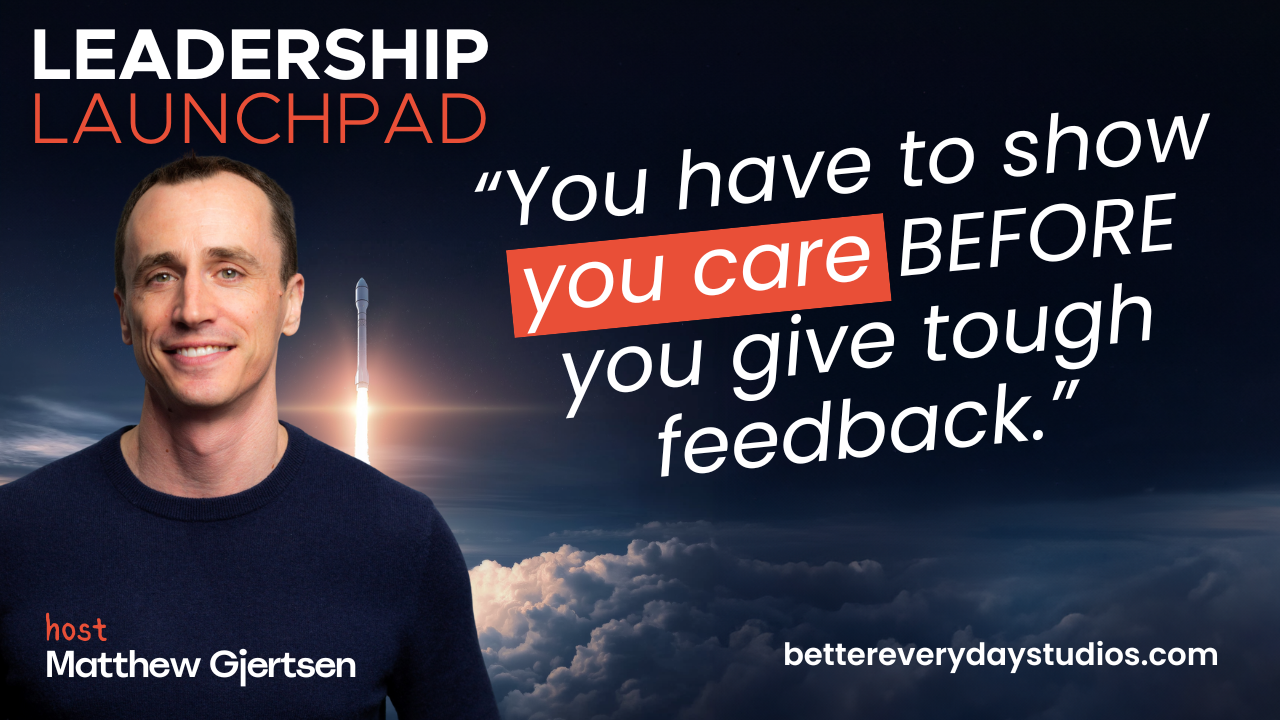
Are you ready to level up your leadership skills? Welcome back to Leadership Launchpad! I'm Matt Gjertsen, your host and a former Air Force instructor pilot and head of training at SpaceX. In this episode, we dive deep into “Project Oxygen” from Google to uncover the secrets behind effective management. We explore how to balance empathy and productivity, guided by the principles in Kim Scott’s book, "Radical Candor."
Join us as we discuss actionable steps to build stronger relationships with your team while driving results. Let’s navigate the path to becoming a more balanced and impactful leader!
#LeadershipDevelopment #GoogleProjectOxygen #RadicalCandor #EmpathyInManagement #EffectiveLeadership #NewManagers #BetterEveryDay
---
Want more tips on effective training? Sign-up for our weekly newsletter: https://www.bettereverydaystudios.com/newsletter
Visit us at https://www.bettereverydaystudios.com
Matt Gjertsen [00:00:00]:
If you have ever been a people manager, or heck, if you've ever been in the corporate world, you've probably witnessed these two extremes of on the one hand, as a manager, you're supposed to be serving your team, right? And so you want to have good relationships. You want to get to know them and really get the most out of them. But then, on the other hand, you as a manager are answering people above you, and they are demanding results. And so sometimes managers can fall into these two extremes. Or on the one hand, you have somebody who's very personable. They're really easy to get along with, but they let a lot of stuff slide. And then on the other hand, you have managers that are just relentlessly focused on results and productivity, and they don't really care about you as a person. If you want to be a good manager, it turns out that you don't want to be on either of these extremes.
Matt Gjertsen [00:00:54]:
You want to find a way to balance them. And that balance is what we are going to be talking about today on this episode. If this is your first time here, welcome to the leadership launchpad from Better Video Studios. My name is Matt Gjertsen. I'm a former Air Force instructor, pilot, former head of training and development at SpaceX, and now with this show, my goal is to help managers by bringing actionable insights that can help improve your own performance and the performance of those around you in the episode. Today, we are in the middle of a five part series looking at Google's project oxygen. If you've missed the last few episodes, I highly recommend you go back and look at it, because this is one of the most pivotal studies ever done when it comes to what makes a good manager. In my opinion, Google spent about five years looking at all of these different managers all across their organization in order to find out, were there key behaviors that made the difference between good managers and bad managers.
Matt Gjertsen [00:01:55]:
Turns out there is. They identified eight of them, and so we're looking at two of them in every episode. Very often, they're kind of opposing actions that you're supposed to be taking. And today's episode, the things that we're focusing on are these two behaviors of, first, you're supposed to express interest in team members success and well being. That's that relationship piece that you want to have. But also, you're supposed to be productive and results oriented. And like I said in the intro, you know, many managers can fall into these two extremes, but the key is to find a way to meet in the middle. And I think one of the best things to look at when it comes to finding that balance comes from Kim Scott and her book radical Candor.
Matt Gjertsen [00:02:39]:
So now in Kim Scott's book Radical Candor, she actually created kind of a four, the four box grid. You know, standard four box grid for figuring out how to think about things. On one axis is care personally. You need to actually care about the people who are on your team. And on the other axis is challenge directly. You, even though you care about them, you also have to be willing to, you know, give them tough love or tell them the truth, essentially. And I just absolutely love this grid because what it does is it can, you know, help us understand all of these spectrums that you can be going down. And so, you know, if you are a, if you're unwilling to challenge directly, right, you, you don't actually get tell people the truth and you don't actually care about them personally, then that quadrant of the $4 grid is called manipulative insincerity.
Matt Gjertsen [00:03:33]:
Right? Where maybe you're just, you're looking out for yourself. You're telling people whatever you need to tell them in order to get what you want. You're just not at all concerned with either the truth or the individual. If you are willing to focus on the truth, you're willing to challenge people, but you don't actually care about them personally, then that's where you become obnoxiously aggressive. You're just always saying like, hey, where are the numbers? Hey, are you getting results? Hey, where's that project? That's the only thing you focus on. And that obviously turns people off as well, where they're just, they're just not going to be delivering for you. They're not going to be doing what you, what they need. The other quadrant that represents one of these extremes is where you care personally, but you don't challenge directly.
Matt Gjertsen [00:04:17]:
I honestly think this is one of the spots that most, that managers most often fall into. It's called ruinous empathy. In fact, I think we can pause on this one for a second because for most of you listening, I'm guessing this is the highest likelihood place you're going to be, especially as a new manager, where, you know, maybe you were part of a team and you got promoted to lead that team. So, you know, all of these people, you're friends with them all, you don't want to, you don't want to tell them the truth. I think a person that, or you want to tell them the truth, but you don't want to break bad news to them. You don't want to make them feel bad. And one person that talks about this a lot is Gary Vaynerchuk. If you don't know Gary Vaynerchuk, he's big on social media.
Matt Gjertsen [00:04:56]:
He runs a media company out of New York called Vaynermedia. And he talks about empathy being his superpower and kind of the superpower of a lot of leaders. In fact, the head of HR in their company is called the chief heart officer. Right. So that's how far they're taking this idea of, you need to care about your people. But Gary admits, especially earlier in his career, that that meant that he just wasn't willing to give hard feedback to people. He would hold onto them for too long when they clearly weren't good for the role. And so, you know, I think one of the common things that we fall into is where we do care about our people.
Matt Gjertsen [00:05:35]:
And so then we struggle with actually giving them, really the solid advice, the tough love that they need. And so that's where Kim Scott's book, radical Candor comes in. Because if you can care personally and challenge directly, now you are being open, honest, and radically candid with them. And so that's the balance that you want to find. The trick is, how do you do this? And I think there's different tactics you want to employ and different tactics that we teach in our workshops. I think the first thing you want to do is prove to your people that you care personally about them. And this starts in one on ones. It can also go into the team meetings that you have where you're asking people direct questions about what's going on in their life.
Matt Gjertsen [00:06:23]:
I will never forget a mic drop moment at a leadership workshop that I was at years ago where the facilitator, he asked everybody in the room how many people had kids, and a bunch of people raised their hand. And then you asked all the people, okay, everybody that has kids, how many of you would say that your kids are more important than work? And, you know, everybody kept their hand raised. How many would you say that? How many of you would say that your kids are the most important thing in your lives? And they all kept their hands raised and said, okay, great, now, how many of you have direct reports with kids, and a bunch of people raise their hand? How many of you know the names of the kids of your direct reports? I don't think one hand went up, maybe one in this room of, like, 50 people. And that was his moment of just like, okay, look, now, wait a minute. You're telling me that kids are the most. Your kids are the most important thing in your life. And that's probably true for the people on your team as well. And yet you don't even know their names.
Matt Gjertsen [00:07:27]:
How do you expect them to be bringing their most to work when you can't even learn the first thing about what's going on in their life? The most important things in their life, and everybody's like, oh, my gosh. Oh, my gosh, you're right. And so the care personally piece is honestly easy. It's there. It's just a basic thing that you need to be doing. Have regular one on ones. Have some questions that you, that you ask them about their personal life, about what's going on. I know, I know that takes time.
Matt Gjertsen [00:07:55]:
I know some people don't want to bring their personal lives to work, but there's small things that you can do to get to know them. Maybe if it's just professionally, you know, understanding that what their goals are professionally, even if they don't want to talk about things outside of work. Keep a document where you keep some of these facts so that even if you have a bad memory, like I do, before a one on one, you can kind of peruse and be like, okay, like, oh, yeah, this is what's going on in their life. These are the important things. These are the things I want to make sure to ask about. It just takes some attention, but it's really, really easy to do so. Care personally. That's the first thing.
Matt Gjertsen [00:08:29]:
Challenge directly. In my experience, most people have more problems with this. I know. I myself have more problems with this. And this is where you want to dramatically lower the bar and stop focusing on figuring out how to give difficult feedback and instead focus on how to give everyday feedback. Because if you can get down a habit of giving everyday feedback, it's just like a muscle. The more you work it out, the easier it is. And if you can give consistent feedback early, it's not a difficult conversation because chances are it's a pretty small thing that you're giving them feedback on.
Matt Gjertsen [00:09:06]:
It only becomes a big thing when you wait, right? And the performance gets worse and they keep stepping on people's toes and they keep not fulfilling their duties. And then it becomes a real conversation because you're having to put them on a pip or talk about termination or kicking them out of the company, that kind of thing. So if you can get into a habit of just giving feedback early, often and start with good feedback, start. It doesn't have to be bad. If you can, if you can tell yourself, I'm going to give every person on my team one piece of positive feedback every single day. That's going to build that muscle of just giving them feedback. It's going to reinforce the point that you care about them personally because you're showing that you see the good work that they are doing. And then when you notice something that could be better, it's easier for you to just say like, oh, hey, by the way, yesterday when you were five minutes late, I know it wasn't a big deal.
Matt Gjertsen [00:10:02]:
I know, I know it doesn't seem like a big deal, but it really disrupts kind of the flow of our team meeting and I would really appreciate it if you go the extra mile. Just make sure you are on time to the meeting. It means a lot to me, means a lot to the team. Thank you so much. Does that sound good? Simple things like that allow you to adjust that behavior early on. So when it comes to being a good manager, going back to what we talked about, Google's project oxygen clearly identified these two things of expressing interest in the team member's success and well being, while also being productive and results oriented. The best way to do that is to start off by really actually caring about that individual, having a list of questions that you ask them during one on ones, keeping some notes about what's important to them, and then develop a habit of consistent, regular, real time feedback that is focused on the results that they are achieving, both good and bad. So I hope you found that helpful.
Matt Gjertsen [00:11:01]:
If you did, I would really love it. If you're watching this on YouTube, then make sure you like the video. If you're watching it on Spotify or Apple, really appreciate a rating for the show. It really helps us improve our reach and I will see you again next time on the leadership launchpad. Thank you so much for listening to today's show. If you are looking for help turning your organization's great engineers into great managers, me and my team at better everyday studios would love to help. We deliver targeted and interactive training workshops that are designed to help build the three fundamental skills of any new manager, building trust, giving feedback, and setting goals. Reach out to me through matt@bettereverydaystudios.com so we can start making your organization better every day.