
An engineer I knew at SpaceX once made a special calculator to figure out how much money the company was spending on All Hands meetings.
He had made some assumptions about the average wage of an employee and the number of employees in the company, then at the start of the All Hands he just hit start.
It ran like a timer, updating in real time the wages that had been spent on the meeting.
He is not the only person I have ever run into who didn’t like meetings. In fact, I would say most people don’t like meetings. I used to count myself as one of them, but not anymore.
I now think most teams need more, larger meetings.
Sounds crazy right? Hear me out.
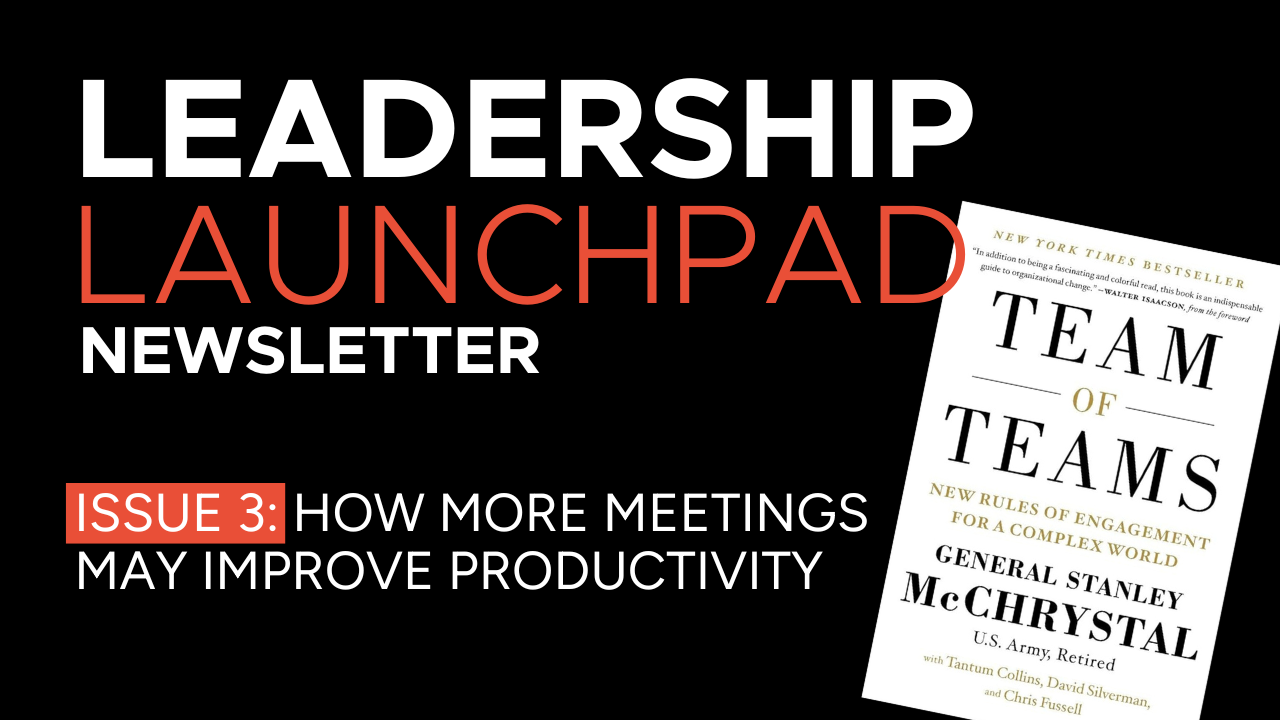
I read the book Team of Teams where General Stanley McChrystal tells the story of transforming Joint Special Operations Command in Iraq back in 2008.
When he took command, here is the problem he was confronted with.
There were all of these different teams under his command, SEALS, Rangers, etc. All of them were excellent on their own. They could solve any problem they were confronted with individually. But when they needed to operate together, they were always stepping on each other’s toes. Their individual excellence came at the cost of creating silos so they weren’t good at communicating with other teams.
This sounds a lot like many of the start-ups I have worked with.
So many great people, doing amazing things, but they are so busy with their heads down doing work that they don’t know what is happening at the desk right next to them, let alone the team on another floor.
McChrystal’s solution to this problem was to enact several measures to build a “shared consciousness” amongst the teams. One of those measures was a daily Operations and Intel brief, or O&I. The O&I was 90-minutes long and would have several thousand attendees. The goal was to make sure every person in the organization knew what was happening all around the command, so they knew the full context of what they were doing.
Chances are, you don’t need to have a meeting this big every day. But it is worth thinking about how often people are making poor decisions because they don’t have enough information.
If this is the situation you are in, a few more well-structured informational meetings might be useful.
If you are looking for something more asynchronous, team blogs or recorded Loom messages might have the same effect. The key is to make sure the information is as relevant as possible and in a format that people will actually consume.
Chances are the first few meetings will feel like a waste of time. But give it a chance and iterate on the design.
You might be surprised by the impact.