
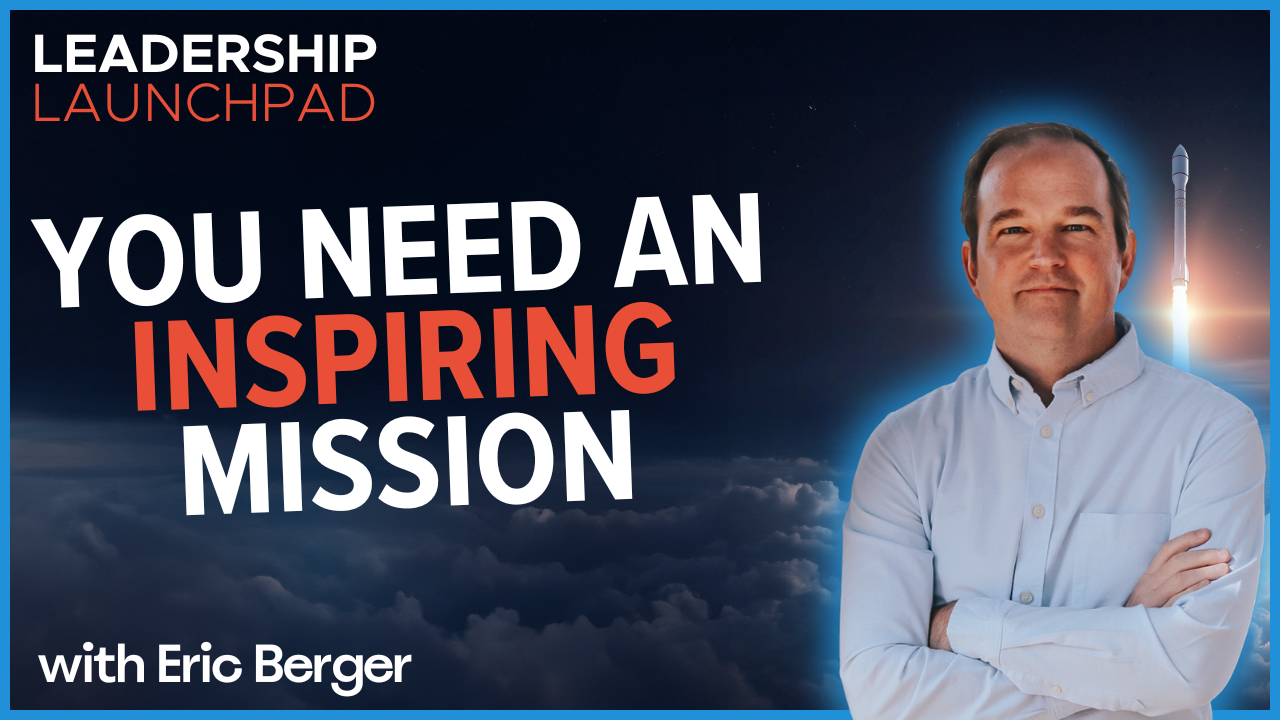
In this episode, Senior Space Editor and author Eric Berger joins the show to discuss the evolving landscape of the space industry. Drawing on his extensive reporting experience, he explores major trends such as the rise of China as a space power and the shift toward commercial space companies like SpaceX. Eric Berger shares insights into workplace culture, leadership traits, and the intense sense of mission driving innovation at companies like SpaceX and Stoke Space. The conversation covers the challenges of sustaining hard-driving environments, the importance of compelling vision, and alternate cultural models emerging within the industry. Listeners will also hear Berger’s perspective on the future of spaceflight and what excites him most about upcoming missions and technology.
 Automated Transcription
Eric Berger [00:00:00]:
It's basically a trade. You're giving that company the best years of your life. You're young, you're full of energy, you're going to work hard, you're really going to break your brain around these really difficult engineering problems. But then you get a lot in return for that.
Matt Gjertsen [00:00:31]:
One of the things, things that always frustrates me when learning about leading in organizations is that almost all of the focus goes to the top. We know a lot about Elon Musk or Steve Jobs, but not always a lot about the director of Falcon Avionics or the senior manager in charge of Apple Maps development. Most leaders are not the CEO, so taking lessons from the CEOs doesn't always get you that far. And that's one of the reasons why I always try to bring in second and third level leaders in a lot of organizations to get a better sense of the day to day lessons and culture that are going on in these organizations today. Instead of talking with one of those leaders, I think I have someone even better because he has made a career off of talking to the leaders and the people on the front lines in space organizations in order to figure out what is actually happening. Eric Berger is the Senior Space Editor for Ars technica, author of two amazing books, Liftoff and Reentry, about the history of SpaceX, and my absolute go to source for the wonky space news that helps us understand the real story behind the headlines. Today I want to capitalize on his experience behind the scenes to understand what types of cultures and leadership traits drive success within the space industry. Before we get into that discussion, I do want to remind you that if this is your first time listening to the show, please hit subscribe so you never miss a future episode.
Matt Gjertsen [00:02:01]:
And if you happen to be someone who is responsible for leadership development in your organization, please, please reach out to mattevereverydaystudios.com I would love to chat to see how we can make the managers in your organization better. With that, let's get into the discussion with Eric Berger. Eric, how are you doing today?
Eric Berger [00:02:21]:
I'm doing great, Matt. Thank you for that very generous introduction. I appreciate it.
Matt Gjertsen [00:02:26]:
Oh no, I mean every bit of it. I actually wanted to start kind of with this idea of what you're trying to do with your writing and reporting because at least from my perspective, I do feel like have a different take in that. You're definitely not just reporting the news in the firmest sense. It's like you will state your opinion, you will call a spade a spade, you inject A little bit of your own personality, it seems. What is your goal with your reporting?
Eric Berger [00:02:57]:
My number one goal is to understand what is really happening and to share that with readers. I spent the first 17 years of my career working at the Houston Chronicle, obviously one of the largest newspapers in the country, writing about science. And I grew passionate about space toward the end of my tenure there. Until about a decade ago, I left to go to Ars Technica. And when I got there, I sort of made a conscious decision that I had been watching NASA for a long time. And I like some of the things they were doing, but some of the things I thought they were doing were really not great for the direction of the country. So I just started reporting more on commercial space and about the companies and the people that were actually changing things for the better. I cover the space industry, try to find out, as I say, what's really happening, and identify the areas where there's progress being made.
Eric Berger [00:03:59]:
Because really, at the end of the day, I'm biased. I'm biased toward progress in the stars as a spaceflight enterprise for anybody.
Matt Gjertsen [00:04:11]:
I mean, I do have a decent number of people that listen to this show that aren't necessarily familiar with the space industry. I'm sure we've all talked to folks who just don't realize kind of how titanic a shift is happening right now. I don't know if you could summarize, like, what do you think? What are some of the biggest changes that are happening right now versus, you know, when you first started writing?
Eric Berger [00:04:36]:
There's two. There's two really big trends that have dominated the last two decades in spaceflight. The first of these is the rise of China as a space power, both military and civil space. It's the point now where there's probably at least a 50% chance that they put humans on the moon before NASA gets back there with the Artemis program. And so that China has completely supplanted Russia and any other sort of space program as a rival to the United States, and they're continuing to rise. And then the other big thing, and I think which really has kept NASA ahead of the rest of the world, is the increasing prevalence and usage of commercial space. The difference between commercial space and traditional space basically, is commercial space doesn't build whatever the government tells it to build. It builds what it thinks is best for its needs, and it sells those to the government as a service.
Eric Berger [00:05:30]:
The most clear exemplar of all this is SpaceX. They're the most successful, by far, the most financially valuable commercial space company. And their success has really changed the game so that now a majority of NASA's contracts going forward are going to these commercial space companies, as opposed to traditional companies like the Boeings, the Lockheed, the Northrops, companies like that.
Matt Gjertsen [00:05:54]:
Yeah, it's that that second piece which I think is so fundamental for people to understand is the change in. Even when the government is contracting with these companies, it's just very different than the way, you know, because private companies have always, in a sense, built space. Like, you know, it wasn't literally NASA employees that were building the Saturn V, it was contracted, but it was contracted out in a very different way where there was no other customer, where now there are many customers potentially.
Eric Berger [00:06:23]:
Right. And the way it was is NASA would decide, well, we need this spacecraft or we need this rocket. It would sort of put out a basic design, go to industry and get bids on a company to build it. And then they would come in to build it, and then NASA would basically design the vehicle and hand it over to the private contractor and then sort of be completely in the loop the whole way going forward as that rocket or spacecraft was built and tested and flown. And it's completely different today. You think about how we get our astronauts to the International Space Station. NASA is essentially the customer. And SpaceX launches the mission on its rocket.
Eric Berger [00:07:01]:
They control the flight of the spacecraft from their own control center in California. And then when the spacecraft gets the International Space Station and docks, then NASA takes over from there. So literally, it's buying an Uber to space, if you will. And that's kind of how NASA is moving from being the designer to being the customer and they're buying services and that trend is increasing and likely to increase further.
Matt Gjertsen [00:07:29]:
Yeah, I couldn't agree with that more. Now shifting into what it takes for these companies to be successful and what you've seen. You've written obviously a lot about SpaceX. You're just talking about how SpaceX is one of the most prominent players, quite unquestionably the most prominent player in, in this, in the commercial space world right now. One of the first times ever reached out to you was on X, where I was talking about having read your books and how well you put, you know, from my time in SpaceX, just how well you kind of put that balance, that almost love, hate relationship that a lot of employees have coming out of there, where it was, it was, it's grueling being there, but you feel like you've just been doing amazing work. I was wondering if you could kind of expand on that A little bit. Just for anybody who hasn't read the book, what is that love hate relationship that you found with a lot of employees with SpaceX?
Eric Berger [00:08:24]:
I think the people that go to SpaceX are very motivated by and large and obviously they're very intelligent and willing to work hard. You might ask yourself, well, why would someone go to work for SpaceX where they're going to be working 80, 60, 70, 80 hours a week, maybe for less salary on harder problems in a really demanding culture when they could go to like a Lockheed or Northrop Grumman and make more money and have an easier job with lesser responsibilities? It's just, you know, I think for a lot of people working at SpaceX, especially in their young years, like you can't really start a family. Like the company, I think is your most of your whole life. It's your work life, it's your social life. And so it's just really challenging and I think. So what I found, and certainly you would know this better than most, Matt, is that it's basically a trade. You're giving that company the best years of your life. You're young, you're full of energy, you're going to work hard, you're really going to break your brain around these really difficult engineering problems.
Eric Berger [00:09:28]:
But then you get a lot in return for that. You get stock in an extremely valuable private company and the stock only seems to go up. You get to work on the hardest problems, you get to build stuff that flies. Whereas if you go to someplace like NASA, a lot of those programs are canceled. And so at a place like NASA, you're spending a lot of your time in meetings, on zoom calls. You're not building, breaking things, flying and things like that. It's just a much more dynamic environment generally in the private industry. And also it's just like it's the peak, right.
Eric Berger [00:10:03]:
If you want to work on the most cutting edge stuff in spaceflight. And I think a lot of the people that go there really feel strongly about they want to advance humanity into the solar system. One of the things that I found about tech companies, and this is especially true in space, is that having an inspiring mission really attracts people. And what is the mission of Lockheed Martin? And by the way, Lockheed Martin, a great company, they build excellent satellites. But what is their mission? Their mission is to return value to the shareholder, right? Yeah. But the mission of SpaceX is to put humans on Mars. The mission of Blue Origin is to build a highway to space. The mission of astroforge is to go out and try to mine asteroids.
Eric Berger [00:10:52]:
I mean, these are very exciting missions. And I think that's really also one of the hallmarks of the commercial space industry is that you sort of have a vision that these companies are founded around, that you're working toward. And yeah, a lot of these companies are going to fail because the visions maybe are too grandiose or you don't have funding or just whatever. But that attracts the best people. And I think to get the best people, you have to have a clear and compelling vision and actually live up to it.
Matt Gjertsen [00:11:20]:
Yeah, that was. Oh, that's a really interesting point they'll have to come back to because I do think in that mission piece it is one of the things that, especially when I was working there and that I say again and again is the make life multi planetary or make humans multi planetary. It's not a slogan, it's true. Every person there's is truly trying to achieve that. And I think that, you know, from my perspective and from the perspective of, you know, a lot of HR professionals, you, you hear, whether you're inside it or you hear stories about SpaceX and particularly the way Elon sometimes acts and you think every leadership book says this shouldn't work, like why? Why is this working? And the only conclusion that I've been able to come back to is that sense of mission and purpose of, of, of really, it makes up for a lot. And it, and it not just makes up for it, it creates a lot of glue that just brings people together kind of. On that last point though, that you mentioned, you have to live up to it. The kind of, the, the question that I wanted to go to next around this idea of culture is what do you think the limits are? Like we see a lot, there's a lot of space companies out there that are maybe trying to be just push just as hard.
Matt Gjertsen [00:12:36]:
Is there a limit to just the we're going to work really hard mentality in order to create success?
Eric Berger [00:12:44]:
I would say there's a couple of things to that. First of all, I think SpaceX is the bleeding edge of is this sustainable or not? I would think you would have to argue it is sustainable because the company now is almost a quarter of a century old and it's larger than ever, it's charging harder and faster than ever into the future. And the formula is you have some managers who kind of survive in that environment and figure out a way to stay there for a long time. And I think they're very special people to go through that crucible and then you just sort of continue to attract really young, bright people who want to take their shot. What does not seem sustainable to me or what I think is a real challenge or could be a limiting factor is how commercially viable are these companies because the most successful ones are stopped back by billionaires. Look at Blue Origin. Jeff Bezos has spent, I would estimate probably $20 billion bankrolling a company that just launched its second orbital mission. Stunning success, by the way.
Eric Berger [00:13:56]:
No other company has that. Elon does not regularly putting money into SpaceX. But again, it was his financial wherewithal and his ability to continually go back to capital markets and raise money that has allowed SpaceX to thrive and to grow and really invest rapidly in things like Starship and Starlink over the last five to 10 years. A lot of the other commercial space companies that are still around are backed by billionaires or really wealthy people. You look at a company like Relativity Space, it was going to go bankrupt. Then Eric Schmidt had to step in and put more than a billion dollars in it to financially stabilize it. The question for me is is there a path to profitability for companies who don't have billionaire backers? If you look at even like Rocket Lab, which has successfully gone from being a small launch company to being a launch and space services company, they have lots of revenue, hundreds of millions of dollars a year, but they're still losing money. They are one of the big success stories in comm.
Eric Berger [00:14:58]:
So I actually think from the worker standpoint it is sustainable because as we talked about, you have an attractive mission that people want to work for. I worry about the long term financial stability if we don't find real commercial applications in space. Kind of beyond mega constellations.
Matt Gjertsen [00:15:21]:
Yeah, it kind of puts you in, I don't know if you want to call it like a catch 22 because it's like you, you need this big compelling vision in order to operate that way and attract that kind of talent. But at the same time, you can only be as big as and compelling as you're able to commercialize. And so you know, if you're on the bleeding, if there's, if you're trying to go after some technology or some new thing that it's going to take a long time to prove out to the market or a market has to be created for it, maybe you just can't stay alive long enough to realistically achieve that. And so you kind of in this tension of how bold can you be? Well, how quickly can you make it a viable market?
Eric Berger [00:16:03]:
And I think that's why there's so much admiration for a company like SpaceX and Elon Musk. For all of, I think the negative, a lot of people think negatively about him and I completely understand that. But if you go back a decade, he made these huge bets. This was at a time when his Falcon 9 rocket was failing and said, no, no, we're going to build the world's biggest rocket and try to make it fully reusable and we're going to build a mega constellation of Starlink satellites. And both of those look like losing propositions. And they were both like five to $10 billion projects to get going and like he undertook them both at the same time. And that has completely changed spaceflight as we know it. The rest of the world is trying to catch up now to Starlink and to super heavy the rocket.
Eric Berger [00:16:50]:
So. I think it's a special person to kind of move that paradigm forward again. This goes back to what we're just talking about. Is it just going to be a couple of billionaire backed companies that find success or is there enough space for other companies to get involved in this?
Matt Gjertsen [00:17:11]:
Yeah, well, kind of moving outside of SpaceX then and kind of some other cultural attributes. You, you get to talk to a lot of organizations, you know, you talk to a lot of space companies. I'd be really, from your perspective, I mean, we don't need to call anybody out, obviously. But like when you meet, how apparent is it to you kind of early on when you're talking to a new company of like they, they're, they have a solid foundation versus I'm not, I'm not, I'm not sure. Like, do you, are there cultural elements that like, you queue off of as you're, as you're meeting people?
Eric Berger [00:17:44]:
There's a couple things and I think cultural elements are one of them. Right. You look at the quality of the talent that people have hired, you look at the CEO and is this person someone who is good at telling a story or actually understands what they're trying to do and can pull it off? So that's one part of it, I think. You know, in the, in the space industry there's an incredible amount of hype and it's really easy to spin things. And so you get, you know, you get people talking about mining helium 3 on the moon, right? Which, good luck. I mean, I'd love to see it, but I'm not sure it's a compelling business case. And so that's one thing, but also you've got, there's lots of other, there's lots of other Clues for a journalist like you would look and see how much money they've raised. Right.
Eric Berger [00:18:37]:
Because I don't think venture capitalists are the best judges of talent. But if someone is putting their money where their mouth is, they've seen enough inside information about this company to believe in the leaders and their vision. You look at what they say they're going to do and is it realistic for me, if you're looking at a launch startup, unless they've raised $200 million, you know, I don't think they have a clear path to orbit. And are they talking about launching a rocket 50 times a year, like within five years? Because that's again, there's a complete red herring like, like that's not going to happen. And if you're premising the success of your business on that, then. Then you really don't have a clear, I think, picture of, of you don't have a clear pathway to success, I guess. Yeah.
Matt Gjertsen [00:19:27]:
So it's still. It kind of a lot of what I'm hearing you say is a lot of it comes back to just a reality, a reality check almost of how closely it's about. In order to attract the talent, you have to have this big promise. But how much do you understand the reality of that promise?
Eric Berger [00:19:46]:
Yeah, and it does kind of go back to the people like you look at, not just the CEO, but who have they hired to be the VPs, who's leading their various programs and like, if they've come from good companies or maybe I know them, then that's a good check. And then you just go talk to other people in the industry and you say, do you think this company's legit or not?
Matt Gjertsen [00:20:04]:
Yeah, that makes sense. You've been having a lot of, I think you recently spoke with, with Andy Lapsa from Stoke Space. They're one of the big focuses right now. I think, at least from what I've seen, they're one of the companies that's, that's doing. I mean, I've been amazingly impressed by them. They're kind of one of the companies that at least seems to be offering a different path to the. We're just really going to work harder. I mean, they're obviously still working very hard, but it's like they're, they're trying to take a different path.
Matt Gjertsen [00:20:40]:
Are you seeing, you know, so we talked earlier about what are the limits of just of kind of like the SpaceX pathway. Are you seeing companies, successful companies, starting to explore other paths?
Eric Berger [00:20:53]:
You know, absolutely. So I remember the very first conversation Andy Laps, the CEO of Stokespace. They founded the company about five years ago. They're trying to build a rocket that can carry about 4 tons to low Earth orbit, fully reusable. So it'd be next to Starship, the only other fully reusable rocket. He's a big believer in full and rapid reuse of launch technology. One of the very first conversations we had was this was years ago, and he sort of went through all the different companies and said, well, you know, look, SpaceX's culture is not sustainable. It's too demanding.
Eric Berger [00:21:26]:
People that go there get kind of torn up and they don't stay. And it's just not. I don't feel it's a healthy environment. He's got kids, it's not a place he really wanted to work. He'd worked at Blue Origin for a decade and it was too slow, wasn't nimble enough. He didn't feel like he was ambitious enough and just had problems. And we talked about the other launch companies and he's like, look, I want to find. He said, I was trying to find a happy medium.
Eric Berger [00:21:53]:
Those are my words. I don't think he's a happy medium, but basically like, you know, look, we want to be hard driving, we want to be cutting edge, we want to do hard things, but we don't need to be assholes about it. Right?
Matt Gjertsen [00:22:02]:
Yeah.
Eric Berger [00:22:03]:
And so it's interesting to see, to sort of follow them five years later and see that they're making incredible progress. I actually just spent an afternoon with him at their launch site in Florida and they're getting close. Yeah. And it's impressive. And so, yeah, absolutely. I think Elon's adventure into politics has really been a difficult moment for this industry to navigate too, because by and large, space more or less had been nonpartisan. And then the clearly most important person in the world when it comes to setting spaceflight policy and flying things into space just goes completely hardcore right wing. It becomes the biggest donor to the president or the president elect.
Eric Berger [00:22:56]:
And I think that that probably made some people at SpaceX pretty uncomfortable. And I think it was an opportunity for other companies to recruit against them a little bit and say, look, our CEO is never going to be on X, attacking foreign leaders or doing this or that. So it. But, you know, at the same time, like, I have not heard anything in the last six months or year that has shown that, like, they're having real challenges recruiting. So I, I do. But I do think, and answer your question, I do think there are alternative pathways to getting Finding the path to success other than the SpaceX way.
Matt Gjertsen [00:23:34]:
Yeah, it's interesting that I was just listening to an interview with Mark Andreessen where it sounded like at least part of the interview was talking about how they really are encouraging a lot of their founders that they invest in to go the cult of personality route in order to make sure they just kind of have this constant pull of talent. But there's implications to that, there's ramifications to that.
Eric Berger [00:23:59]:
Well, I think it's interesting too, you know, if you look at Blue Origin, right, Jeff Bezos's company, which was founded even before SpaceX and moved slowly for a long time, they have really only turned it on the last two years when he brought in Dave Limp from Amazon to run Blue Origin. And that company has gone through a wrenching culture change from. I don't want to say it was a country club atmosphere, but it was pretty laid back. Now they're doing the Amazon culture, they're doing stack ranking, they're doing periodic layoffs to sort of get rid of people that they don't think are performing. They're trying to think, cut back on some of the management layers. And so, like, a lot of people who had been there a long time were turned off by that. But clearly Bezos felt the need that, okay, we need to go harder core on our culture if we're really going to compete in the space industry. And, you know, I think that that is starting to bear some fruit for Blue Origin, as painful as it's been for some of the employees.
Matt Gjertsen [00:25:04]:
Yeah, I'm sure I, I talked with somebody recently who kind of, they described that transition as, you know, they're making the, they're going from like an R and D lab to a company. You know, that's kind of the shift that they're having, that they're having to make. And yeah, it's a, it's, it's an, it's an intense shift and.
Eric Berger [00:25:20]:
No, I was just gonna say Bezos, I think he, he made a huge mistake when he brought in Bob Smith in. I think it was around 2017, because he basically went from an R and D lab under Rob Myerson to a big traditional aerospace company under Bob Smith. And now under Dave Limp, he's trying to sort of get back to a new space upstart, sort of trying to be disruptive. Right. And so this is kind of like the third culture. And I just think this five or six years that he spent in traditional spaceland with Bob Smith was a real mistake.
Matt Gjertsen [00:25:58]:
Interesting. What, what do you think since, you know, bringing up kind of the traditional companies, you know, we mentioned Lockheed earlier, like what is the difference in those cultures? Do you think it, does it ultimately come back to is that when you are a giant company, like ultimately the bottom line is delivering for shareholders versus delivering on a specific mission. Is, is that the difference or what? What do you think?
Eric Berger [00:26:19]:
So one of the commercial crew astronauts told me he spent a lot of time both at SpaceX and Boeing after NASA made that selection in 2014 of SpaceX with Dragon and Boeing with Starliner to get cruise the astronaut. He said that the first time he went to SpaceX after that contract was awarded at SpaceX, it was grad students running around. No one had time, they all had 10 different things they had to finish up and they couldn't focus on commercial crew because it wasn't like the close most important thing they had to do at that moment. Then he said when Boeing got the contract, the first thing they did was give it to their lawyers to try to figure out how they could get more money out of it. That I think is a pretty good differentiation in the culture of SpaceX or a new space company versus a traditional space company. Of course, we all know how that story ended. SpaceX got to orbit with crew in the middle of 2020 and started flying operational missions by the end of that year. And it was last summer, summer of 2024, where Boeing launched Starliner with two astronauts, Butch and Sonny.
Eric Berger [00:27:35]:
And they ran into pretty serious thruster troubles on the way up. They were bad enough, NASA said you're not coming home in Starliner if they had to fly home eventually in Dragon. And So more than five and a half years after SpaceX safely flew crew to the stations, Starliner is still, you know, not very far from being an operational vehicle.
Matt Gjertsen [00:27:55]:
Yeah. And is that because what I'm taking from kind of all these different, different threads is just like the problems are very hard and just like you, they're so hard that you have to be really clear eyed and really focused every single day in order to achieve them. Does that, does that, does that sound right to you? Like that that's really kind of the crux of a lot of this.
Eric Berger [00:28:21]:
Yeah, I think it's like you've got to have a motivated workforce, they've got to know why they're at the company and you've got to have a clear focus. You've got to know what the most important thing is you're working on and be given the time and resources to solve those problems. Yeah, yeah, yeah.
Matt Gjertsen [00:28:42]:
Because I think that's it. Especially that second part, I think is potentially one of the big differentiators in different companies that I'm seeing of, of how if, when they are successful they are able to successfully identify and keep people focused on what the most important thing is. But there's different ways that you could choose to do that. And you know, to use the two examples, I would say very often, you know, some companies choose to just do it through lots of action and test and fail and like lots of chaos and like, just like the truth rises out of the chaos almost versus other companies, you know, again to use. I know the little bit that I know from Stoke is that they kind of immediately identified the fact that there wasn't good software in order to figure out what the most important thing was and they created their whole own software just to do that. And now there's a whole series of startup companies around engineering software to help and manufacturing software to help identify what the critical path is. So if on the one hand there's just the, you kind of let the chaotic nature of the, of the workforce and the busyness of the workforce push it forward versus trying to make see if there can be a more deliberate path to identifying what it is. And it seems like those are kind of the two differences that at least are playing out right now.
Eric Berger [00:29:56]:
Yeah, no, I think there are multi, certainly there are multiple pathways to success. But I think it's very important for the workforce to know where they're going and to know why they're there. Look, if you're working for Boeing and you've got great healthcare and whatever your business center is profitable, that's great, you probably feel okay about working there, but are you motivated to put that extra effort in by a certain deadline because fate of the company is good, is in the offing or you're going to increase the value of the private shares that you hold. There's just more motivations. I think at a place like SpaceX or other commercial space companies, there's a lot of them out there that are attracting good young people with stock options and clear and compelling visions.
Matt Gjertsen [00:30:48]:
Well, I know in talking with some of the folks, I have a few friends who have started recruiting firms and they recruit specifically for some of these early stage startups. And early on they were trying to figure out, okay, we know we're going to talk to space companies, but who else are we going to talk about or talk to? And at first they thought it was going to be kind of like, like aviation and Flying. And it turned out that that wasn't the case at all. At the time, at least a few years ago, it was like battery storage and kind of green energy. And it was. It was like it was less about how close the technology is and more about just like having these bigger missions and goals that you could try to go after and solve.
Eric Berger [00:31:26]:
You know, when I look at. So I have two daughters who are Generation Z, and it does seem to me like it's more. And I don't mean to sort of label anyone, but I think that it is very attractive for younger people. They look around, they see the world has a lot of problems, like a lot of problems, some environmental, some political, and they like to find a way to solve those problems. And so if your company is trying to create a solution to solve those, and it's more attractive. So that's why I think what you were saying is the energy sector, not like fossil fuels, but like battery storage, alternative energy, solar energy, nuclear energy, those kinds of companies are pretty appealing because they have a good story to tell about how they can help out humanity.
Matt Gjertsen [00:32:19]:
Yeah, yeah, absolutely right. And that's the neat. I actually, I've been thinking about a post because, like, as you mentioned, there's. There's lots of problems that people see in the world. I'm connected with a lot of folks who aren't familiar with the space industry or generally the. The hard tech industry. And I always just want to tell them, like, if. If you're feeling there's lots of problems, there's lots of things going wrong with the world, but if you want to get lifted up, like, spend a minute getting smart on what's going on in like hardware tech right now.
Matt Gjertsen [00:32:47]:
Because there is. I mean, it feels like it's the 1950s or one that we're on the verge of potentially being the 1950s. We're just like over the next decade gets like it's a completely unknown new world that we're going into.
Eric Berger [00:33:01]:
Yeah, no, I agree. One of the things I think that you have to admire about Elon is that he builds things for a long time and he builds things quickly. And that just doesn't happen as much in this country as it used to. That's just one of the main major advantages that China has or us is they're manufacturing a lot more stuff than we are and they're building big public works projects. So, yeah, we need the builders.
Matt Gjertsen [00:33:31]:
On that kind of optimistic note, as somebody who's plugged in as you are, is there anything in particular that you're most excited about over call it the next 18 to 24 months.
Eric Berger [00:33:44]:
I mean, honestly, one of the things I'm most looking forward to is Blue Origin's lunar mission, Blue Moon Mark 1, scheduled to launch hopefully in the first quarter of next year, maybe flip to first half of next year. But this will be the largest lunar lander we've ever put on the surface of the moon, entirely privately developed. And I think that's very exciting and sort of really will wake people up to the fact that we are going back out there in a big way.
Matt Gjertsen [00:34:11]:
Yeah, if they can, they can stick that landing. It's going to change the story like.
Eric Berger [00:34:15]:
It'S hey man, we saw them land new Glenn. I think I give them at this point pretty high odds of sticking the landing with yeah, I. I agree.
Matt Gjertsen [00:34:23]:
Well, thank you, Eric. I too am very excited about that. There's a lot of amazing things happening right now, so it was great to get a little bit beside behind the scenes curtain, so. Or behind the curtain. Thank you so much for talking today.
Eric Berger [00:34:35]:
Thank you, Matt.
Matt Gjertsen [00:34:37]:
Thank you so much for listening in on the conversation. I hope you got as much out of it as I did. If you are a manager yourself and you're looking for more insight onto how to better lead your team, please make sure to check out some of our other amazing episodes. If you are responsible for developing leaders in your organization and you're struggling to make programs that actually change behavior and actually impact the business, please reach out so we can figure out how to make your organization better every day. Drop me a line using mattereverydaystudios.com I look forward to the conversation.


