
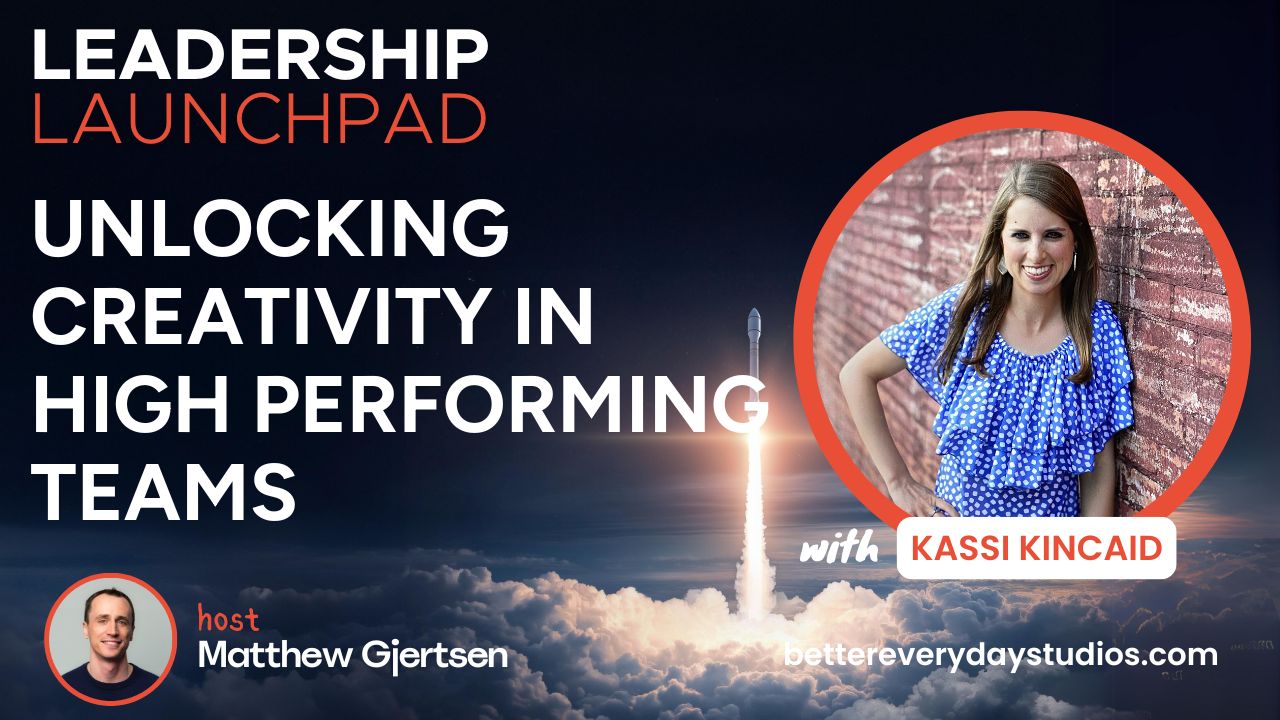
In this episode, Kassi Kincaid, a speaker, trainer, and expert in creative leadership, joins the show to discuss the importance of creativity in leadership and team performance. She shares her five-step framework for fostering creativity within teams: generating ideas, pursuing them, overcoming disappointment, taking time to rest, and remembering how far you've come. The conversation highlights practical strategies for managers to encourage creative thinking, support team members through setbacks, and create an environment where new ideas can thrive. Listeners will gain actionable insights on how to apply creativity as an ongoing process, not just as a means to a specific outcome.
 Automated Transcription
Kassi Kincaid [00:00:00]:
As hard as you pursue them, some of them aren't going to go anywhere or you're going to have to find another avenue. So literally, disappointment is not something to be feared.
Matt Gjertsen [00:00:27]:
One of the most common questions I get asked is how is SpaceX so successful? How are they so far ahead of everyone else, basically in the space industry? And hard work definitely has something to do with it, but I would actually say, in my opinion, a bigger part is how they approach problems and always have a new way of looking at things that have been plaguing the industry for years and come up with very creative solutions. And so I know last week's episode was focused on creativity, but I really think this idea of thinking creatively is such an important topic that I actually wanted to devote two episodes in a row to this really critical element of having high performing teams. My guest this week is Cassie Kincaid. Cassie is a leading expert in creative leadership. She is a speaker, trainer and author committed to helping people leverage their creativity to lead with greater impact and innovation. Her journey from building a grassroots literacy project to inspiring professionals across industries fuels her mission to equip leaders and teams with practical creativity frameworks that spark innovation, increase engagement, and drive meaningful change. In this week's episode, we really dive into her five part framework and give leaders practical steps that you can take to improve the creativity of your teams. I really think her framework really matches with the things I've seen in successful organizations because the thing that makes it different is it's much less output focused and and more focused on creating a continuous process and cultivating a mindset of creativity.
Matt Gjertsen [00:02:24]:
Before we get into the discussion, if this is your first time listening to the show, I do have to remind you to make sure you subscribe so that you never miss a future episode. And if you happen to be someone who is responsible for developing leaders in your organization, I would love for you to reach out to me matttereverydaystudios.com to see if there are things that we can work together on to make the leaders in your organization better. With that, let's get into the discussion with Cassie Kincaid. Cassie, welcome to the leadership launchpad. How are you doing today?
Kassi Kincaid [00:02:58]:
Hi Matt. I am wonderful. Thank you so much for having me out. I'm excited about our conversation today.
Matt Gjertsen [00:03:05]:
I am too. And thank you so much for doing this on relatively short notice. Actually for the listeners, it's funny if you follow the feed then last week we had a discussion on creativity and that had been one that I had planned for a couple weeks and it was A good friend of mine. And then it just so happened that immediately after I recorded that episode, we had kind of like an intro call together where we were just getting to know each other. And as we were talking about it, I find out about your book. All this creativity. I couldn't pass up an opportunity to just do a double header about creativity on the feed. So thank you for your flexibility and being able to jump in so quickly.
Kassi Kincaid [00:03:46]:
Oh, my pleasure. Happy to do it.
Matt Gjertsen [00:03:49]:
Yeah. So I'll start this off kind of similarly to the way I started off the previous conversation, because I do think generally, like all words, everybody has their own idea of what a word means. I think creativity, very often people tend to think about it from more of a, know, artistic realm or something like that. When you think about creativity, what comes to mind? What do you mean when you say creativity?
Kassi Kincaid [00:04:14]:
Absolutely. And you're so right. Creativity is one of those kind of abstract words. What I define creativity as is simply seeing the same picture with a different perspective. It's not about changing the situations or necessarily even creating something brand new. It's. It's really a lens that we can put over the situation, the project, whatever it is, and see it in just a different way.
Matt Gjertsen [00:04:44]:
That makes sense because I think since we've gotten to know one another, I've been looking at some of the things that you've spoken about and that you've written. And if I'm remembering correctly, I think you refer to creativity as more of like a process or a practice. Is that right?
Kassi Kincaid [00:05:01]:
That's right. So creativity. And we. We'll get into this, I'm sure, later on the conversation. But it's really a cycle and one that really never ends. You know, we don't just have one creative project, one creative thought, and then we're just done for the rest of our lives. We're constantly in this kind of like creativity flow, if you will. And I've discovered from my own experience and journey different steps of that cycle.
Kassi Kincaid [00:05:27]:
And we can get into that a little bit later. But you're absolutely right. It's one big step cycle and one. Sometimes you're having those same cycles in between, like a lot of other ones going on in your life.
Matt Gjertsen [00:05:39]:
Yeah, that. That makes sense. It's interesting the things that are connected in my brain right now. I actually just finished reading a book called I think the Nvidia Way, which is about Nvidia, obviously, which is a company that, you know certainly five years ago and maybe even today, a lot of people haven't heard of, but they're actually the, they're the most valuable company in the world because they're making these microprocessors, the chips that AI is basically built on top of right now. And one of the things that I read in that book was how they don't really necessarily set traditional goals. There's not like a, you set a goal and then you go after it, and then you set a new goal and you go after it. They talk about it much more of as a continuous process of you're always looking for the new information, looking for the new angle to try to adjust to the world. And so that's one of the reasons why I wanted to focus on creativity so much for, you know, for two weeks on the show is because as I'm learning more about these companies, you know, I was at SpaceX or learning more about Nvidia, is that this idea of just constantly looking for new angles, as you, as you put it, is core to, to a lot of their successes.
Matt Gjertsen [00:06:52]:
And so the, I wasn't necessarily planning on diving into this right away, but since you mentioned it, the, the five steps of that process. How do you define that, that creative process?
Kassi Kincaid [00:07:02]:
Yeah, absolutely. It. So it all starts with. It sounds so basic, but just dumping ideas and lots of ideas. So the brainstorm, right, it all begins with an idea, you know, TedX, what is your world changing idea? That one idea. And so most of the time you just need to have a lot of ideas before one actually become, okay, seems like you're gonna land on it. But that part can be tricky. It sounds so simple, right? Just like get out of, you know, sticky notes and just go to town.
Kassi Kincaid [00:07:37]:
But it can be really sticky because depending on your personality, if you're a realist or an optimist, you can really hinder even the first step just by like shutting things down. Because I'm a realist and I'll admit that I, when ideas come up, I'm immediately thinking about all the ways that like it's not gonna work versus the optimist is just like, oh, let's do this amazing thing. But then like, okay, somewhere reality has to come in. So the first is ideas, the second is actually pursuing the idea. Sometimes we don't even take the first step. And when I talk about the first step is literally doing the Google search, making the email, doing the phone call. Sometimes we have such big ideas and then like it's so simple just to get started in those capacities. The third step is overcoming disappointment.
Kassi Kincaid [00:08:32]:
And I literally say the word disappointment. I feel like, it's a dun, dun, dun kind of word in life, but it's so true. Like, as much as you have the ideas, as hard as you pursue them, some of them aren't going to go anywhere or you're going to have to find another avenue. So literally, disappointment is not something to be feared, it's to be expected. And so those two are the hardest parts of the cycle because it takes a lot of grit and resilience. But then it's so vital. The fourth step is to rest. We cannot expect ourselves to just be like these creative geniuses all the time that we need to focus on, that we're taking care of ourselves, that we're taking care of ourselves physically and mentally, and so we can show up optimally for our jobs and, and be able to be in that creative zone.
Kassi Kincaid [00:09:23]:
And then the last step is literally remembering where you started it. People maybe see memories as, like, these, like, nice things and pictures and all this stuff, but it's so vile to remember where you started because most of the time I like to kind of describe it as climbing a mountain. And you might get halfway up the mountain, you're like, oh, my word, the peak seems so. So unattainable. Not unattainable, but far away. But then when you look back and you're like, oh, my word, like, it's a long way down. So it's. It's really important to remember how far you've come so you can keep going along the process.
Kassi Kincaid [00:10:03]:
So those are the five steps, and those kind of just keep going around and around until, you know, things become bigger and better.
Matt Gjertsen [00:10:12]:
That's. I love these five steps. A couple things. I kind of want to go through each one of them one at a time. But a couple things. That one big thing that stood out to me, kind of to your point of, again, of it's a process, is that there isn't necessarily a clear point of outcome in those five steps. You know, very often, you know, when you're talking about any kind of process, there's some thing that you're always aiming for that denotes kind of like the end of the process or some kind of outcome is expected from the process. And in yours, I don't necessarily see.
Matt Gjertsen [00:10:48]:
See that. And I think exactly, because it's meant to be just a continuous cycle. Am I reading that right?
Kassi Kincaid [00:10:54]:
Oh, absolutely. So. And I love that even in the beginning you mentioned in video, and they don't have like, set goals and outcomes because that is what creativity is. Sometimes you really don't want set Goals and outcomes. Because sometimes the creativity grows so big that it surpasses even like your wildest goals. So you really don't even want to set some in the first place.
Matt Gjertsen [00:11:19]:
You're reminding me of a quote that I've been meaning to, I don't know, copyright for like a decade back when I was in. I was first starting out in triathlon and the. I don't know where this phrase came from, but I've repeated it a lot since then. It's. You can't imagine what you can do until you do more than you can imagine. And I think that's really the heart of what you're saying is sometimes it's like the old Henry Ford quote where he said, if I had asked people what they wanted, they would have said a faster horse. Where there is just. Yeah, it just, it just expands and expands.
Matt Gjertsen [00:11:58]:
Going through a few of these ideas really quickly. This first one of dumping ideas, you mentioned how for some people, that's, that's the hardest part. And you mentioned a couple different, like, kind of personality traits. What are, Are there any practical ways you have seen this or like real life situations where you've seen this really impede people and make it difficult to just get ideas out there? Because on its face, it seems like that should be the easiest step, but I can imagine it's sometimes the hardest.
Kassi Kincaid [00:12:27]:
This one's really funny. And, you know, I saw this way back, even in my early career as a preschool administrator is. Yeah, I think we are just our, our own hindrances, honestly, Matt. And it's. We have to unlearn that. I know I did. And being in leadership. So my sister was the director, I was the administrator.
Kassi Kincaid [00:12:53]:
And when we would come together for our leadership meetings, this is my favorite story to tell, that she was the big idea man. She was the optimist. She was always seeing how to do things better, better. And I loved her for that. But then immediately I would come in right behind her and be like, do we. I don't know if we have the stipend for that. Do we have the budget? Like, thinking of all the logistics, which are so vital and important, you can't just have the big idea man, you know, wanting to do all these incredible things, but they're never going to come to life because of the situation. So it.
Kassi Kincaid [00:13:23]:
And then she was like, you're being such, like a killjoy, like, basically like this, no fun anymore. And so I had to realize in myself, these are actually good ideas. Let's come in the middle and see how we can make them happen realistically, with all the resources. So I, I would say we are our biggest hindrances.
Matt Gjertsen [00:13:47]:
Yeah. Yeah. I mean, I know for me, I think the way I personally see it in myself is, you know, I'm working on writing a book right now. I've written a lot before, and very often the challenge is getting past any one idea so that you can write down the next idea. Because it's like, you write it down, you're like, oh, but I want to tweak that, or, oh, that's not quite perfect. And you wind up spending four hours, like, rewriting a single paragraph. And is that really the point of what you're trying to do right now? And it's, it is so often just about pushing, you know, just getting stuff out there so you can have that discussion. And whether it's the, as you mentioned, you know, like the realist in us or the perfectionist in us, that that makes all those limitations.
Matt Gjertsen [00:14:29]:
I want to actually go in a totally different direction than I originally said we wanted to, because I love, I love these five things so much. And since this is a podcast primarily aimed at helping managers lead their teams specifically to this idea of getting better at dumping ideas, you know, what are ways that you've seen, how can a manager of a team, a leader of a team, make it so that their team feels more comfortable with this idea dumping?
Kassi Kincaid [00:14:57]:
So there's two ways. First, I love the timer, because when you put constraints, then it actually allows for more creativity. Because I'm horrible. I'm. I'm very much like you said, Matt, like, let me write down one idea and then let's start, like, analyzing and dissecting. And you're like, oh, I only have one idea. So, yes, the timer is amazing. You would be probably amazed at what you can, like, not get out of your team that says, but, you know, receive from your team from a five to ten minute timer.
Kassi Kincaid [00:15:32]:
Just get ready, set, go. And two, when you make it, we are actually going to implement some of these ideas. Like we're going to take the top one or two or whatever it is. Then the, the excitement of actually seeing one of these ideas come to life I think puts more excitement and into the team and not just, oh, it's going to be another brainstorming session. We'll see if, you know, one of these ideas happens over the next five, 10 years or in my career time. So I think the urgency of both getting it out in a, you know, a few minutes and then actually implementing one of those ideas will really enhance the morale of the team.
Matt Gjertsen [00:16:20]:
I love this idea of constraining time in both ways, especially that second half. You know, any software engineer is going to be familiar with this idea of hackathons and how you're, you know, you bring together and it's about solving a bunch of problems or. But the whole point is actually implementing code, getting stuff out there. Because yeah, having ideas is great and all but unless you are like actually doing something with those ideas then you're really quickly going to be demotivated to come up with any more. I also was thinking of just on this idea of idea dumping again I'm in kind of a writing space and I think this research came from Daniel Pink. I'm not sure but I know that there was a study where they had two groups of individuals and they said this group said they were going to be rewarded for writing, for the best writing and another group was told they were going to be rewarded for having the most writing. And not only did obviously the ones who were told you're going to get rewarded for having the most writing wrote a lot more. But in the end they also ended up writing the best stuff simply because they were getting more practice at it.
Matt Gjertsen [00:17:29]:
And so I think this idea of idea dumping is. It's like you want to be rewarding and encouraging almost just volume and then through the repetition of the volume of the ideas the ideas tend to get better over time anyway. So there's just lots of reasons to encourage this idea of, of just generating ideas.
Kassi Kincaid [00:17:48]:
It is a lot and like you said, creativity, the idea dumping process, it's a lot of trial and error. And for any like perfectionistics on listening to this because I grew up a perfectionistic person and it's OK to it would be better to just be doing brain dumping thinking creating at like a B minus level than being at a plus level because at least then you're moving forward.
Matt Gjertsen [00:18:19]:
Yeah, totally. I yeah it's all about some kind of movement forward which again as you said is that idea of like putting some kind of time constraint on it as well as of, of making that forward movement. And that then I think goes right into this your second step of pursuing ideas. Yeah, like I bring this up a lot but this idea from Mark Randolph of he always says, you know it's not. Mark Randolph says not only he does the reverse of every idea is a good idea. He actually says every idea is a bad idea. But the only reason way to know how it's bad is if you actually test it out and Start pursuing it. Do you find that teams get caught a lot in that first step of just dumping ideas and it is difficult to move into that pursue phase.
Kassi Kincaid [00:19:07]:
I think the ideas, once they kind of come together and start talking about it. I have seen the ideas flow in my workshop that I do with organizations, the Edge of Creativity workshop, we do a lot of brain dumping. But in each organization we focus on whatever their pain points are. So whether it's healthcare, nonprofit, like everyone is different. And I love seeing the ideas just really pour out of everybody and, and they work in teams and sometimes it's like cross, depart. What is the word? Like departmental, whatever the word is. So yeah, I, I, because there is a mixture of every group, the realist and the optimist. And so I think the balance is easier in the groups and I think it's easier.
Kassi Kincaid [00:19:59]:
So I would probably say it's harder. The pursuing part.
Matt Gjertsen [00:20:04]:
The what you're saying, the dump, the creation is harder than.
Kassi Kincaid [00:20:08]:
The pursuing part or vice versa. So like I, I see.
Matt Gjertsen [00:20:11]:
Okay, the pursuing part is the hardest part.
Kassi Kincaid [00:20:13]:
Yeah. Whether they go and implement that, like that's, you know.
Matt Gjertsen [00:20:17]:
Yeah, yeah, yeah. That, that's kind of what I was expecting because it's great to generate those ideas and it's interesting. This is a process and there's all kinds of mini feedback loops in here. Like you were saying before, you're like, it's great to create all these ideas, but then if you, you know, the first time, then if you don't do anything with them, then the next time you get less ideas and then you don't do anything with those. And so then the next time you get less ideas. So when it comes to the pursuing, you already mentioned what I'm assuming is one tactic that, you know, a leader can put time constraints on themselves to say or on the team that says, okay, we're going to go do something with this, this. What are some other tactics that you've seen that can help teams get started on these ideas?
Kassi Kincaid [00:20:56]:
Absolutely. So some other things that you know, leaders, managers can do in the aspect I say even if just one person leading by example is so important that if you're a team leader that your team seeing you step, step out in that creative and lead that. So you as a leader being creative, that will boost the whole morale of your team, but also asking your team how to be creative and not just being like, oh, this is an open environment, feel free to come to us with any suggestions. A lot of people are burdened. You're going to have the Ra Ra. Challenging person, not challenging personalities, but like, that kind of are more bent to challenge the status quo. But people are introverted and so asking, you know, hey, Courtney, are there any. I loved your opinion on this.
Kassi Kincaid [00:21:56]:
Can you. Because people have a lot of ideas that they're not necessarily. Maybe not even they might feel comfortable. But a lot of people, if you ask them, you will get a better response because people will answer you. So I would say those two things. Lead, Be the first one to step out and whatever the project or whatever, lead it, be that creative leader, and then to ask point blank for people's ideas. I think sometimes we think of the meetings, you know, around the conference table, and let's have these brainstorming sessions. But having those conversations one on one with people can be very, very beneficial.
Matt Gjertsen [00:22:37]:
To the organization, I'm sure, especially on this idea of actually pursuing the ideas, that questioning is really important, because I think one of the biggest struggles that you have to overcome as a leader, especially a new leader, is this idea that you're supposed to have the answers. So, you know, maybe you sit down with your team and you do this brainstorm, and then there's all these ideas, and, like, you're supposed to be the one who knows what to do with all of these ideas or how to take action on any of these ideas. And so the creativity flows through the whole process of. Okay, so let me ask you, like, what if we want to action on this idea? What's the first step we can take? And continuing to ask your people for that kind of input as well, I'm sure helps that process move forward. So then the third step, overcoming disappointment. I don't know. For me, I would say I've had some managers who probably reinforced the disappointment in many ways. It's that idea of, like, oh, why didn't.
Matt Gjertsen [00:23:41]:
That didn't turn out very well, did it? Oh, my gosh, you're gonna get dinged on your. On your next performance report because that idea didn't really work out. That's obviously not what we want. What does it look like to be a good manager to help people get over a disappointment?
Kassi Kincaid [00:23:56]:
I think looking forward is the best way to overcome disappointment. So, Matt, I have done and tried some wild things in my career. Going from preschool administrator to leader of a global children's illiteracy program to taking my creative skills and knowledge and now, like, keynote speaking and workshops and all the different things has been a wild ride. And I think one of the biggest things that I was working on, I guess, you know, hardest to get into was working with NASA. And I have a YouTube channel for children that we pair children's books with experiences. So we go. Go all over wherever, you know, the. The books take us, essentially.
Kassi Kincaid [00:24:45]:
And I had wanted to film with NASA for probably about five years. And so I tried, like, the traditional route. What is like, right, the first step. And it's to find, like, the media inquiry, right, on the website, the general information. So that was the first step. Well, you know, it is very hard to get into NASA, you know, federal. And then especially if you're filming, that's, like, even doubly worse. And so the first time I, like, sent an inquiry, whatever the first general step was, I don't think I heard back or even if I did, is very.
Kassi Kincaid [00:25:22]:
You know, basically, it's kind of all this long, long, long, long, long, long, long, long wait list. And. And so it's kind of a dead end. And so I didn't pick it up for a while. And then I just saw the door. Eventually I was in this Facebook group for speakers and somebody was introducing themselves. I hardly ever get in there because who has enough time to go into, like, all the commenting on LinkedIn, so, you know, aside from Facebook groups. And she was just like, hi, I am a spacesuit expert at NASA.
Kassi Kincaid [00:25:59]:
And I'm like, oh, my word. Like, there's my door. There's my door.
Matt Gjertsen [00:26:03]:
Yeah.
Kassi Kincaid [00:26:04]:
So we connected. She loved the idea. She was my inside person. We are still friends. That is how I got in. But she had to clear it. We. I thought it was all cleared.
Kassi Kincaid [00:26:17]:
Then the person, she's like, you know, fill out this form, whatever. Then the. The, like, the media person's like. Like, it's usually a really long process. I was like, oh, no, I thought we were there. So she's like, put me in touch with your, like, contact. And like, poof, that was it. And I was into NASA.
Kassi Kincaid [00:26:37]:
So you never know. You never know. And it's like the optimism of what could be is what keeps me excited every time I go for, like, the next big thing or reaching out to the next big person about whatever that you never know. Just because you get a no, just because there's silence doesn't mean it won't happen. So it's that really optimist. Like, I might get shot down 10, 20 times, but it's that one that will make it all worth it.
Matt Gjertsen [00:27:10]:
Yeah. And I think to your point, from the manager's point of view, especially if the manager has a little bit more experience or a little bit more situational awareness than the people on their team is continuing to remind them to keep trying and as you said, reminding them of the big picture and reminding them of what you're trying to do, even if every idea that we try doesn't pan out. And it's interesting kind of the scale when you say, you know, overcoming disappointment, thinking through the ranges of. I just recently read a book on intel, actually, and kind of they talk about, like, the OKR process and the. The formal objective and key results process says that you should only achieve, like, between 50 and 70% of your objectives. Like, if you're setting big enough goals, like, you should only meet, like, half of them. And so there's a lot of disappointment happening in that. But then I'm also imagining kind of like the sales world as well, and any account executives or stuff or sales development representatives, they have like a 98% failure rate when they're trying to, you know, get into a new organization or something like that.
Matt Gjertsen [00:28:21]:
It's all about repeatability. And so, you know, there's a whole range there of what disappointment means. But as a manager, like. But moving forward always means some disappointment. You're never going to achieve it all. And that the manager. I love how you put that. That it really is the manager's place to kind of provide that bigger picture, that encouragement and make sure.
Matt Gjertsen [00:28:44]:
Make sure people stay motivated to keep trying.
Kassi Kincaid [00:28:47]:
Absolutely. And I. I love that you talk about the sales teams and everything, because that's kind of what I think about is like, somebody, you know, making a bunch of phone cold calls and getting like one out of a hundred or one out of 200, but it's worth it. And then once you get that, like, you're making every call hoping for that, and once you get it, it's like the boost. Right. For like the next 200. So I love that you bring that up because it really is. You need a very small percentage to keep that fire going.
Matt Gjertsen [00:29:17]:
Yeah. I always think I'm not a big baseball fan, but I remember years ago I would think a lot about how, you know, in baseball, people get into the hall of fame for succeeding 30% of the time. Yeah, right. You know, like, if you can hit the ball 30% of the time, then you're on your way to the hall of Fame. And so it's like, okay, like, for the rest of us, like, let's give ourselves a little bit of slack and keep moving forward. The last two steps, the rest and remembering where you came from. What I don't know, like, make that A little more. I'm trying to think of it, you know, we're trying to make this a little bit more practical.
Matt Gjertsen [00:29:53]:
What does that mean? Day to day, especially like from the manager's perspective and encouraging their employees.
Kassi Kincaid [00:30:01]:
So, yeah, it is. Those two steps are a little bit, seem a little bit random, right? Because it's like no wellness, a wellness talk. But yeah, rest for the employees. I think one of the biggest things is encouraging, not necessarily encouraging people to take time off, but being excited for them when they take time off. And I had a boss like that in my, you know, career and she was so understanding and actually really excited for people to, you know, whether their kid was graduating or like, have an amazing time. Like, don't think about work. That is incredible. Right.
Kassi Kincaid [00:30:47]:
Instead of when are you going to be back? Like, I can't believe you're taking so much time off. You know, we really need you here on the team. And two, really having those morale, whether it's the get togethers, creating that space in the work environment and little things like, like relaxing music in the break room or like the air diffusers, you know, you can, maybe you're going to take like a, a rest time, but just kind of like quiet time, you know, from 12 to 12:30 every day. You know, you can, you can kind of take a break and mingle or whatever it is. You can get creative about it. I can't. I'm not going to tell you how to get creative. But I think that whole rest piece, it really does trickle down to managers saying, hey, when you're off the clock, you're off the clock.
Kassi Kincaid [00:31:43]:
I'm not going to be trying to talk to you. And I think that's something I'm even trying to learn for myself as being like an entrepreneur and having my own schedule as a founder. And everything is like, when it comes five o' clock, there's a lot of nights to where I work into the nights and the evenings because I just, you know, it's me and really signing off. And so having that those boundaries is, is vital. Like morning to evening and creating that culture of when you're at work, you're at work and when you're not, you're not.
Matt Gjertsen [00:32:15]:
Yeah, I mean, Cal Newport is one of my favorite authors. He wrote a book called Deep Work and he talks a lot about creativity and productivity in the knowledge worker space. And one of the things that I truly believe is if you are really good at, if you, if you're good at like really deep work, like if you have a Setup where you can, like, okay, I'm going to get into flow and I'm just going to crush some work. Like, most, like, certainly for me, most people that I know can really only be engaged like that for three or four hours in a day. Like, it is incredibly taxing. And to try to do that for, like, you have to train yourself to be able to be that engaged for longer. And, you know, then on the creativity piece, you know, I. One thing that I've been trying to do in my own life, I listen to podcasts all the time.
Matt Gjertsen [00:33:10]:
I'm really trying hard to spend more time outside and walking around, not listening to a podcast where I'm giving my brain a minute to not have new information pumped into it, but to just let it, like, sift through and process the information that's already there, to kind of give my neurons a little bit of a rest so that they're ready for that next time when I want to be creative. So I definitely appreciate this idea of being. Of being restful, of being mindful of the fact that you can't just be on all the time, especially in a creative endeavor.
Kassi Kincaid [00:33:53]:
And I love how you say the walking around everything, because there was studies done that said that if you walk, tread, even on a treadmill or outside, it stimulates the creativity. And even taking vacations. The hit Broadway music. Yeah, the hit Broadway musical, Hamilton was. That idea was actually born on a vacation. So when people are taking time off, managers and leaders like you are doing them a favor that they, like, will think more creatively when they come back by getting that rest.
Matt Gjertsen [00:34:27]:
Yeah, yeah, absolutely. Absolutely. And then this final point of, you know, remembering where you came from, I imagine that has. That's really strongly tied to kind of this idea of. Of thinking into the future and, you know, encouraging people. Is that a big part of it or are there other elements to it as well?
Kassi Kincaid [00:34:45]:
Yeah, absolutely. So it's. It's this space to really have gratitude and to really that encouragement space. Sometimes we're in, like, the things we're working on, the projects, whatever it is, they take a while and to come to fruition. Sometimes things aren't as easy as, you know, you start on Monday, you end by Friday. And so it's that piece of moving forward and honestly being proud of everything that we've been able to accomplish and be a part of. I mean, Matt, seriously, in my life, I never imagined in, like, my entire life that I would go from a preschool administrator to. To working on a passion project that would end up going on to combat illiteracy around the world.
Kassi Kincaid [00:35:38]:
And don't even like, mention the TED Talk because I'm like, seriously this time, like, I did that, but like, that was not any of the plan of my life. Like, I was happy being an administrator. And then things just kind of unfolded and continue to unfold to where I honestly don't know how far and big that they're continuing to unfold. But that's what makes it fun. But so when I look back in, you know, this has only been six years that I've been. Haven't been preschool administrator. I was like, I can't even imagine. So yeah, yeah, looking back, it's like, it's really cool, like the different ways our lives and our careers can go.
Kassi Kincaid [00:36:14]:
So taking that time to kind of be still and just to, to think back is it just does a world of good and kind of keeps us going into the idea phase. So you kind of go from the remember phase and it just kind of starts all over again.
Matt Gjertsen [00:36:32]:
Yep. Well, I think that's why, you know, you had kind of made the comment that these last two points seem kind of out of the blue or kind of like they don't fit. But I think they fit so perfectly. You know, the rest piece in this idea that you have to. You have to give yourself time to kind of recuperate so that you're ready for the next step. But then even the remembering piece, because this is a process that's continuously happening on all kinds of scales. Sometimes big scales, sometimes just small scales. It is so easy to forget where you came from.
Matt Gjertsen [00:37:01]:
That's one of the, one of the best attributes and worst attributes of human beings is how quickly we adapt to the present and just assume this is the status quo. And, you know, that's the thing where we can get into these hedonistic death cycles or whatever they're called, where we continuously acclimate to this new level and then want more, and then want more, and then want more. And so we never become satisfied. That's very true in our personal lives. But then from this idea of wanting to create a creative environment, you need to take that moment to just be like, appreciate what you've done. And then you can also spend time to learn from that. We started there, we thought we were going to go over here, and we wound up over here. Why did that happen? What can we learn from that process as well? So there's a lot of learnings that can come from looking backwards as well.
Matt Gjertsen [00:37:58]:
So it's not just purely a motivational piece There's a lot of learning about the creative process that I'm sure can happen.
Kassi Kincaid [00:38:06]:
It is a lot of learning and development, Matt. I mean, literally creativity, everything that, whether you achieve or don't achieve in all of this kind of mess that it is all learning. I mean, and I think we learn more from what we don't achieve or what we get disappointed about than whether that we actually hit the ace every time. Because, you know, it's fun, we get what we think we want, but in the long run we're way better when honestly we don't hit that ace.
Matt Gjertsen [00:38:36]:
This has been a really great discussion, Cassie. I really love this process because I feel like it is so different than what I traditionally hear from, like how to be creative again kind of to the point I mentioned so often. I think steps of being creative, it's. They're all driving towards an outcome rather than just a practice of something that just is. So I think this has been really, really great. I think managers are going to get a lot of practical things that they can do out of it. If people want to learn more about you and your work, where. Where can they go?
Kassi Kincaid [00:39:08]:
Absolutely. So I love to connect with you on LinkedIn. My name, Cassie Kincaid. You can find me real easy or on my website@cassie kincaid.com for all of my things. So yes, those are the best two places.
Matt Gjertsen [00:39:23]:
Awesome. Well, this has been really great. Yeah. I hope you have a great rest of your week and thank you so much. I'm sure we'll talk more in the future.
Kassi Kincaid [00:39:30]:
Thanks so much, Matt. Really appreciate it.
Matt Gjertsen [00:39:34]:
Thank you so much for listening to today's show. If you are looking for help turning your organization's great engineers into great managers, me and my team at Better Every Studios would love to help. We deliver targeted and interactive training workshops that are designed to help build the three fundamental skills of any new manager. Building trust, giving feedback and setting goals. Reach out to me through Matt better everyday studios.com so we can start making your organization better every day.


