
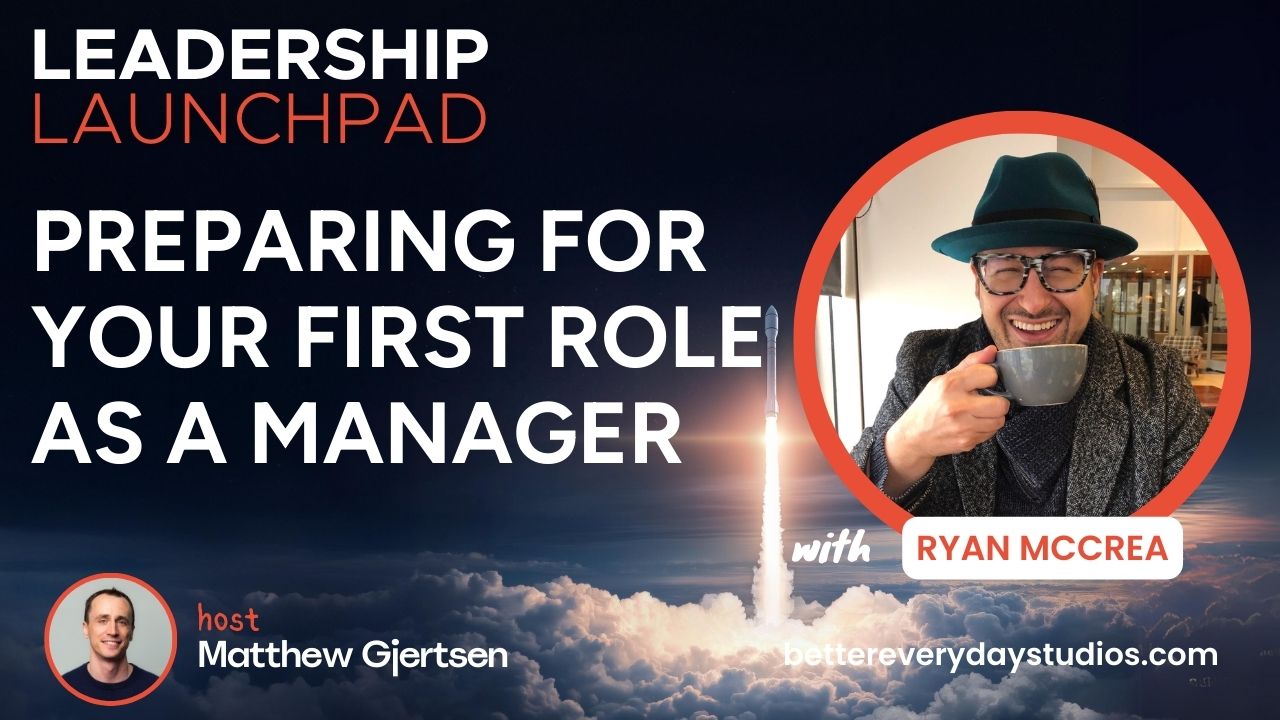
OVERVIEW
On this episode of the Leadership Launchpad, I sit down with Ryan McCrea, head of learning and leadership development at Ameren. Ryan brings his extensive experience in talent development to tackle some of the most pressing issues faced by technical managers today. Are you struggling with delegation, transitioning to leadership, or managing emotional conversations? This episode is for you. We delve into effective delegation strategies, the importance of dual career tracks, and how organizations can better prepare new managers. Ryan also shares insights on the evolving "player-coach" roles, emotional intelligence in leadership, and aligning organizational incentives to encourage team development.
Want more tips on effective training? Sign-up for our weekly newsletter: https://www.bettereverydaystudios.com/newsletter
Visit us at https://www.bettereverydaystudios.com
 Automated Transcription
Ryan McCrea [00:00:00]:
People that truly are micromanagers and people that have problem delegating, sometimes it's about the idea of giving up the way to do it or that process to someone else. Now, maybe you want to coach them and guide them so that they don't get themselves in trouble during that process or that they don't do something political that might really have them, you know, step in a really gross, nasty puddle. But. But for the most part, just because a group wants to do something different than the way you would have done it, you have to get comfortable with that. The idea of giving up that power to someone else so that they can get from a to b in maybe a little bit of a different way and maybe a better way than you would have done it, quite honestly, is what it comes down to. That is the huge part...
Matt Gjertsen [00:00:48]:
Welcome to the leadership launchpad, where we help technical managers improve themselves, their teams, and their organizations. On this show, I talk with industry leaders, coaches, authors and experts to give you actual insights that will help improve your own performance and the performance of those around you. Our guest today is Ryan McCrae, the head of learning and leadership development at Ameren. Ryan is focused on making an impact in organizations through strategic talent management, leadership development, mentoring, team dynamics, and culture building. Prior to Ameren, Ryan was the vice president of talent development at Commerce bank, where he launched a corporate wide professional development program while overseeing the strategy around people and leadership growth. In this discussion, you can expect to learn the questions any individual contributor should be asking themselves before they become a people manager. The importance of dual track career ladders, the most common challenges new managers face, and how you can overcome one of the most difficult challenges, delegating tasks to your new team. Before we do get into that discussion, I want to make sure to remind you to make sure you are subscribed so that you never miss a future episode.
Ryan McCrea [00:02:07]:
And if you are already subscribed, then I ask that you would just take one moment to share this show with at least one other person. That, after all, is how we grow. I can't tell you how much it means to me. So with that, let's get into the discussion with Ryan McRae. Welcome to the leadership launchpad. How are you doing today?
Ryan McCrea [00:02:25]:
I'm doing well. Excited to get a chance to chat with you today.
Ryan McCrea [00:02:29]:
Yeah, we had a really great discussion when we first met up a couple weeks ago that I thought was so interesting because especially for you, you know, you've worked in currently you're working in a very technical company. You've worked in a lot of technical companies, but, you know, a lot of that was around, like, biosciences, and you did a stint in banking. And one of the things that we had in our discussion that I thought was interesting because I like to talk about when I say the leadership that I'm teaching is primarily geared towards technical people. And you kind of made this point of like, yeah, well, even in banking, there's technical people. When you think of technical people, what do you mean?
Ryan McCrea [00:03:04]:
Yeah, that's a great question because I've worked in a lot of different types of organizations. I've worked in six different type of organizations. One of them was a tech company, but I work for a company that very technical. But you might not think is technical, like an agricultural company. Tons of scientists.
Ryan McCrea [00:03:18]:
Yeah, yeah.
Ryan McCrea [00:03:19]:
And now I work at an energy company, obviously can be pretty technical. A lot of engineers when we think about that as well. So when I think of technical and technical skills, it's those things that are the non human skills. So, you know, we think about all the people skills we've got that whole soft skills thing, don't get me started. I hate the word soft skills. I know it started, you know, back in the day in the military, and it's kind of stuck. I'm not a fan, but so I tend to call them people skills. So everything that's non people skills that it would take to do a job.
Ryan McCrea [00:03:50]:
Like, obviously I worked with scientists, so really understanding the scientific method, understanding how the processes work, understanding how the systems work, the technical skills that they had to do to do their job like that, to me, the, those are all the technical skills. So I think it's the, what do you need to know to be good in your field? And I think not only good in your field, but an expert in your field. I think that's what that really means to me because I think a lot of organizations, I think that do this well with technical people, they have that great individual contributor technical track, because I know a lot of scientists that just wanted to be a scientist. They never ever wanted to be a manager in the first place. They just wanted to be the best scientist that they could be.
Ryan McCrea [00:04:29]:
Yeah. Yeah. Well, I mean, kind of on that point, like, what do you see as some of the common challenges that companies have when they're thinking about promoting technical talent? Because I think that's where the rub is, is that what often happens is clearly when somebody's getting promoted to their first people manager role, they're getting promoted likely because of their skills as an individual contributor. But then that doesn't necessarily mean that any of those skills translate. Like, what are the primary challenges that you see or gaps that you see companies have in identifying which excellent individual contributors, especially technical ones, will make good managers?
Ryan McCrea [00:05:10]:
Well, I think that's the problem, and that's the rub that most organizations have. They decide, okay, we're gonna hire and put the best individual contributor into a manager role. So the one that is, again, in the expert of their field from a technical perspective. But being a leader is a whole nother job. I think that's what people sometimes don't think about. Like, yeah, someone that's going to be a good technical person will be able to help lead a team in the technical aspects of it. Maybe just means they have the knowledge. That doesn't mean that they are able to share and grow and help others do that, too.
Ryan McCrea [00:05:43]:
So when you've got somebody moving from a very technical role into a leadership role, do they even really understand what they're getting into in the first place? Like, a lot of times they take on that role because it's maybe the next thing to do or they feel it's important, but really they're taking in a whole brand new spanking job is really what it gets down to. Like, with a very different set of skills. Like, to be a leader is a very, very different set of skills. And I think the big thing, I talk to people a lot when they're an individual contributor and they're going into that role, especially when they're a, like, high potential, very strong individual contributor, is the idea that this is no longer going to be about you.
Ryan McCrea [00:06:24]:
There it is.
Ryan McCrea [00:06:25]:
That's a big one for people, is like, when you're a strong individual contributor, you're there about you. Yeah, but once you make that change into being a leader, it's not about you anymore. It's about your team. It's about the team goals. It's about motivating people. It's about developing people. It's about making sure that you do hit, you know, those goals that you have as a department or what you need to do or what you're supposed to do for the organization. It's, it can't just be about you anymore.
Ryan McCrea [00:06:52]:
So that's a huge shift for people. Huge, huge shift. And I think that's, that's where organizations kind of fall down sometimes, is one not getting people prepared for that, not helping them understand that that's a huge shift and that it looks different and then giving them the skills that they need, knowing that, hey, this is a different skill set, it's a different job. You're probably going to have to focus on some of these things in a way that you maybe haven't ever for the first time.
Ryan McCrea [00:07:18]:
Yeah. And I think kind of to your point, since it is such a new skill set, something that a lot of these really high performers also have to realize is the thing that you are best at, you are no longer going to be best at. You know, almost by definition, if you're going to take time out of your schedule to get good at this other thing, you're going to start to neglect those coding skills or those whatever, whatever skills that got you there. They're gonna start to atrophy. Like, they just have to. If you're actually gonna give management, it's.
Ryan McCrea [00:07:50]:
Due, like, you are going to be delegating, hopefully a lot of those things that maybe you really, really enjoy doing. I think that's why it's so important for people to really understand, like, what are you jumping into? What are you getting into? You know, do you understand why you're doing some of these things? I mean, when I think about a new person jumping into a role, and this isn't probably just for technical people, this is quite honestly for anyone, I think that's jumping in to a new manager role. Like, there's a couple very key things that I think they should know. One is why do you want to be a leader? Why? Why do you want to be a leader in the first place? And I ask that because are they doing it for the right reasons? If they're doing it for money, they're going to find that it's probably not worth it if they really don't like the idea of being a leader. So really understanding your why, that's a big one for me. Like, understand your why. And then what does it mean to be a good leader in the organization that you're in? Because that's not the same thing in every single organization we know, leadership doesn't have just one consistent definition across the world. That's just not the same, not the same thing in organizations, too.
Ryan McCrea [00:08:54]:
So, you know, what does it mean to be a good leader at that organization you're at? What are the expectations of a leader? And then you need a real good, realistic job preview. So, like, and when I say a good, realistic job preview, like, look, there's some things about being a manager that are awesome, and there's some things about being a manager that aren't great. And so you need to have the good, the bad, and the ugly. You need to, like, pull back the curtain and actually see it all for what it is and understand kind of what you're getting into and then do a real good, and we'll get into this in a second. I think probably is a good self assessment, like, do you know what you are good at and what you're not good at from that management perspective? And so you need to know and understand those things before you're jumping into a role. I think especially for technical people, because I see the challenge of, like, being a great technical person means that you're probably often more focused on solving problems, you know, very technical problems, but maybe where you don't do as much as communication and collaboration and when you're a leader.
Ryan McCrea [00:09:55]:
Yeah.
Ryan McCrea [00:09:55]:
Things like communication and collaboration key. It's why it's such a different role.
Ryan McCrea [00:10:01]:
Yeah. Yeah. So I think those are such great examples of kind of questions and self reflection that any person should be asking themselves prior to getting into a leadership role. When we think about things really tactically, like, what have you seen organizations do? Or maybe what have you done at an organizational level to help people do that self reflection, like, help them really make sure before they even become a people manager to understand if this is the right fit for them.
Ryan McCrea [00:10:36]:
Yeah, I think, you know, I've gotten an opportunity to be part of organizations where we've been really tactical about this.
Ryan McCrea [00:10:41]:
Yeah.
Ryan McCrea [00:10:42]:
So my favorite example came from an organization called Commerce Bank. I was at wonderful organization. This work was done by a team that I was on. It was led by a woman named Carrie Kyme. She was amazing. And so what we ended up doing was we really first started with just helping some of those early questions I talked about, like your why and understanding a little bit more about what leadership is, having that realistic job preview. What is an expectations in that organization? Well, we did that. So what we started doing is doing what we called an aspiring manager discovery session, and it was open up to anyone in the organization that wanted to go with it.
Ryan McCrea [00:11:16]:
So you could have been there for three days or 30 years if you like, got an itch and you decided you wanted to think about becoming a manager, you could sign up for that session. It was a 90 minutes session. So 90 minutes, an hour and a half out of your day to answer some of those big questions we just talked about. Now, what we did is we had them do a little bit pre work. They did some pre work, and they went and interviewed three or four managers. Go and talk to managers about managing, like, which you sometimes don't do when you talk to your manager, you talk to other managers. You don't actually talk about what does it mean to be a manager and what do you like? What do you dislike? What do you really enjoy about it? What skills did you have to build to get there? What surprised you when you became a manager? So we gave them a list of questions and said, go talk to managers. Then they would come to the session, that 90 minutes session, and we would do everything we just talked about.
Ryan McCrea [00:12:01]:
What is your, why? What is a realistic job preview of what it means to be a manager. We called him, I think, the perks and the pitfalls of being a manager, you know, and what did it mean to be? What were those things that you had to do? Well, you're gonna have to have hard conversations. You're gonna have to do performance reviews with individuals. Sometimes you're gonna have to tell people, no. I mean, are you okay? Are you ready to deal? Sometimes you might have to deal with emotions. Are you ready? Are you comfortable? When we think about super technical people, dealing with emotions is sometimes not their strong suit. Yeah, not their strong suit. So do you know what you're getting into? So they did that session.
Ryan McCrea [00:12:36]:
They did that 90 minutes session, and then there was some post work. We gave them a workbook to sit down with their leader and have that conversation and talk about what did they learn from that? What did that mean for their psyche and what they thought next steps were in their career. And then we had them make a decision. So we actually had them go in and answer a survey that said, like, yeah, I want to be a leader right now, or maybe I might want to be a leader or a, uh, uh, like, you know, this. This kind of made the decision very easy for me. Like, I do not want to be a leader. This is not something I'm interested in. So we gave them a few options.
Ryan McCrea [00:13:09]:
We actually tracked those, and then the individuals that were interested in doing that, we introduced a six month session called, you know, um, aspiring managers. And then it was, I think, journey to. Journey to management or something of the sort like that.
Ryan McCrea [00:13:24]:
Okay. Okay.
Ryan McCrea [00:13:25]:
And that was the six month session where we actually dug into a lot of these different pieces of, like, communicating and how important it was and how you could do it and how you should do it. And again, what are these expectations of a manager? Understanding your why, really digging in, finding out what it is that you wanted your management style to be, but then digging into all these different important aspects of, again, how do you hold somebody accountable as a manager? That's a huge, huge part of it. How do you have a hard performance conversation? That's a huge part of it. And then in the last session, we actually said, okay, so how can we help prepare these individuals to be into those roles, to get into those roles? And what we ended up doing was really spending most of that time talking about what did it mean to do a good behavioral interview? What did it mean to maybe share your why or how you were going to market yourself? What, what were some of the pitfalls and things that people didn't do well in internal interviews? Sometimes things, people don't do internal interviews well because they're like, oh, well, I'm already here. And they don't bring their a game. Like, you can't do that. You still got to bring your a game. It's an internal interview.
Ryan McCrea [00:14:32]:
So we tried to prepare them so that when they were interested and when those roles came up and they interviewed that maybe they would do better than just hopefully jumping into it and hoping they were going to do okay. We actually, then when people graduated, those programs, put them, gave all those names to the recruiters in the recruiting department so that they knew and were very aware of the people that had management on their mind and also had gotten the opportunity to learn some of these things, too.
Ryan McCrea [00:15:01]:
I don't think I have ever heard a clear what's in it for me answer from a learning program. Right. Where like, very you very clearly and deliberately created a learning program. It's like, no, like, this is how it's going to help your career move forward, which is what is so often missing. It's just like, oh, we're learning these skills, or, oh, we're getting this knowledge and I don't know really how it's gonna apply. It's like, this is gonna put you on a special list that the recruiters are all gonna see. And, you know, I mean, that's. That's amazing, going back to the tracking that you said you did.
Ryan McCrea [00:15:37]:
So one. So two questions on that. First, did you do like a before and after of like, how many people wanted to do it before the session, the 90 minutes session and the homework and how many wanted to do it after? Cause that'd be a cool thing to see.
Ryan McCrea [00:15:49]:
I don't think we did that, though. I agree. As being a stats guy, I'm surprised that I let my team get away with not.
Ryan McCrea [00:15:57]:
So then for the post stuff, do you remember roughly coming out of it, what the percentages were like? Were most people really bought in or having to do it? Were there a fair number that were like, eh, I kind of learned I didn't want to do this.
Ryan McCrea [00:16:09]:
I think the people that were still pretty bought in and said, yep, I think I kind of want to move forward with this. I would say, realistically was probably, like 30% to 40%, you know, then you had some that I think still wanted to be managers. Just maybe not yet.
Ryan McCrea [00:16:22]:
Yeah.
Ryan McCrea [00:16:22]:
And there were definitely were some that came out of that that were like, yeah, no, I don't think this is for me, at least for right now. Who knows what their life was gonna be 510 years from now?
Ryan McCrea [00:16:31]:
But.
Ryan McCrea [00:16:31]:
But at that point in time for that situation for where they were in their life, they're like, okay, yeah, this is not something I want to jump into. That is definitely not responsibility that I want. That maybe.
Ryan McCrea [00:16:41]:
Yes.
Ryan McCrea [00:16:41]:
Whoa. That was different than the expectations of what I thought a leader was going to be. It was. We actually did those once a quarter because we used those discovery sessions we were talking about not only to help people learn, but we used them as a feeder pool into this other program, of course. So when we first launched those discovery sessions, I think we did. I think we maybe set up three or four, like, within, you know, first launching them. They filled up within minutes, Matt.
Ryan McCrea [00:17:08]:
Minutes.
Ryan McCrea [00:17:10]:
It was like we were selling concert tickets. They were signed, they filled up in minutes, and we had a 90 person waitlist.
Matt Gjertsen [00:17:16]:
Wow. Yeah. Yeah.
Ryan McCrea [00:17:17]:
I believe that's when, you know, in our work and L and D that, like, you've done something right. Like, you've put the product out there that people really need when something like that happens. And we were like, yeah, we hit the nail on the head with this. This is exactly what everyone was needing. That's what we were here, but we put it out there, and it's like, that was definitely. I like to think about everything we do in hrs products. Like, that was a product that. There was the demand.
Ryan McCrea [00:17:41]:
We were hearing the demand. We supplied the demand.
Matt Gjertsen [00:17:44]:
I love it.
Ryan McCrea [00:17:45]:
Boy, did it come. They bought. They bought what we were selling.
Matt Gjertsen [00:17:48]:
Yeah. That's incredible. That's incredible. And it's one thing that's interesting that I think about the statistics, and you're saying that there were those people that said, oh, I'm not really ready for this, or I'm not sure. I think there's that challenge of judging effectiveness when training people skills, because they're things that people so often reflect on. And I'm a big believer in, like, confidence level as a really important indicator, you know, especially in this space, since true ROi can be really hard to pin down in terms of, like, you just need a lot of time. Like, you need a lot of time and resources to really see that effectiveness. And so I like confidence level, but what can happen actually is for some of these skills, a person can go through an amazing course that really helped them, and their confidence level might go down simply because they're learning all the things that they didn't know.
Matt Gjertsen [00:18:40]:
And that's a good outcome, even though it might seem at the face like a bad outcome, which is interesting. So you do all this great work to kind of prep people and get people ready. A lot of organizations obviously don't do that. Um, whether it's, you know, based on your experience. Let's. Let's move now. Okay. So people get promoted.
Matt Gjertsen [00:19:01]:
What are some of the most common pitfalls that you see, maybe specifically to, to technical managers? Like, we, we touched on this. You touched on this a little bit earlier. What are some of the most common challenges that you see in them? Making the transition?
Ryan McCrea [00:19:14]:
Yeah, there's definitely some very key things that I see with technical managers when they make jump into management for the first time. I think one, communication skills, like, again, very tactical people trying to solve problems, love that. From that perspective sometimes that, that idea of communicating with others and definitely communicating a clear message, because those people usually super smart, so there's a lot going on up here.
Matt Gjertsen [00:19:39]:
Yeah.
Ryan McCrea [00:19:40]:
But do they know how to communicate that in an articulate and a succinct way to help others understand still it down. So that's a big one. And I think very similar to that is then sharing a vision, because if you can't communicate well and communicate articulately and specifically in kind of what's going on in your head, it's really hard to share a vision or a strategy for a group that you're in. So that is sometimes an area that I see kind of, if you want to bucket all that is communication. But communication strategy, like that piece is one of the areas that I see quite a bit. For sure.
Matt Gjertsen [00:20:12]:
Yeah. There's a reason why, like, the Neil Degrasse Tysons and the Brian Greens and stuff stand out, you know, because it's a skill that's so often lacking. And so when, when people are good at taking all these complex ideas, you know, Elon Musk talks about, my mind is a storm, you know, and he, despite everything that he does, like, if you listen to it, like, he has a difficulty, like, just in daily really distilling it down into a simple structure that people can follow, you have to like, kind of really want to follow it 100%.
Ryan McCrea [00:20:45]:
I've. I've gotten the opportunity to have lunch every once in a while here and there with one of those very brilliant type of people, including one of the founders of. I think it was square here in St. Louis. And I was just like, brilliant guy, brilliant guy. Probably. His ability to articulate like, it was one of the weirdest lunches I've ever been at in my life.
Matt Gjertsen [00:21:05]:
I bet.
Ryan McCrea [00:21:06]:
Great guy, super smart guy. Like, very personable in a lot of ways, but just kind of weird and awkward. So, I mean, sometimes that exists, sometimes that doesn't. Definitely sought a lot with scientists. I've seen it with people like lawyers and really anyone that you can think of. Engineers, of course, yeah. With a lot of different groups, data scientists. I've seen some challenges there as well.
Ryan McCrea [00:21:26]:
So that's definitely one area for me. I think the idea of dealing with emotions is something that's challenging for them and having hard conversations, that I found something specifically in technical people to be really, really hard. And that is such an important part of being a leader. And now this day, it's more important part of being a leader than it ever has been, because there is this shift from the command and control leadership, and maybe you could, you know, get promoted as an engineer and have. Be a good command and control leader because you don't have to worry about emotion, showing vulnerability, having connection with people. It's fine. Doesn't matter.
Ryan McCrea [00:22:03]:
I'm good.
Ryan McCrea [00:22:03]:
Technically, what I am. But in now is today. In today and age now is today. It's just that you need that, you know, you need that ability to be a human centric leader. It's this idea of being able to hold people accountable and also making sure that you have the appropriate level of kind of vulnerability.
Matt Gjertsen [00:22:18]:
Yeah.
Ryan McCrea [00:22:19]:
And some empathy for the people that you're leading, that you're thinking about, that people have choices. And the pandemic shattered all of that and work, as far as I can see. Like, it just shattered it. You know, it's. It's out. It's out of pandora's box. You can't stick it back in. And if leaders aren't being able to do that, then that's a challenge.
Ryan McCrea [00:22:36]:
And I think technical leaders struggle, struggle, struggle, struggle with that. I think, in the same vein, influencing others, like, that's not something they usually have to do when you're. When you're someone that's very technical. So the idea of influencing others, selling others on things, managing up, is an area that I see a lot of new managers and leaders struggle with, especially those technical leaders, for sure. And then I think one of the biggest ones is because they were so strong, again, those high potential, really strong individual contributors. Getting promoted is delegating. Delegating again, that ability, those things to others because they're so good at it. I'm so good at coding.
Ryan McCrea [00:23:16]:
Why would I give this to someone else? Well, you have to. Yes, because that's not what we pay you for anymore.
Matt Gjertsen [00:23:25]:
It's interesting, I remember reading years ago, so there's a very old HBR article called leadership that gets results. And it was this massive study where they created these different leadership styles. And everybody has multiple leadership styles, just like everybody has different personality styles. But I remember taking the assessment to find out where I was. And this, you know, it's things like coaching, dictator, pace setting, like those kinds of things, relational. And I remember getting excited because I scored really high on pacesetter. And I'm reading the description of Pacesetter. It's like, leads from the front, leads by example is always doing the best work of the team, like showing everybody what to do.
Matt Gjertsen [00:24:11]:
And then I go, and this was based on a huge data set, and it shows the long term impact of all the different leadership styles. And pacesetting was right next to coercive as the only two, like, negative impacting styles. And it was the heart. Like, it was such an explosion in my brain when I read this, because literally, when you're reading the description, it's like, this is what a leader is supposed to be. But then when you think about all the second order ramifications of it, you're micromanaging, you're not letting people solve their own problems. You're just doing all of these things that's just taking power away from your team. And certainly in short term bursts, maybe it's required, you know, even something like a coercive leadership style maybe is required in certain extreme emergency moments, but it's not something that you lean into. And ever since then, I think pace setting is really, is almost like the default of a high performer that gets promoted because, like you said, they're almost by definition, the best at the things that their team does.
Matt Gjertsen[00:25:22]:
And so it becomes really difficult for them to leave. I'd love to, like, sit on that for a moment. What do you, what advice do you give? How do you train new managers to get better at that delegation?
Ryan McCrea [00:25:36]:
Yeah, that is a great question. So I think you have to learn to set expectations of what you're hoping or what you're thinking in your head, but give people the freedom to get from a to b in a different way than you would get to from a to b. I think that's the biggest part of it. Like people that truly are micro managers and people that have problem delegating, sometimes it's about the idea of giving up the way to do it or that process to like the house. And so you have to be okay if they get to Z, which is where you wanted them to go. Now, if you usually do that in a straight line, but they're going to do it in a bunch of squiggly lines to get there. What the important thing is, is did they get to Z. Now maybe you want to coach them and guide them so that they don't get themselves in trouble during that process or that they don't do something political that might really have them, you know.
Ryan McCrea [00:26:31]:
Yeah, step in a really gross, nasty puddle. But for the most part, just because a group wants to do something different than the way you would have done it, you have to get comfortable with that. And for people that are so right brained like that, that are so technical, the idea of giving up that power to someone else so that they can get from a to b and maybe a little bit of a different way and maybe a better way than you would have done.
Matt Gjertsen [00:26:59]:
Exactly. That's what I was gonna say.
Ryan McCrea [00:27:01]:
Yeah, it comes down to, that is the huge part. It's just they sometimes have to start small. Like, how do I start giving some of this away in small little increments and making sure that we're really digging into it and touching on this. Because it's sometimes if you start just giving everything away, it's hard for people. But you have, it's a skill you have to work on. It's a muscle. You gotta build that muscle.
Ryan McCrea [00:27:24]:
I like that, that idea of starting as small as possible, starting with the small projects that you can let go of. And I think you hit the nail on the head of like. Yes, though many times you're going in a straight line and they're kind of twisting around. Maybe you're the one twisting around and you don't even realize it. And they find the straighter line and they end up finding the better way. But I think when it comes to the long term, you know, that's the, that's the only way that either the team or them is gonna get, is gonna get any better. And so you have to, I like that technique of just kind of lowering the bar minimum viable delegation project and then, and then go from there and then go and, yeah. Have you, do you ever have people, they try that? I'm sure you've heard stories are just like, oh, I tried that, and everybody messed it up.
Matt Gjertsen [00:28:16]:
Does that come up a lot? Is that a limitation on folks, you think?
Ryan McCrea [00:28:20]:
Yeah, sometimes. Then that tells me that they're still really stuck in the mindset. And so that's when the coaching comes in. That's when the, okay, so how did they mess it up? You know? Okay, so who believes.
Matt Gjertsen [00:28:31]:
Interesting.
Ryan McCrea [00:28:31]:
Did you believe they messed it up? Do you have stakeholders, what was the stakeholders perspective on what that looked like? What was the team's perspective on what that looked like? So when you say they messed it up, who says they messed it up? So I think having them think through that a little bit, and a lot of times it was, oh, well, no, the stakeholders didn't have any problem with it. No, it's been working really well. People have liked it. Okay, so is that about you or them?
Matt Gjertsen [00:29:01]:
I like that. I like that. I love that you centered on kind of delegation as being just such an important factor, because in so many ways, it can be just a vicious spiral of the leader is so stressed because they're keeping it all on their shoulders. They're trying to do everything. So they're just becoming an ever worse leader as they continue to take more and more on the people on the team. Not only are they not getting a chance to kind of exercise their own skills, but they're feeling demotivated, they're feeling more detached. And so they just become less and less invigorated by the worker engaged in the workplace. And it can just kind of, both sides are just going in opposite directions from one another.
Matt Gjertsen [00:29:41]:
So I can see why that would probably be one of the first things to focus on is that delegation piece. I love that.
Ryan McCrea [00:29:48]:
And I don't think we're making it easier in organizations these days either. Either, because think about all the people that have been let go, especially in the tech world. We see these huge tech companies shedding, shedding tons of people. So organizations are getting flooded, flatter and flatter. And that's not necessarily a bad thing. There's good and there's positive things that come with that. One of the not so positive things that I've seen in the last five to ten years that, quite honestly, Matt keeps me up at night, is the idea of kind of the perils of being a player coach, you know, and we see this.
Matt Gjertsen [00:30:18]:
That was going to be my next question.
Ryan McCrea [00:30:19]:
Yeah, see this a lot like these old idea this. And I'm seeing it more and more. I remember even 5-10 years ago when I started my career, managers were given time to be managers.
Matt Gjertsen [00:30:31]:
Yeah.
Ryan McCrea [00:30:32]:
Managers are very rarely now given actual time to be managers. Like, everyone is a player coach. Like I'm a player coach, but at my level, maybe that's okay. Directors in my company are player coaches. Vps in my company, I would say, are player coaches in the one that I'm currently at right now. And that's not dissimilar to other organizations that I've been at, too. I've been at a couple, though, where I have been, where I've had seen that there is definitely a very different line between, again, this whole delegation of, you're a player, you're a coach. What's a big challenge here, though, is I don't think as organizations is they incentivize someone to be a manager.
Ryan McCrea [00:31:08]:
They incentivize them to be a good player. The pace setting you're talking about. So organizations often reward the pace setting behaviors, not management behaviors. So again, if you have, if you're running a sales team, well, you're gonna get a big old bonus because you still decided to keep that $3 million account and get the big bonus that comes with that instead of delegating it.
Matt Gjertsen [00:31:33]:
Yeah.
Ryan McCrea [00:31:34]:
So why would I delegate that when that's my vacation to Tahiti there?
Matt Gjertsen [00:31:38]:
Yeah.
Ryan McCrea [00:31:39]:
So we're not actually structuring either the organization or our policies or our procedures or the way we manage performance to actually make sure that people are doing the coach side of that more than the player side of it. So if we don't have the environment around us actually supporting us to be a good manager, this whole player coach thing is going to keep getting worse and worse and worse. So I, that keeps me up at night all the time, because I just feel like most managers actually don't have time to manage anymore. When I talk to managers, the first thing I hear out of my mouth is just don't, I just don't have time. I don't have time to be a good manager.
Matt Gjertsen [00:32:22]:
Yeah. Yeah. Can a manager. So how do you, how do you suggest people get out of that? Is it if the incentives aren't there? Is it just kind of, I guess even if the incentives aren't there, you still just work on the delegation for your own sanity, I suppose.
Ryan McCrea [00:32:40]:
I think to work on it for your own sanity, really understanding, because one of the other things, one of the last things I was going to say, I see sometimes a problem with technical people is developing and growing others, because it's not a mindset that they had before that. So developing and growing others, and that's the, if you can get people into that mindset and help them understand why that's important for the organization and why that's important for their team and also important for, I think, the dynamic of their team and the growth of their people and for actually keeping those people on your team because you, you don't want to hire someone every two months because you are not a good leader. That's not growing and developing your people. Like, they have to understand that from that perspective. But also, I would say, as an organization, look at your policies and procedures and everything that's going on there, how are you actually rewarding this behavior? So one of the companies I was at, that big agricultural company I was at, they actually rewarded development behavior. So when you think about the bonuses that you got at the end of the year. Yeah. You were, you were looked at, your performance was looked at, for sure, 100%.
Matt Gjertsen [00:33:41]:
Yeah.
Ryan McCrea [00:33:42]:
But if you were a leader at this organization, there was a portion of your bonus that was based on that. There was a portion of your bonus that was based on whether you were developing or not, and then there was a portion of your bonus based on whether you were developing your team or not. So if you weren't developing yourself, you got hit in the pocket. If you weren't developing your team, you got hit in the pocket.
Matt Gjertsen [00:34:05]:
Hmm.
Ryan McCrea [00:34:06]:
You lost thousands and thousands and thousands of dollars for not developing your team. That was the place, I think, where they did the best at, like, putting their, their money where their mouth was when it comes to this and really saying development is important to us. In fact, it's so important to us that we will minimize your bonus based on you not spending time developing your people. But I also think they did a really good job at that organization, specifically of giving managers time to manage.
Matt Gjertsen [00:34:33]:
Yeah.
Ryan McCrea [00:34:33]:
Because that would have probably been fairly unfair if they didn't actually give their teams opportunity to manage.
Matt Gjertsen [00:34:39]:
Absolutely. Yeah. Awesome. Well, this has been, this has been a great discussion, Ryan. I've really enjoyed it. I think, I love how we got, I think we got pretty tactical for both the company perspective and the individual perspective perspective on some things. We can help in making that, that first jump, especially for technical folks. Any closing thoughts? Where should people, where can people get in touch with you?
Ryan McCrea [00:35:03]:
Yeah. Excellent. I think the best place to get in touch with me is on LinkedIn. You can keep track of what I'm doing, what I'm out there. I talk a lot about work. I talk a lot about psychology. I talk about learning and leadership development. So that's where I kind of share my thoughts, my ideas, and really what I'm doing in the different companies that I'm working at, too, which I think people really like seeing.
Ryan McCrea [00:35:21]:
It's that practical aspect that we put a little bit into today, Matt, and people love that. So, yeah, I would say catch me there. That's the best place to get me.
Matt Gjertsen [00:35:31]:
Perfect. Excellent. Well, thank you so much for being here. I hope you have a great rest of your day. All the listeners, thank you so much. I'll see you on the next episode.
Ryan McCrea [00:35:39]:
Sounds great.
Matt Gjertsen [00:35:41]:
Thank you so much for listening to today's show. If you are looking for help turning your organization's great engineers into great managers, me and my team at better everyday studios would love to help. We deliver targeted and interactive training workshops that are designed to help build the three fundamental skills of any new manager. Building trust, giving feedback, and setting goals. Reach out to me through Matt ettereverydaystudios.com so we can start making your organization better every day.


