
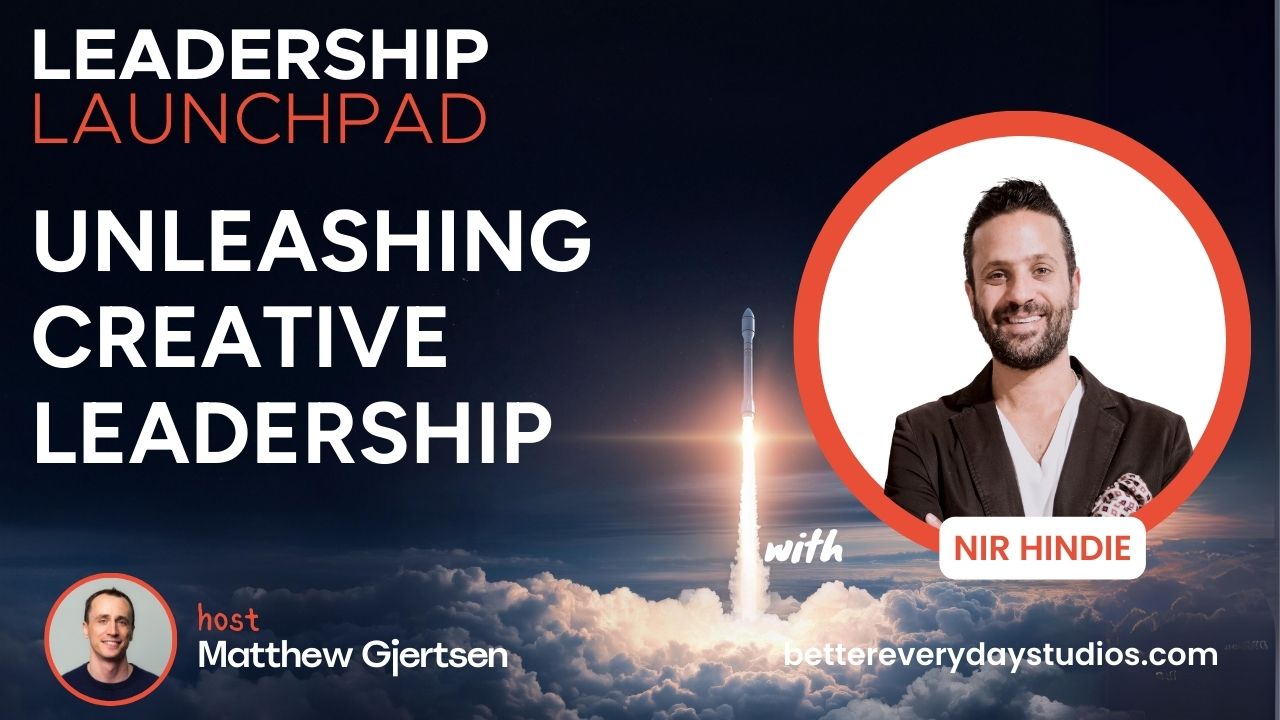
Episode Description
On today’s episode we're diving into a topic that's pivotal for all, especially technical managers—unleashing the creative potential within your teams with the incredible Nir Hindi, Founder of The Artian. Nir expertly shatters the myth that creativity is only for artists, sharing insights on how blending artistic thinking with tech can drive groundbreaking innovation. From Steve Jobs' inspiration by art to Nobel laureates' artistic hobbies aiding their science, Nir highlights the essential role of creativity in leadership. We'll also explore the practical steps managers can take to nurture creativity and leverage hidden talents within their team. Interested in transforming your leadership approach and elevating your team's performance? Tune in!
Keep in touch with Nir on LinkedIn:
https://www.linkedin.com/in/nirhindi/
Follow Nir's work here:
https://nirhindie.substack.com/
https://theartian.com/
---
Want more tips on effective training? Sign-up for our weekly newsletter: https://www.bettereverydaystudios.com/newsletter
Visit us at https://www.bettereverydaystudios.com
 Automated Transcription
Nir Hindie [00:00:00]:
Creativity is a human thing. The fact that we put, you know, if you are an artist, so you are creative, and if you are an engineer, you are not. No, it's not. It doesn't work that way. We I think that organization can benefit much more if they will tap into it. And why do I mention it? Because you asked me about the individual manager and there is this nice quote by Steve Jobs. And one thing that he said is he said the ultimately it comes down to a taste. It comes down to trying to expose yourself to the best things that human have done and then try to bring those things into what you are doing.
Nir Hindie [00:00:39]:
He used to take his teams to see exhibition of jewelry. So he exposed his teams not only to what happening in the computer industry, but what happening in the jewelry industry. So they will look at the Macintosh like a piece of art.
Matt Gjertsen [00:00:59]:
Hello and welcome to the Leadership Launchpad where I help technical managers improve themselves, their teams and their organizations. On this show I talk with industry leaders, coaches, authors and experts to give you actionable insights that will help improve your own performance and the performance of those around you. Our guest today is Nir Hindie, an entrepreneur, speaker and adjunct professor known for his innovative approach to blending artistic thinking with business strategies. As the founder of the Artian, he is dedicated to integrating artistic perspectives into technology and innovation, driving creativity into the very DNA of companies. This discussion was a lot of fun for me and though we start off talking about some bigger picture ideas and concepts, by the end there are some really great lessons that any manager can start putting into practice today. Through the episode, you can expect to learn about key innovations in our history that have been driven by artists, why artists are so able to push technology forward, what it even means to be an artist, and why every manager should start taking their team to art exhibitions. Before we get into the discussion, I do want to remind you that if you are not subscribed to this show, then you need to. We have some great guests lined up and you are not going to want to miss a single one.
Matt Gjertsen [00:02:28]:
If you are already subscribed, then I ask that you share this show with at least one other person. That, after all, is how we grow. I can't tell you how much it means to me. Just a quick copy paste, shoot it over. If you like this episode, let somebody know about it. I can't tell you how much it means to me with that. Let's get into the discussion with Nir Hindie. So I do wanna start off by thanking you for the recent time we had together in San Francisco.
Matt Gjertsen [00:02:57]:
You go to San Francisco. I'm new moving back up here to the San Francisco area, but you, I think, may have been here more recently than I have. Is the weather normally that amazing in San Francisco? Cause it was awesome when we met.
Nir Hindie [00:03:09]:
Yeah, yeah. I mean, that specific day. Because normally, you know, San Francisco is too freezing for me. I mean, you told me this quote by I don't remember, Huckleberry Fino, that the coldest winter I've ever experienced is the summer in San Francisco. I don't remember it if you told me this or someone else that when I was complaining, but it's beautiful place to be.
Matt Gjertsen [00:03:34]:
Yeah, yeah, yeah.
Matt Gjertsen [00:03:36]:
It was absolutely gorgeous. We had. We had a great discussion. So I'm really excited about this discussion. And the timing is hilarious because I just started reading the innovators by Walter Isaacson, and that book opens exactly in your field, where he talks about how. He talks about a number of stories, but one of the stories that he mentions in the introduction is Einstein, and how when Einstein was struggling with relativity, he would go play Mozart on his violin to help kind of, like, reconnect things in his brain. And that's exactly where you're at, right. This idea of trying to convince very technical people, hey, if you want to drive innovation, the art is actually the way to spur innovation.
Matt Gjertsen [00:04:19]:
Is that right?
Nir Hindie [00:04:20]:
Yeah. I mean, yeah. Because. Well, there's so much to talk about this, Matt. So, first of all, thank you for giving me. Giving me the opportunity. Listen, I think that the concept of kind of recreational activities like the arts, something very known, every time someone tell us we need to think about, or if we think about new ideas, we should take a long walk or we should take. We should take a cold shower or whatever it is.
Nir Hindie [00:04:53]:
But, you know, there is two researchers from Chicago University, I think their name is Robert and Michelle Ruth Bernstein, and they did fascinating research. They actually have been researching this intersection of science and art in the last maybe 40 years. And one of the things that they discovered is that Nobel Prize winners are three times more likely to do art, to actually practice art, because apparently, you know that when you practice art, it helps you with pattern recognition, what oftentimes you need in. In science, it helps you with analogous analogical thinking, you know, kind of using metaphors and combining different disciplines. So it's. There is a lot to draw from the arts when you are a technical person. But with your permission, I would like to shift the conversation to a different angle. That I think it's more interesting, in my own humble opinion, is that artists, as technological innovators.
Nir Hindie [00:06:06]:
Because the thing is, in a business context, we often tend to think that the source of innovation should come from science and business. And what I believe is that we are missing a whole different and very rich source, which is the arts. And let me give you one concrete example. You know Morse code, right?
Matt Gjertsen [00:06:29]:
Yeah, Morse code.
Nir Hindie [00:06:31]:
Samuel Moss, who developed Morse code and before they developed the first electrical telegraph, was a painter. The whole idea for the technique, the electrical telegraph, came from his canvas stretcher. And if you go to that Missouri.
Matt Gjertsen [00:06:55]:
Smithsonian.
Nir Hindie [00:06:55]:
Smithsonian, yes, Smithsonian. If you go to the Smithsonian museum, you will actually see the canvas structure that led him to the invention. And if you will cross the street and you will go to the National Gallery in Washington, you will see Samuel Moore's painting. It's just we don't tend to think about artists as innovators. And let me give you maybe a concrete, a modern example. So, you know, my trip to San Francisco was amazing because I met great people like yourself. But I also made, I met an artist that I've been looking up to many years. His name is Michael Nimarg.
Nir Hindie [00:07:38]:
And Michael Nimarg, since the seventies, has been interested in place representation, basically how we can allow people to visit places they never been. We are talking the seventies, and he was involved in a legendary kind of art piece that called the Aspen movie map. And in 1978, a group of researcher artists basically mapped the whole city of Aspen, Colorado. And you couldn't travel with buttons in Aspen, Colorado. And two weeks ago or three weeks ago, we are talking now. It's September, August 2024, he got together with some of his colleagues his maybe 17 patent on a new way to create kind of immersive conversations. So even you and me now recording and we see each other, but the technology they developed let you feel that you and me sitting across each other in a real setting.
Matt Gjertsen [00:08:40]:
Yeah.
Nir Hindie [00:08:41]:
So there are many examples, Matt, but I can talk for hours.
Matt Gjertsen [00:08:47]:
I love. So, okay. So I'm happy that you kind of took it in that different direction, because you're right. I think I normally think about this in terms of, like, the technical people are doing the technical work and then they're just drawing inspiration or kind of getting reinvigorated by the arts. It's. I'd be interested. I don't know if you've seen this before or if you've looked into this at all. I have no idea.
Matt Gjertsen [00:09:08]:
But, like, I could imagine when it's Arthur artist driven, truly coming from the art side, that some of that technology that develops might be more like almost like human focused. Like, the two examples that you gave were both like, how do we connect people? I don't know if that tracks at all with what you've seen and some of the examples that you've seen.
Nir Hindie [00:09:37]:
Spot on. I mean, it's exactly that.
Matt Gjertsen [00:09:39]:
Interesting.
Nir Hindie [00:09:40]:
Exactly that. And, you know, my interest kind of. Maybe I'll give you the context, because oftentimes people ask me, how did I get to do what I do?
Matt Gjertsen [00:09:52]:
Yeah.
Nir Hindie [00:09:52]:
You know, when I was a kid, I really loved art and architecture and photography. But at the same time, when I was 10-12 years old, I really loved business. And when people asked me what I want to do when I grew up, I said, I want to do my own thing. I didn't know there is a word for it. Entrepreneurship. But, you know, the society channel us. What are you, left brain, right brain? Creative, analytic. You want to study engineering or art?
Nir Hindie [00:10:16]:
Yeah, you. You cannot do both. So, I was interested when I got in my twenties to get to know a lot of artists in my social circle and a lot of entrepreneurs in my professional circles. I asked myself, how can it be that those two societies do not interact? So I embarked on a journey to research it. And one of the things that caught my interest, you know, there are certain companies that we know or we perceive, and we feel that they are truly creative, and they think about us. And obviously, Apple is the epitome of it, specifically the era of Steve Jobs. But Polaroid, you know, Polaroid was the same thing that Polaroid invented instant photography in 1947.
Nir Hindie [00:11:03]:
All the selfies that we taking today, basically, there was kind of the seed was in 1947. And when you think about what Pixar is doing or what Beats, you know, the story around how. How Jimmy Iovine, Doctor Dre, invented Beats.
Matt Gjertsen [00:11:18]:
Yeah.
Nir Hindie [00:11:19]:
So you. Yeah, I'm kind of. Maybe not. I don't want to say that I'm diverging. It's just I want to lend it into what you said. These companies that we perceive as true creative, I believe they are able to achieve it because they start differently. They start with us at the center. And if technology doesn't exist, to give the experience they have in their mind, they invent it.
Matt Gjertsen [00:11:51]:
Interesting.
Nir Hindie [00:11:52]:
So they are not technology driven. They are human experience driven. And that's why when technology don't. Don't ex. It doesn't exist, they invent it. And oftentime because they want to create amazing experience.
Matt Gjertsen [00:12:08]:
Yeah.
Nir Hindie [00:12:08]:
They are all the time inventing, and people think they are technology company. Disney is not a technology company, but Walt Disney invented color, invented sound invented, surrounding systems in cinema invented, even the process of scaling creativity. So as you can see, Matt, I'm super excited about this topic.
Matt Gjertsen [00:12:27]:
So it's great. I love it, because even in, even in my world or in the background that I've seen, one of the things that drives really successful companies and certainly really successful entrepreneurs is a concept of customer obsession, of really focusing on the customer experience, the customer outcomes. Wanted to make sure you're delivering the most for the customer. And I think, you know, businesses, sometimes, you know, more technical businesses are just business minded people in general, kind of have to come to that conclusion of like, we really care about the p and L, we really care about the numbers. And then hopefully they get to this idea of, oh, the best way to take care of the numbers is to take care of the people. Whereas people who maybe come from a different background or an artistic background where like, obviously, like the people, the experience is the seed of it. And so that's what, that's what grows. So that makes a lot of sense that like, the companies just kind of start from a different point of view.
Matt Gjertsen [00:13:37]:
With a different point of view. That's interesting. That's interesting. When we chatted last time, you also, I think it was with Polaroid or something, you mentioned some companies that almost had like artists in residence or just kind of like a much more deliberate way to try to foster artistic ability or creativity within the organizations. What are those? I can't remember those examples.
Nir Hindie [00:14:02]:
Yeah, I mean, listen, there are, I want to touch two things you mentioned because you said there are some companies that are customer obsessed. And, you know, it's this kind of conversation, always reflect or always help me to kind of reflect. And I refine the way I talk about things because, yes, there are certain companies that are very customer obsessed, but in my opinion, they are not artful. So they might deliver incredible experience. But given, if I take another competitor and given all things equal, I'm kind of, I don't mind to diverge to them because they are lacking the emotional part.
Matt Gjertsen [00:14:46]:
Yeah.
Nir Hindie [00:14:47]:
And Apple, Disney, Beats, Polaroid, Pixar.
Matt Gjertsen [00:14:52]:
Yes.
Nir Hindie [00:14:53]:
All those companies understood that the ultimate goal of, for that matter, the arts is evoke emotions and they were able to do it and bring it into their own products. And if you ask me about, I'll tie it back to the question you asked me about those companies in 1947 when Doctor Edvin Land, which everyone look at Steve Jobs as the kind of epidemy of creativity and innovation. But if you really want to understand where Steve Jobs found his inspiration, go and start researching about Doctor Edwin land. In 1947, when he started to work on this, on Polaroid, he actually started to hire art history graduate, women art history graduate, and bring them to work in his scientific lab. And the person that led one of the labs, she's an art history graduate. Basically. She already has more than 17 or 18 patents on her name. She pushed the technology a lot.
Nir Hindie [00:15:53]:
But more importantly, she helped doctor Edvin land build a relationship with the artistic community. So when Edwin Land start to see that photography becoming more and more popular, and they developed the Polaroid, Polaroid was considered an inferior product for professional. It was perceived as a mature product. So he met Ansel Adams, probably one of the most famous and important american photographers. And Ansel Adams immediately recognized the potential of the technology. And doctor Ed Vinland told him, listen, I want you to be to work with us. I don't know what you will do. I don't have a clue.
Nir Hindie [00:16:36]:
I just want you to work with us. And Ansel Adams started to work with them. And he worked with Polaroid for 44 years, probably 44, 45, until he basically retired from 52 until 80, 82 or 84. So 30 years. And the things that Ansel Adam did, because people ask, okay, what artists can do over there. First of all, he's the one that tested all their film and all their product in the field. Some of his legendary photographs in Yosemite were taken with Polaroid. And he's the one that gave them the feedback how to develop it and how to increase the quality of the product.
Nir Hindie [00:17:16]:
And when you have someone like Ansel Adams, probably the most important photographer, american photographer, using it, it immediately elevated the product. Now, it's not that Edwin land looked at Ansel Adams as a vehicle to elevate the product. He was really interested in the intellectual engagement with artists. So this is one example. I have many more. Just let me know.
Matt Gjertsen [00:17:44]:
I'm sure, I'm sure. I mean, there's just. Yeah, I feel like. I don't know. What do you think? It's almost like artists just have this unique desire for they have in mind a particular experience or a particular quality or a particular thing. And maybe they're just like really good at. Just because they have such an exacting idea of what they want to create, they are then able to just like pull the maximum amount out of the technology and the innovation because they have such a clear vision of what they want to create.
Nir Hindie [00:18:23]:
I'll tell you a few things. So when technology companies ask me about the work with artists, I want to tell. I want to say a few things about this. The thing about artists is that they are never satisfied with what you give them today. And that's why it's great to work with them, because they will always push the technology to the edge and more. So one way that artists gives you when they, when you work with artists is that they push what the way you think about technology. Because oftentimes the technology that we have today are being used by the mainstream. Artists are never working at the mainstream.
Nir Hindie [00:18:59]:
They are always one step, two step, ten steps ahead of the mainstream. So one thing that you can gain is that they will push your technology, but another way is that they will show you what your current technology can do in different contexts. And OpenAI just launched their artist in residence, I think, maybe two, three months ago. So they have artists in residence program. And, yeah, you have Google Quantum. My friends, one of my closest friends, Forrest Stern, is the principal artist at Google Quantum at Golita in Santa Barbara. So there is kind of a lot of things, and for the listeners that listening to us but don't see us, this is a famous book that was published by Xerox PaRC called Art and Innovation. And Xerox PARC had a legendary artist in residence program when they invented many of the technologies that we use today, or at least conceptualize them.
Nir Hindie [00:20:02]:
So I don't know if I answered your question, so.
Matt Gjertsen [00:20:04]:
Yeah, well, I actually had a question on that. I think you did. And then I honestly don't know. How does, how do most artists in residence programs work? Is it just like, hey, here, use our tools and see what happens, and then they like push and pull? I honestly have no idea. How do artists in residence programs work inside organizations?
Nir Hindie [00:20:26]:
You are asking excellent questions. So one thing that's important to understand, there is no one size fits all. So one of my friend manages the artist in residence program in a Stratases. It's a 3d leader mark leading company in 3d machinery. And the way their artist in residence work is that they kind of reach out to the artist, invite them to develop project together around things that also the company is interested. Other, other organization can just invite artists or open call. It's not where each you, we just publish on our website. You can apply and you can just come and join for a period of three weeks or three weeks or three months for that matter.
Nir Hindie [00:21:11]:
And other companies will like the Xerox PARC, for example. They were actually looking for artists that worked with specific technology that one of their specific scientists work. So that was okay. Technology and a scientist.
Matt Gjertsen [00:21:28]:
Very deliberate.
Nir Hindie [00:21:29]:
Exactly.
Matt Gjertsen [00:21:30]:
Yeah.
Nir Hindie [00:21:30]:
So there is no one size fits all in that sense.
Matt Gjertsen [00:21:35]:
Okay. Okay. But the idea is to kind of create a space where you can get these people who will test and push your product farther because of kind of their demanding vision of what they want to achieve.
Nir Hindie [00:21:52]:
One angle, another angle is that they will give you a different way to look at your own technology.
Matt Gjertsen [00:21:57]:
Yeah, yeah.
Nir Hindie [00:21:58]:
You know, and what are the potential uses that maybe you overlooked?
Matt Gjertsen [00:22:03]:
Yeah, yeah.
Matt Gjertsen [00:22:04]:
I love it. How, when you work with companies right now, how do you normally work with them? I mean, are you kind of, just kind of encouraging them to set up these kinds of programs? Or are there, are there other ways that companies and artists can work together?
Nir Hindie [00:22:22]:
It's a great question. First of all, you know, in, in the first, 1st step of me working with organization is actually open their mind to the potential of it. Most of them don't even think about.
Matt Gjertsen [00:22:35]:
Yeah.
Nir Hindie [00:22:36]:
The arts as a source for innovation. So oftentimes it can start from just inspirational and motivational keynote that I will show them technologies they are familiar with, they use, but weren't invented by technologies, were invented by artists. And that by itself is like, what? I never thought about it that way. Tell me more. Now, the thing about art is that art gives you a mindset, and it gives you a skillset that both are super important for innovation. And maybe over here, Matt, with your permission, let me take one step back to kind of tell the audience something I think is very important to know about arthem. You know, when I. I don't know about your audience.
Nir Hindie [00:23:25]:
When I was a kid or when I was even in my twenties, I thought that art is painting, and artists are painters because that's what we are growing up with. And when I started to speak with a lot of artists, I was like, what? How do they ask those questions? How do they think that way and interesting? And then I realized kind of truly three important lessons about arthem. The number one and the most important. Art is not an object. Art is not a painting. It's not a book, it's not a song, it's not a movie. Art is a mindset. And the project or the product at the end is just the end result of a thinking process.
Nir Hindie [00:24:08]:
And it's this thinking process that we need to learn from the second part that contrary to business, it's something very important. Art is driven by originality. Art is probably one of the fewest spheres that originality has value. If I will copy you, Matt, I won't be considered original or creative.
Matt Gjertsen [00:24:40]:
That's what you mean.
Nir Hindie [00:24:41]:
So I need to always kind of try something different. And, you know, there is Jim McKelvey that co founded Square, the online mobile payment. He's an engineer, but he's also a glass artist. And he used to fund all his companies by selling his artworks. And the whole idea for Square came when he couldn't sell his artwork. And, you know, when I interviewed him to my podcast, I. He actually said it, you know, that the trick in art, and now I'm quoting him from the podcast, the trick in art is to do something original. And it's one of the few fields of endeavor where original thought and expression are truly valued.
Nir Hindie [00:25:24]:
So the second thing people need to understand, art is about originality. It's not about beauty, per se.
Matt Gjertsen [00:25:31]:
Okay, interesting.
Nir Hindie [00:25:34]:
And the third thing that I learned to artists are not painters. Artists are thinkers. Paint is a medium. And just like paint is a medium, technology can be a medium. Yeah, that makes sense.
Matt Gjertsen [00:25:50]:
I think it 100% makes sense. It. Yeah, I definitely agree that it is a lot about kind of having this particular mindset, and that's a mindset that can then be applied to a whole bunch of different things. That's why art can be so varied. It can be language, it can be paint, it can be photography, it can be visual, it can be auditory, it can be textural. It can be so many different things, because it's just kind of like, really what you're talking about is kind of playing around with the human experience, bringing it back to kind of what we talked about before. That's interesting. Okay, so you're.
Matt Gjertsen [00:26:29]:
So when you're going into organizations, your kind of number one goal, it sounds like, is opening their minds up to what art is first, and then that it can have this amazing impact.
Nir Hindie [00:26:42]:
Yeah. So, you know, I think that one of the things that art is associated with is creativity. But art is also about exploration, experimentation, trying different things. It's about experience. And I don't need to say it to the audience. It's kind of. I don't know if it's a well known fact. Most of the people come to the organization, and they leave 20% outside the gates, 30%, 40%, 50%.
Nir Hindie [00:27:10]:
And oftentimes they leave their creative selves.
Matt Gjertsen [00:27:13]:
Yeah.
Nir Hindie [00:27:14]:
So, you know, one of the things, and that's something beautiful that happened in my. When I work with organization is that when I come to the room the first time, everyone come and introduce themselves, Matt, with their job title, I'm the CEO, I'm the CFO, I'm the whatever it is, and then something interesting happens, you know, I go on stage and then I give my keynote, and then I kind of invite them to think differently then. And then what happened? When I go off the stage, suddenly this CFO is actually writing poetry. And suddenly this marketing person is also taking photographs and another person kind of build with Lego. Whatever it is. It's like they need creative permission to know that creativity is valued. And then, you know, what happened in the organization. Few things.
Nir Hindie [00:28:09]:
First of all, people start to understand that their creative self can help them in their own role. Second, it create a totally different dynamic if you and me, Matt, work together and both of us engineer, and suddenly you discover that I paint and you write poetry. I was like, what?
Matt Gjertsen [00:28:32]:
Yeah.
Matt Gjertsen [00:28:33]:
So it's creates a whole new way to interact and connect.
Nir Hindie [00:28:36]:
Exactly. And I had those cases that, you know, and the third thing that happened, you know, that specifically in business organization, if you have people that come in from the liberal arts and the artistic background, they always, in a way, feel inferior. And when they suddenly see it, suddenly they actually, wow. I actually have a lot what to bring to the table and the organization can actually tap into the full potential of their people.
Matt Gjertsen [00:29:04]:
Yes, yes, yes.
Nir Hindie [00:29:07]:
Does make sense.
Matt Gjertsen [00:29:08]:
That's interesting. That 100% makes sense. I mean, part the thing that clicked in my mind or that really resonated with me. Washington in a past role where I was managing a team. It took a while to uncover this, but eventually one of the team members was really involved in larping. I don't know if you know what that is. Live action role play. So this is like where it's like they get together and everybody has homemade costumes to pretend they're like medieval characters or fantasy characters, and they go into a big field and they like, like have fights with like foam swords and stuff.
Nir Hindie [00:29:45]:
Wow.
Matt Gjertsen [00:29:46]:
You know, it's like, it's a really big deal, and it's a really, really creative community subculture. And it's something that I don't think, to your point, it's very niche and very out there, and it's something that a lot of people don't feel comfortable talking about. But once we had the environment where it was comfortable talking about it, and we all knew about it and it was all fun and we were all excited. It just created this whole new way to understand her as a person, to draw more creativity out of her, it was just a great, it was a great ad to the whole team to understand that.
Nir Hindie [00:30:24]:
Here you go.
Matt Gjertsen [00:30:25]:
So what you're saying.
Nir Hindie [00:30:26]:
Yeah, you don't need me. You experienced it?
Matt Gjertsen [00:30:30]:
Yeah, absolutely. It's interesting how many people come up to you. So would you say. So it sounds like you're saying that there's a lot of this is out there. It's just being hidden. Like people are hiding it because they don't think it's going to be of value. And then a big thing of what a big step forward could be made if all we did in companies is just kind of remove the veil and let people express everything they're already doing creatively.
Nir Hindie [00:31:01]:
Yeah, I mean, listen, I'll tell you something that, I mean, creativity is natural to human being. The fact that we tell people, you are not creative, that's not natural.
Matt Gjertsen [00:31:11]:
Yeah, yeah.
Nir Hindie [00:31:12]:
You know, to tell you, you are a left brain, you are a right brain. No.
Matt Gjertsen [00:31:16]:
Yeah, yeah.
Nir Hindie [00:31:17]:
That's not natural. This divide, this, you are here, I'm there. No. Creativity is a human thing. The fact that we put, you know, if you are an artist, so you are creative, and if you are engineer, you are not. No, it's not. It doesn't work that way. We, I think that organization can benefit much more if they will tap into it.
Nir Hindie [00:31:39]:
And, you know, let me give you an example from one company that I think worth knowing how they do it, because oftentimes companies ask me, how can we do it? So I got to learn about Steve Stout. He's the founder of transition agency. And one of the things that he institute in his kind of a company is that every employee has a major and a minor, like in school, major is your role. Matt is an account manager. Your minor is your true passion. You love music. So one of the things that he does, if they have a new project with a client, and this project might involve live music or using a musician, even though you, it's not your client, you will be part of it, because that's your passion and you can contribute. And that's why oftentimes, sometimes you will see is his own employees are taking responsibility on the creative part of their clients.
Matt Gjertsen [00:32:49]:
Yeah.
Nir Hindie [00:32:49]:
And by so doing, he allow everyone to be who they are, is not met of the work environment and meth of off work environment. And by the way, it's totally fine if someone wants to keep themselves for themselves. I'm not saying you should not. I'm just saying I believe that working in a creative environment is also fulfilling on a personal level.
Matt Gjertsen [00:33:16]:
Yeah, yeah.
Nir Hindie [00:33:18]:
And bringing your creative self into the table. You know what? Not only that it's fulfilling, it's fun.
Matt Gjertsen [00:33:26]:
Yeah, yeah, absolutely. Absolutely. It really is. Yeah. And the thing that I love about where we've gotten to, in this conversation is, it feels very practical for even an individual manager. Right. I have a man. I'm just a manager of a small team.
Matt Gjertsen [00:33:46]:
I can't start an artist in residence program in my organization, but I can potentially try to change the way we view this stuff, the mindset that our team has, and try to get people to kind of bring more of their whole selves to work if we want to use that phrasing by embracing everyone's natural creativity in this way. Does that sound right?
Nir Hindie [00:34:12]:
Yeah, I mean, listen, I think that, I don't think I, managers understand how a big role they are actually having in fostering or killing creativity. And most of the time, you know, unfortunately, they are the one that kills it, by the way. It's like parents. Just to let you know, you know, oftentimes when I give these talks, I have parents in the, in the, in the room, and then they ask me, okay, so how can I make sure that my kid will stay creative? I ask, I ask them, when they continue to paint at the age of nine or ten or build stuff, what do you tell them? Continue. Or you tell them, focus on what's important, which. And you refer to mathematics and science.
Matt Gjertsen [00:34:59]:
So, yeah.
Nir Hindie [00:35:00]:
Don't people think that education means only education system? No. You know, there is a beautiful kind of moment that Marissa mayor, that was the first female engineer at Google and the number 20 employees at Google. She was on a stage and the founder of Salesforce asked her about how she brought, because she's the one that led the design of Google page. And he asked her, what led you to connect design with the power of technology. And what did she say? She spoke about her mom, that she's an art teacher, and how the fact that she got education to it at home, to aesthetics and beauty and how important art is, how she brought it into, to Google. Her father was an engineer, her mom was an artist. And for her, it was natural that they coexist.
Matt Gjertsen [00:35:50]:
Yeah. Yeah.
Nir Hindie [00:35:51]:
So a manager need to think about themselves. Like, you know, in a way a parent, not that you need to educate, you know, but you need to create the environment.
Matt Gjertsen [00:36:04]:
Yeah.
Nir Hindie [00:36:05]:
That people can bring themselves.
Matt Gjertsen [00:36:08]:
Yeah.
Matt Gjertsen [00:36:09]:
And where this kind of creativity is valued.
Nir Hindie [00:36:11]:
Yeah.
Matt Gjertsen [00:36:13]:
I love it.
Matt Gjertsen [00:36:14]:
Awesome. Awesome. Well, this is, it's, again, to make it practical. It's, we're, this isn't, there's no, there's no expense here. This isn't any money. This is, this isn't any new, you know, it's just changing the language you use, the questions you ask, the high fives you give for what is kind of what it takes.
Nir Hindie [00:36:37]:
Listen, you know, I'll give you another example. One of the quotes that kind of Steve Jobs maybe. Let me tell you kind of again, you know what, like about this conversation, first of all, I'm sorry if I'm talking too much, but I have so much to say about it because I think it's so important. You know, oftentimes I have a class I'm teaching in a business school here in Madrid, and I have a class about building creative companies. And in one of the session, I dedicate part of the session to discuss taste, personal taste. And oftentimes students kind of what, why we are discussing taste when we talk about creative companies. And one of the things I think people don't understand is that if you don't know what you love, how you are going to develop a product and tell me that my customers going to love it. Developing your own taste, it's the zero point you need to start before you tell me you can develop product to others.
Nir Hindie [00:37:45]:
And why do I mention it? Because you asked me about the individual manager and there is this nice quote by Steve Jobs. And, you know, I know that Steve Jobs can sound cliche, but it's, you know, in many ways, there is a lot what to learn from him. And by the way, I can bring the same type of quotes from Edwin land, etcetera, because those founders thought in a similar way. And one thing that he said, he said the following. Ultimately, it comes down to a taste. It comes down to trying to expose yourself to the best things that you men have done and then try to bring those things into what you are doing. And what he used to do. He used to take his teams to see exhibition of jewelry, exhibition of whatever it is that relate to what they are doing.
Nir Hindie [00:38:36]:
So he exposed his themes not only to what happening in the computer industry, but what happening in the jewelry industry. So they will look at the Macintosh like a piece of art.
Matt Gjertsen [00:38:51]:
I love it.
Matt Gjertsen [00:38:52]:
Yeah.
Nir Hindie [00:38:53]:
So every individual manager, every individual manager that listened to us can do that at least two to three times a year to take his team, or to take her team in the morning to go and choose one exhibition that they think can contribute from an intellectual level, have a breakfast after, discuss what they learned, what, what do they loved about it, and then how can we bring it to what we do three times a year?
Matt Gjertsen [00:39:21]:
So easy that. That is so easy and so incredible, because I can almost guarantee you that no one has ever gotten manager advice that says three times a year, take your team to an art exhibit. Like, nobody's ever been told that, and it makes so much sense. That's too good a note to not end on. I think that is such a great ending point. But I know you're very passionate about this. You have so much more to give on this if people are, you know, we're just scratching the surface on this, on this subject. How can people follow you? How can people get involved with what you're doing?
Nir Hindie [00:40:00]:
So, first of all, they can find me on my website, www.theartian.com. i also have a substack where I actually publish every week about this topics.
Matt Gjertsen [00:40:13]:
So incredible.
Nir Hindie [00:40:14]:
Yeah. People can read over there about how this way of thinking pushed manufacturing at Apple. So people oftentimes ask me about. Okay, so it's only for designing product. No, no. It's changing the way the organization think. So my substac as well. Just type my name near Hindie at Substack and you will find me.
Nir Hindie [00:40:33]:
And I have a podcast that now I'm coming back. I took a hideous for a bit of. But yeah. And obviously LinkedIn.
Matt Gjertsen [00:40:43]:
Yeah, LinkedIn.
Matt Gjertsen [00:40:44]:
Yeah.
Matt Gjertsen [00:40:44]:
Well, we'll make sure to put links to all that in the show notes. Cause I think this will really get some people's gears churning, and I think people will be really interested in learning more ways that this can apply, because you're right. It's such a big shift that it probably takes a while for people to really understand it. Well, nir, thank you so much. This is a great conversation. We kind of went, went in a number of different directions. I really love where we landed at the end. Super practical advice.
Matt Gjertsen [00:41:12]:
So thank you so much for your time, and I hope you have a great rest of your day.
Nir Hindie [00:41:15]:
Thank you, Matt. I really appreciate it.
Matt Gjertsen [00:41:18]:
Thank you so much for listening to today's show. If you are looking for help turning your organization's great engineers into great managers, me and my team at better everyday studios would love to help. We deliver targeted and interactive training workshops. They're designed to help build the three fundamental skills of any new manager, building trust, giving feedback, and setting goals. Reach out to me through matt@bettereverydaystudios.com so we can start making your organization better every day.


